CSO @ Harvey - building the future of legal + AI, board member@GTM, former CPO @ Google, partner@GDC. I write about how AI is reshaping the legal profession.
The velocity of progress here keeps blowing my mind. 2027 is going to be a pivotal year as more organizations begin to appreciate and prepare for more fundamental change than most have yet appreciated.
As AI models get better, we kept seeing the same problem in legal work.
Agents were still starting each matter from scratch.
Harvey Graph gives agents two maps for retrieval: a context graph linking a firm’s matters, documents, and people, and a knowledge graph mapping legal citations.
@ryanrsamii explains how agents follow those links to find relevant sources in fewer steps and use less compute.
Provocative observation: I've had multiple experienced public company board directors signal to me that board service is rapidly losing its appeal, largely due to AI-related challenges. It's increasingly challenging to get board composition right, to be confident they are providing the right guidance and oversight, and confidence and predictable value in their largely equity-based compensation is eroding rapidly. I wonder if we're on the cusp of a major wave of board turnover.
How Phil built a collaborative Word editor with no human engineers.
Inspired by @russelljkaplan's story of how @cognition builds their Android app with just a swarm of Devins. https://t.co/6dDxnygL0m
It’s almost incomprehensible how wide the distance is between someone who’s working at the frontier with AI and basically everyone else right now.
The crazy thing is these lines are not converging, but only growing farther apart. If the curve of AI progress had leveled off, it would certainly have given most people and companies time to catch up or implement their workflows in a standardized way. The technology would have neutralized competitive advantage because everyone would be using it the same way.
But what’s happened is the opposite. The curve of AI progress is basically going vertical right now, which means if you had codified your processes 3-6 months ago you’re likely already behind again. Now imagine most companies that kicked into gear a year ago and thought that they were done. Even further behind now.
I’ve never seen a technology in my life and career that improves at this rate, which consequently means you need to upgrade your expectations at a similar rate. Our brains weren’t wired for this, and our organizational change management processes certainly weren’t either.
With any form of recursive self improvement, things just get wilder. It’s a time when you will need to be constantly reevaluating the things that didn’t work just a couple months ago to see if they now can be solved. AI native companies certainly have a strong advantage due to this right now, so now it comes down to can the bigger companies keep up. Wild times.
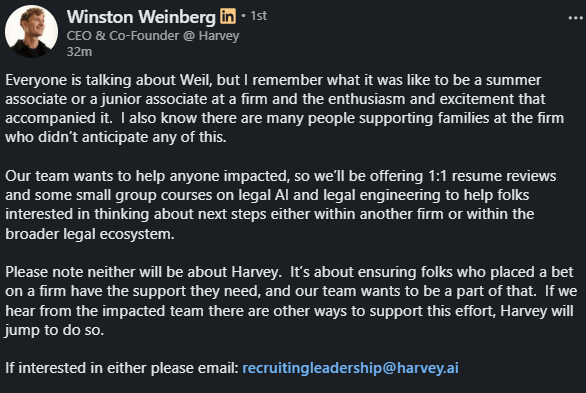
👒H/t to @winstonweinberg and @harvey. This is fantastic PR and crisis response!
This is how you engender positive sentiment about you and your company. "Never let a crisis go to waste," doesn't have to have a negative connotation.
We’re not aware of any law firm going to this extreme.
For example Latham is buying GPUs but is also firm-wide on Harvey and we announced a deeper partnership today.
We think that’s the right strategy and what matters more than build vs buy is how heavily a firm is investing in AI.
The best way to invest is a portfolio approach of working closely with vertical vendors and the labs and cloud providers while also self-building with open source and the frontier ecosystem.
Everything is moving too fast and law firms are too complex for a single binary approach like this post suggests.
Law firms will not rely on a single vendor nor will they build the entire stack themselves.
My view is that longer term the labs and clouds will build general intelligence infrastructure and vertical players will help customize it for each industry.
Then individual firms will leverage their unique data, human expertise and workflows to build differentiated AI to better compete against their peers and serve their clients.
Our goal is to build the trusted vertical layer and open it up through APIs so firms can build everything from custom models and context layers to agents and products with us.
And most importantly do it in a way they can trust that their data and their clients’ data is safe and only used for their benefit.
A closer look at Harvey Graph.
Starting with graphs for US Case Law and Spaces, Harvey Graph maps the connections between matters, documents, and legal knowledge so agents can start work with the context they need.
In early Legal Agent Bench tests, adding a context graph raised rubric pass rates on firm-knowledge questions from 65% to 80%.
We’re opening a Boston office this fall.
The office will bring us closer to the law firms and in-house legal teams we work with across New England and help us grow the team serving them.
We’re hiring in Boston across sales, recruiting, legal engineering, and customer success.
When I shared @harvey’s model strategy a few months ago, there were two parts:
1. Build our own model
2. Use that to help customers do the same
We’ve done the first. Now we’re hiring for the second: Harvey’s Private Model Program.
We’re seeing huge demand from law firms to own their own intelligence leveraging private data.
This will enable them to become frontier firms that get smarter with every client matter.
You’ll: - Partner with law firms to build these systems.
- Build the team that delivers this at scale. - Work with our technical org to define the platform that powers this team.
We’re looking for a technical PM or founder type to own Harvey’s Private Model Program.
DM me if this sounds interesting.
The hardest thing about building @harvey is doing what’s best for our customers despite immense pressure to do what’s easy.
The easy thing would have been to force our customers onto consumption pricing before they were ready and serve them worse models to protect our margins.
We chose to help our customers transition on a timeline that works for them and give them the best models in the meantime, even though it hurt our margins.
This meant optimizing our product through routing, harness improvements, and post-training so we could serve frontier intelligence at an affordable price.
It also meant building the infrastructure for customers to monitor and manage spend: usage dashboards, per-matter cost attribution, spend caps, and ROI reporting.
As a result, we improved our gross margins from -50% to positive in a single quarter despite usage doubling month over month and continuing to serve the best models.
Our philosophy is simple: do what’s best for our customers, even when it’s painful, hurts our margins, or draws criticism from competitors, X, and the press.
We believe the most important part of building a company is earning and keeping your customers’ trust. You do that by doing the hard thing for them, even when it costs you.
@ryanrsamii@Tom_Hirschfeld Agreed it’s often a combination of factors. It’s going to be fascinating to watch lateral hires for the next few years, as firms make big and differentiated bets on which practices warrant asymmetric investment.
Tenet is @harvey's first model post-trained for legal
It reaches frontier performance on Legal Agent Bench and generalizes to other agentic benchmarks
Tenet comes with three subagents post-trained for specialized tasks: M&A diligence, review tables, and firm knowledge
It's Harvey's first major step towards building frontier legal intelligence and enabling firms to build their own specialized models
More from @gabepereyra:
Introducing Harvey II: smarter agents from the start.
- Featuring Harvey Tenet, our first model trained for legal work
- Built around matters and projects
- Agents start with the files, context, permissions, and history they need
- Assign tasks to lawyers or agents, then track and review the work
- Harvey remembers how you work and writes like you
Today we’re launching Harvey II: a whole new design, smarter agents that have memory, and a custom model post-trained for legal work.
Read more here!: https://t.co/uwjdaRYoom