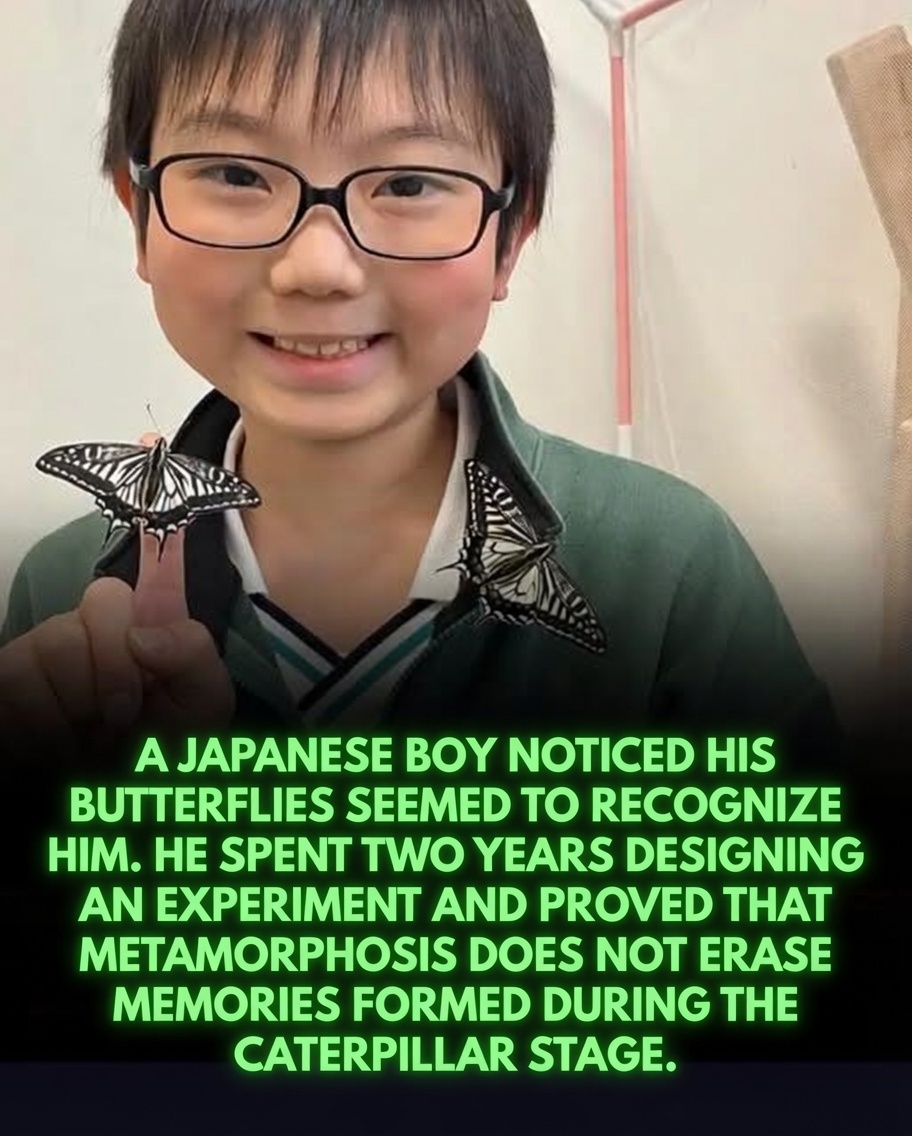
A 10 year old child’s experiment demonstrated that memories can be inherited across generations.
The story started when Jo Nagai, a second grader from Kobe, Japan, observed that swallowtail butterflies he had raised by hand appeared to recognize him, whereas wild butterflies would flee.
Motivated to uncover a scientific explanation, he contacted Georgetown University entomologist Dr. Martha Weiss, who had previously shown that moths retain memories despite the extensive cellular reorganization during metamorphosis.
Encouraged by her research, Jo suggested conducting a similar study with butterflies. This led to a remarkable international collaboration. Using a simple setup created at home, Jo conditioned caterpillars to link a gentle vibration with the smell of lavender.
Remarkably, after their brains were entirely reconstructed inside the chrysalis, 70 percent of the adult butterflies still avoided the lavender scent, demonstrating that their memories had endured the transformation.
The most surprising result emerged when Jo bred these conditioned insects. Neither the offspring nor the grandchildren had ever encountered the vibration, yet both generations displayed an instinctive aversion to the lavender scent.
At the age of ten, Jo compiled his groundbreaking observations into a 33 page paper and presented them alongside Dr. Weiss at the International Congress of Entomology in Kobe. This discovery of transgenerational memory challenges conventional views of genetics and inheritance while illustrating how a child’s curiosity can push the frontiers of scientific understanding.
@MatthewBerman Anecdotes are just that, but I can say that my business is benefiting, I think most companies will swap over sooner than later.
My business isn't huge so I have the ability to move quickly compared to large companies.
@HarryStebbings Software market is gone. Much larger trend. In my current business I've had a specific software for years (since before 2020) I've probably spent over 10k on that alone.
Yesterday I decided to replicate and spin up my own version. I'm going to be saving over 2k a year.
I've been following Ray for decades, I knew about the singularity before anyone I knew over a decade at this point. To this day I still think he's correct.
AGI by 2029
ASI by 2040.
Ray Kurzweil says:
"AGI means a computer can be equivalent to a person who really knows a subject, for every subject.
and there are hundreds of thousands of subjects in which you could be an expert"
By 2029, I think it will be able to do everything a human can do
Ray Kurzweil says:
"AGI means a computer can be equivalent to a person who really knows a subject, for every subject.
and there are hundreds of thousands of subjects in which you could be an expert"
By 2029, I think it will be able to do everything a human can do
@JayMAllen@iruletheworldmo I say singularity starts after agi. After that point it's not just compounding quickness, it's actual novel things agi is building. Right now we're just shuffling papers.
@jun_song Not so hot take, it's only like this because llms don't have a moat. Wait several years when they start attaching stuff to make the llm better that's when the US will hold a permanent lead because of our computer chips?