Most of my friendships with other men are built around risk, challenge, and belonging. Sadly, most online technology companies are built around simulating and monetizing those very things.
Gambling has rapidly become a part of American life. What is this doing to individuals and society at large? Join us on June 18 at 1pm ET for a webinar with @kylascan, Matt King, and @JonathanDCohen1, moderated by @germanrlopez. Register:
https://t.co/54O7IV9YX4
“They thought they were legalizing one thing, but the thing that actually arrived was different,” AIBM’s @JonathanDCohen1 explains as legislators begin rolling back the legalization of sports betting.
https://t.co/GsuttWpugI
Five months in, Boys & Men Online is cutting through the hysteria and thinking about what online life is actually doing to boys and men. @oso’s latest piece hits on the real conversations about prediction markets, porn, gaming, and AI that we need to be having.
https://t.co/ZtQaAnF3xc
I was nervous talking to a religiously affiliated publication about pornography. I thought they might be looking for a gotcha quote. But @grahamtoday was very fair-minded about a complicated topic that deserves more attention and nuance.
"Very few people want to be ‘the pornography professor’ or ‘the pornography funder’ at a foundation or at the NIH. It just doesn’t attract the attention that it deserves."
@oso discusses a new research focus for AIBM with @grahamtoday on @Deseret https://t.co/CscAqzVrgT
Our digital lives are too vast to be simply good or bad. But they can be better.
It's been 5 months since @aibm_org launched Boys & Men Online to improve our relationship with online gambling, pornography, gaming, and more.
We've got an exciting lineup of new talks and projects:
https://t.co/DfCMgpFoCd
It’s actually crazy we don’t have RCTs of programs designed to help young men/women find love.
Finding recruits would be easy. Follow up time wouldn’t be that long. Numerous cheap candidate interventions are available but untested.
Warren Buffett, in his first sit-down since stepping down as Berkshire CEO, gave the cleanest indictment of legalized gambling in a decade. He called it a tax cut for the wealthy. The math proves him exactly right.
Americans wagered $165 billion at legal sportsbooks in 2025. They lost $16 billion of that. FanDuel pulled $6 billion of the losses. DraftKings pulled $5.3 billion. Every state with legal mobile sports betting collected a tax on the bettor side. New York alone took in over $1.2 billion in 2025 sports betting tax revenue.
Layer the lottery on top. State lotteries generate over $90 billion a year. The bottom half of income earners account for roughly 70% of total spend. The average lottery player makes $38,000. A household earning $20,000 spends three times more on tickets than one earning $30,000. The implicit tax rate, meaning whatever the state keeps after prizes, runs 30 to 50% depending on the game. No other revenue source in America has that base and that rate.
The structural design is the engine. A single straight sports bet carries a hold of 4 to 5%. A four-leg parlay carries a hold above 30%. FanDuel and DraftKings spent five years rebuilding their apps to make parlays the default product. FanDuel's blended hold rate hit 11.4% in 2025, up from roughly 7% in 2022. The product got worse for the customer and the customer wagered more anyway.
Now look at the substitution. Nine US states have no state income tax. Seven of those nine run state lotteries. Seven of those nine have legalized sports betting. The states most committed to never taxing wealth are the same states running the largest extraction machines on people who cannot afford to lose. Read it as policy.
Here is what Buffett is actually pointing at. The state needs revenue. It can raise income tax on the top decile, or it can run a lottery plus a sports betting tax. The second option raises the money from the people who can least afford it. The first option becomes politically optional. New York's $1.2 billion in 2025 sports betting tax is $1.2 billion the state did not have to ask of someone earning $5 million.
DraftKings and FanDuel sell a privatized collection mechanism for a regressive tax that the state never has to defend at the ballot box again. Voters approve legalization once. Collection runs forever. The state takes a cut. The wealthy get a quieter top bracket. The bettor's cut shrinks every quarter as the parlay menu gets pushed harder.
The function of a government, Buffett said, is not to play its people for suckers.
Thirty-nine state governments now do.
But what are prediction market users mostly betting on? Apparently, Indian cricket, which airs in the middle of the night in the US. Via @DustinGouker https://t.co/yD6NeG2E9X
The gamblification of our digital lives can harm the gamblers.
But it’s also yet another force pushing news to become a nihilistic spectacle.
From @sarafischer and @Christiiiinnne - The attention economy's dark side: gamifying tragedy https://t.co/kHZa4yjyV4
“We are making virtue more difficult and vice easier to access.”
“… the combination of pornography and gambling does far, far more damage to young men than any ideological debate over ‘toxic masculinity.’”
"Putting it all together, and we’ve devised a grim reality for younger Americans. If you want to watch porn or place a prop bet, the wind is at your back. If you want to go to college or start a business, the wind is in your face." https://t.co/Iu46cxjHbe
It's insanity that Robinhood nudges me to port over my wife's 401k right before offering me $100 to get a friend to gamble on prediction markets.
Kudos to @johnarnold for supporting @aibm_org's work to establish reasonable guardrails for online gambling.
https://t.co/xCzIuXdqfd
Everything you wanted to know about pornography, but were afraid to ask: Join us today at 2 pm ET for a fun webinar with four of the U.S.’s leading pornography researchers! https://t.co/rEbciwMzeJ
Pornography reaches boys and men everywhere—but research and policy are far behind. Join us on April 2 for a webinar featuring leading researchers including @oso, Marc Potenza, @kraus_phd, @EmRothman, Josh Grubbs and Bailey Way. Researchers will present their findings from the recent landscape scan and explore a field-wide research agenda. Register: https://t.co/Wo4CHsaVPv
https://t.co/Wo4CHsaVPv
If social media is now liable for addictive design, imagine what that means for gambling apps. Great thoughts from @andersknospe. And more analysis here:
https://t.co/MYg2ry48Fv
What does yesterday's court decision about Meta and YouTube signal about potential liability/addictiveness of sports betting and prediction market apps? AIBM's @andersknospe gives his reflections.
People come at this issue for many reasons: states' rights, morality, closing a tax loophole, religion, protection of minors, etc. Regardless of why, there is a growing consensus that decisions around sports betting should return to states.
https://t.co/CNwGzY2gda
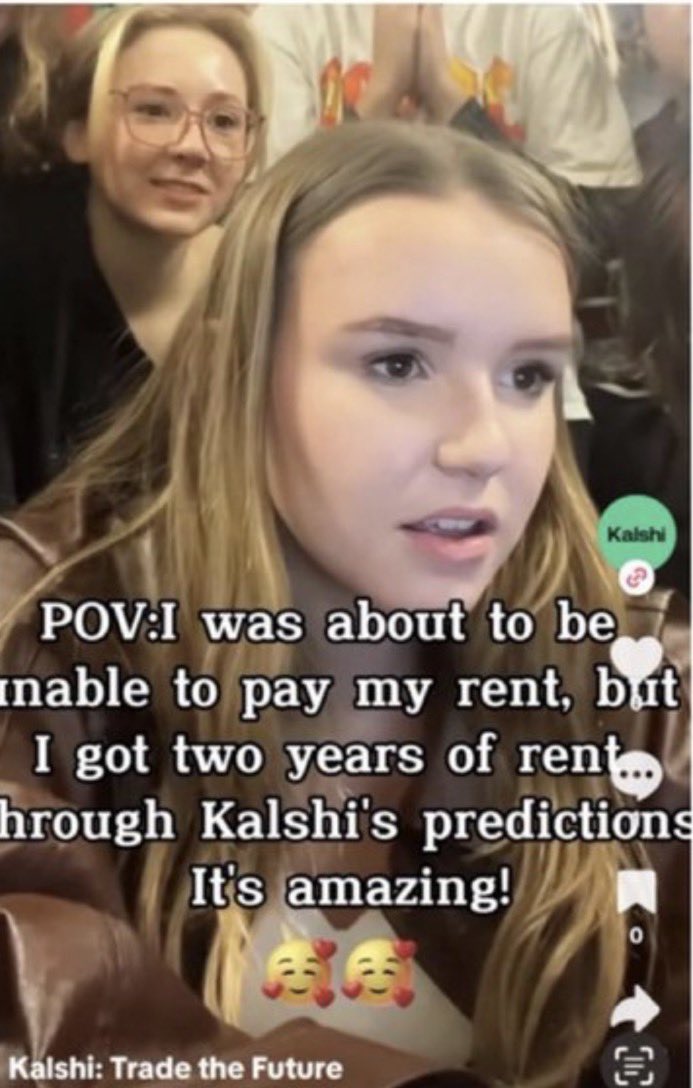
Kalshi runs these super predatory, untruthful ads. And now 41% of prediction market users say their main reason for using the platform is to make money
How are AI tools, crypto, and buy now, pay later services reshaping financial lives? And how do we protect consumers? Join AIBM’s @JonathanDCohen1 at @urbaninstitute on March 10 for a robust conversation on these topics. RSVP:
https://t.co/TlvsnsYvF2