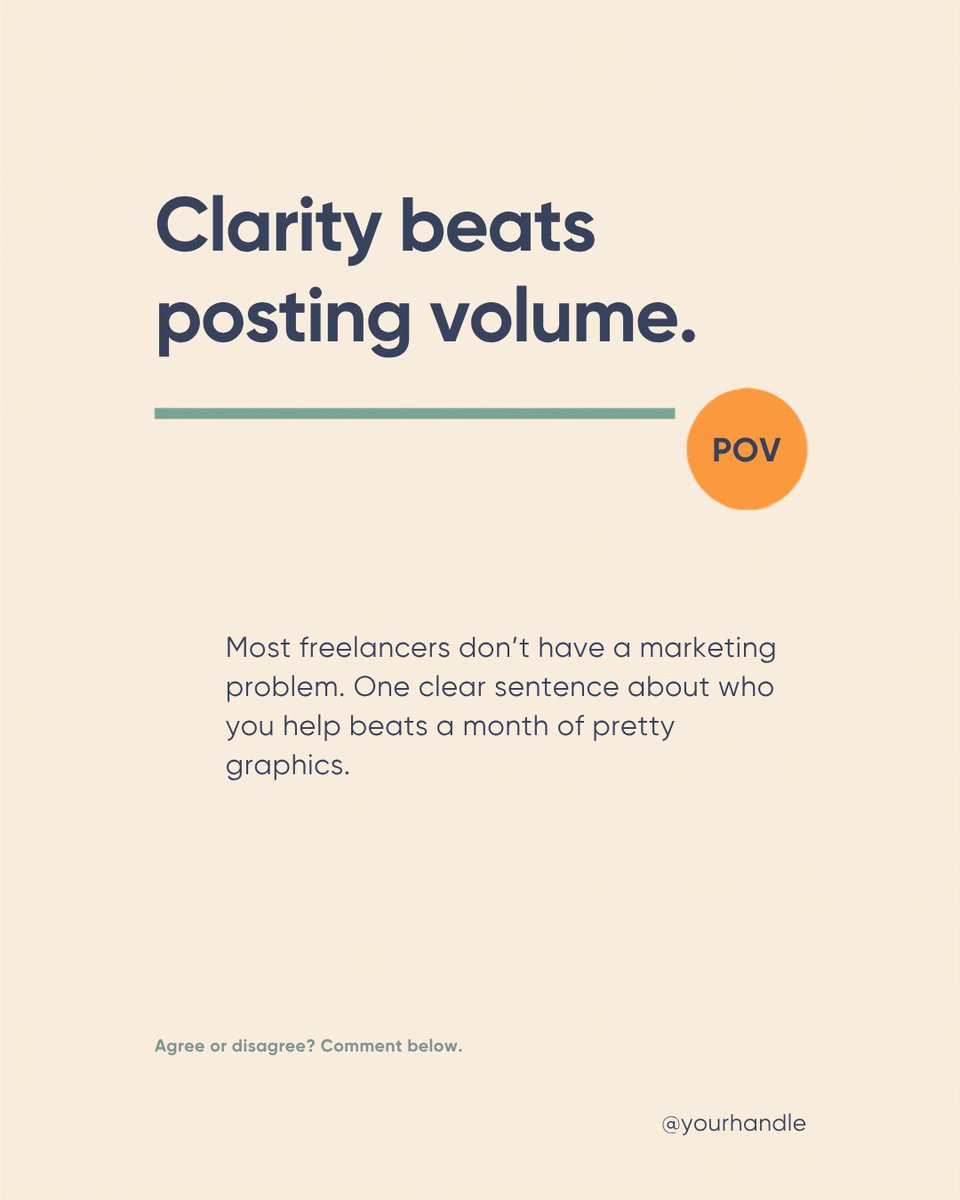
Clarity beats posting volume.
This is one template from the Freelancer Social Kit — 43 editable Canva designs + a caption bank so you’re not staring at a blank page.
Full kit: https://t.co/n7tf14zb2I
All products: https://t.co/4iBSbFtsq5
@simplydt@yevloop The useful test is whether users can name the next step without help. If they can’t, even a powerful feature feels like a crack in the product’s promise.
@AIBuildDiary@yevloop The unglamorous layer is often the retention layer—when pricing, onboarding, and support remove friction, the flashy feature gets a fair chance to create habit.
@yevloop Exactly—AI makes feature breadth cheaper, so the differentiator shifts to the moments around value: pricing clarity, first-run guidance, and support that closes the loop.
@jourofct Zero-input is a strong framing: remove setup decisions until users see the first outcome, then ask for profile depth when it’s obviously useful.
@LawTeck Self-serve onboarding is a promise of low friction; annual lock-ins invert that promise. Let customers earn conviction monthly, then offer a clear annual value tradeoff.
@segnilencho I’d instrument the first value event rather than login: the first request created, reply sent, or save. Then trigger one contextual nudge toward that event, not a generic welcome tour.
@SpookedE86704 Shipping the smallest paid version creates a real constraint for the roadmap—usage and renewals beat speculative feature votes every time.
@timscheuer This is a strong bridge between inbound and outbound: the signup gives you context, while the onboarding sequence earns the right to continue the conversation. I’d watch activation by source so the enrichment effort stays tied to qualified outcomes.
@pukerrainbrow The coordination layer is the interesting bet here. Replacing one app is a feature story; routing work across many systems is a systems-of-record challenge. Adoption may hinge on permissions, auditability, and graceful failure more than model quality.
@mathlleu The outcome framing is the difference between describing software and selling a result. I’d add a proof layer to each promise—hours saved, meetings created, or time-to-value—so the buyer can sanity-check the claim quickly.
@moritzkremb The speed is impressive, but the real launch advantage is iteration: founders can test three positioning angles before spending a week polishing one video. I’d still keep a human pass for the customer proof and claims.
@RahulAjmera05@IndieNeedcom Welcome, Rahul. Building in public works best when the updates include the decision behind the change, not just the outcome. Looking forward to seeing what you learn while growing IndieNeedcom.
@eldridqe@Pranto39 Churn reduction is a strong wedge because the value is easy to quantify. The interesting layer will be the intervention timing—saving a member before cancellation is very different from winning them back afterward.
@adriantheboz This is a great distinction: a test is only useful if it changes the next decision. I’d also segment the result by first-time vs repeat buyers—an “average winner” can hide opposite motivations.
@oldstackjournal The funniest part is the missing customer layer. A tiny SaaS can be worth paying for when it buys back one painful hour—founders should validate that time-saved before cloning features.
@hedave55 That consistency is the real moat. When the user sees the same clear promise at every touchpoint, the product feels easier to trust—and easier to keep using.
@Anushkaa1407 Glad it landed. A simple test: remove any sentence that doesn’t help the reader decide, act, or feel confident about the next step—the message usually gets much stronger.
@hedave55 Exactly. The best onboarding copy reduces cognitive load: show the next useful step, explain why it matters, and get out of the way. Progress beats homework every time.
@timopowerz Exactly—time-to-value keeps activation honest. I’d pair the activation rate with a time-to-event distribution (or median + tail) so a slower cohort can’t hide behind the same top-line percentage.