Black Bart robbed 28 stagecoaches in California, and in the end a handkerchief brought him down.
For eight years, the "Gentleman Bandit" worked the mountain roads alone and on foot. He wore a flour sack over his face, carried a shotgun, and politely told drivers to "throw down the box." Twice he left behind a poem signed "Black Bart, the Po8."
In 1883, the bandit stepped out from behind a rock on Funk Hill, the same spot as his first holdup. This time, a young hunter with a rifle was close by.
Shots chased him into the brush. Wounded in the hand, he got away, but dropped a handkerchief with a laundry mark: F.X.O.7.
Wells Fargo detectives went to some 90 laundries in San Francisco until they found the match. The handkerchief belonged to Charles Boles, a gray-haired gentleman who called himself a mining engineer.
California's most wanted stage robber was brought down by his laundry.
Belle Starr was riding home alone in 1889 when someone hidden along the trail opened fire.
She was the most notorious woman in Indian Territory, the rough country that later became Oklahoma. She had married outlaws and done prison time for horse theft, and her cabin on the Canadian River was a known hideout.
That winter, the outlaw queen learned a man renting her land was wanted for murder in Florida. She let him know it, then ordered him off her place.
Two days before her 41st birthday, a shotgun blast knocked her from the saddle. The killer walked up and fired again.
Footprints near the ambush were said to match the tenant's boots. Edgar Watson was tried, but nobody had seen the shooting, and he walked free.
The Bandit Queen was buried in her own front yard with a revolver in her hand. No one ever answered for her murder.
Pictured: Belle Starr at Fort Smith, Arkansas, in 1886, beside the deputy U.S. marshal who had just arrested her.
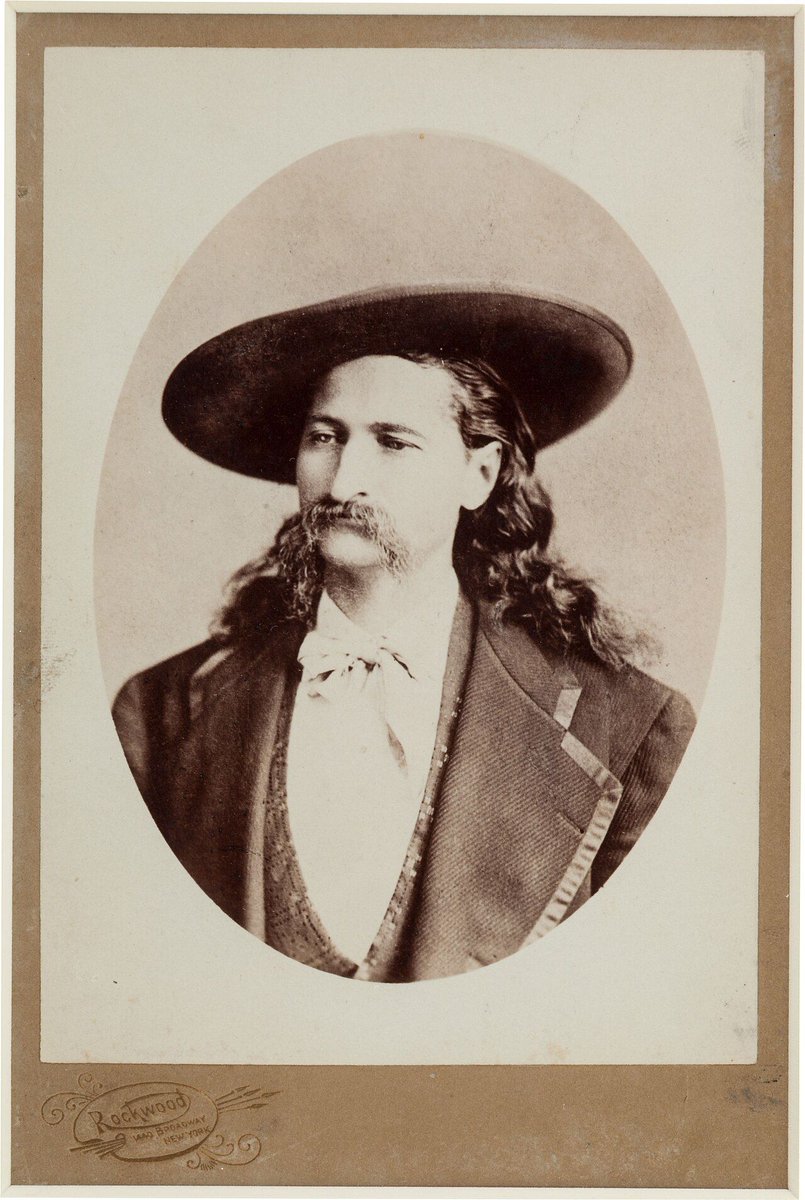
Wild Bill Hickok never sat with his back to a door, until one afternoon in 1876.
No gunfighter in the West was more famous. He had been an Army scout and a lawman in the rough Kansas cow towns, and plenty of men wanted him dead.
That summer, Wild Bill sat down to play poker at the No. 10 Saloon in Deadwood, a lawless gold camp in the Black Hills.
His usual seat against the wall was taken. Twice he asked the gambler in it to switch. The other players laughed it off, so he took the open stool, his back to the rear door.
Three hours later, a drifter named Jack McCall walked in and fired a pistol into the back of his head.
The gunslinger was 39.
A miners' court set the killer free the next day. A real court later sent McCall to the gallows.
According to legend, the cards Wild Bill was holding were a pair of black aces and a pair of black eights. They are still called the Dead Man's Hand today.
In 1933, a gang of killers shot their way out of a Missouri hideout and left their own camera behind.
The gang belonged to Clyde Barrow and Bonnie Parker. With his brother Buck and two others, the couple had rented a garage apartment in Joplin to lie low.
Local lawmen thought they were raiding a nest of bootleggers. The outlaws opened fire from the garage.
Two officers never made it home.
The gang raced off and left their camera behind. The Joplin Globe developed the film.
On it was Bonnie, her foot on a fender, a pistol in her hand and a cigar clenched in her teeth. The paper ran it, and the wire services sent it across America.
She smoked cigarettes, not cigars. A gang member had handed her his for the picture.
To this day, that cigar is how America remembers her.
John Wesley Hardin was the most feared gunman in Texas, until the day he reached for his pistol on a train.
The outlaw was said to have killed more than twenty men. After he shot a deputy sheriff in 1874, Texas put a $4,000 reward on his head, and he fled east under a fake name.
Texas Ranger John B. Armstrong was still healing from a gunshot wound and walking with a cane, but he trailed the fugitive all the way to Florida.
In 1877, Hardin sat on a train at Pensacola with four of his men. Armstrong stepped in, cane in one hand, a long-barreled Colt in the other.
"Texas, by God!" the gunman shouted, and went for his pistol.
It caught in his suspenders.
One of the outlaw's men fired at the Ranger. Armstrong shot him dead, then brought his Colt down on Hardin's head and knocked him cold.
The deadliest gunfighter in Texas had been taken down by a man on a cane.
Pictured: John Wesley Hardin as a young man.
The most important man in an Old West town wasn't the sheriff. It was the blacksmith.
Out West, everything moved on hooves and iron-rimmed wheels. Rocky trails wore a horse's feet down fast, and a thrown shoe could leave a rider limping home.
The blacksmith mended busted wheels, forged the ranchers' branding irons, and hammered out the nails, hinges and tools a town was built with.
A town could get by without a lawman for a while, but not without a blacksmith.
The most famous gunfight in the Old West lasted about 30 seconds, and it didn't even happen at the O.K. Corral.
In 1881, a band of cowboys in Tombstone, Arizona, was wearing guns in town against the law. One had spent the night drunk, swearing he'd kill the Earp brothers.
The marshal went to take their guns. With him walked a few deputies, including Doc Holliday, a shotgun hidden under his long coat.
They found the cowboys in a narrow lot beside a photography studio.
"Throw up your hands!"
Two shots cracked at once, and smoke swallowed the lot.
Doc cut a cowboy down with the shotgun. The drunk who'd made all the threats ran and left his friends to die.
Three cowboys lay dead. Two of the lawmen were bleeding. Wyatt Earp walked away without a scratch.
The next day, the bodies sat in an undertaker's window under a sign: "Murdered in the Streets of Tombstone."
Pictured: Doc Holliday at 20, in his 1872 dental school graduation photo.
Butch Cassidy and the Sundance Kid outran every posse in the West, but a stolen mule gave them away.
Chased by Pinkerton detectives, the two outlaws fled to South America. By 1908 they were in the mountains of Bolivia, robbing a mining payroll.
At sundown they rode into the tiny village of San Vicente. One of their mules wore the mining company's brand, and a posse was already in town.
The lawmen crept in after dark. Butch stepped into the doorway and shot the lead soldier in the neck.
Gunfire roared into the night. Then villagers heard three screams from inside, and everything went quiet.
At dawn they opened the door.
The Sundance Kid sat dead with a bullet in his forehead. Butch lay on the floor, shot through the temple. It looked like he ended his friend's suffering, then turned the gun on himself.
The village buried two strangers that afternoon. No one there even knew their names.
The story of how they died didn’t make it back to America for 22 years.
Billy the Kid was about two weeks from the hangman's rope when he shot his way out of jail.
In April 1881, he sat in chains upstairs in the courthouse in Lincoln, New Mexico. Scheduled to hang in a few weeks.
One guard, Deputy Bob Olinger, hated him. Olinger loaded his double-barreled shotgun with buckshot in front of the Kid and dared him to run.
On April 28, Olinger took the other prisoners across the street to eat. The Kid asked the other deputy to take him to the outhouse.
Coming back up the stairs, the Kid got hold of a pistol. The deputy turned to run, but the outlaw shot him dead.
He grabbed Olinger's shotgun. When the Deputy came running, he was looking up into both barrels of his own gun.
The Kid showed no mercy.
He smashed the shotgun and threw it down on the body. He hacked his shackles until he had one leg free, climbed onto a horse, and rode out of Lincoln.
Not one man in town tried to stop him.
America's most famous outlaw was shot in the back of the head while dusting a picture in his own home.
For 16 years, Jesse James robbed banks and trains across the Midwest, and no posse or Pinkerton detective ever caught him.
By 1882, his gang was dead or behind bars. Jesse was hiding in plain sight in St. Joseph, Missouri, under a fake name, with his wife and two kids.
He needed men he could trust, so he moved two young brothers into his house, Bob and Charley Ford.
He didn't know Bob had already made a deal to collect the $10,000 on his head.
On the morning of April 3, Jesse took off his guns so the neighbors wouldn't see them. He stepped onto a chair to dust a picture, his back to the room.
Bob drew and fired.
His mother had his gravestone carved: "Murdered by a traitor and coward whose name is not worthy to appear here."