LangChain’s YT channel has been one of the most valuable resources in my AI journey.
Just as I was diving deeper into context and prompt engineering…
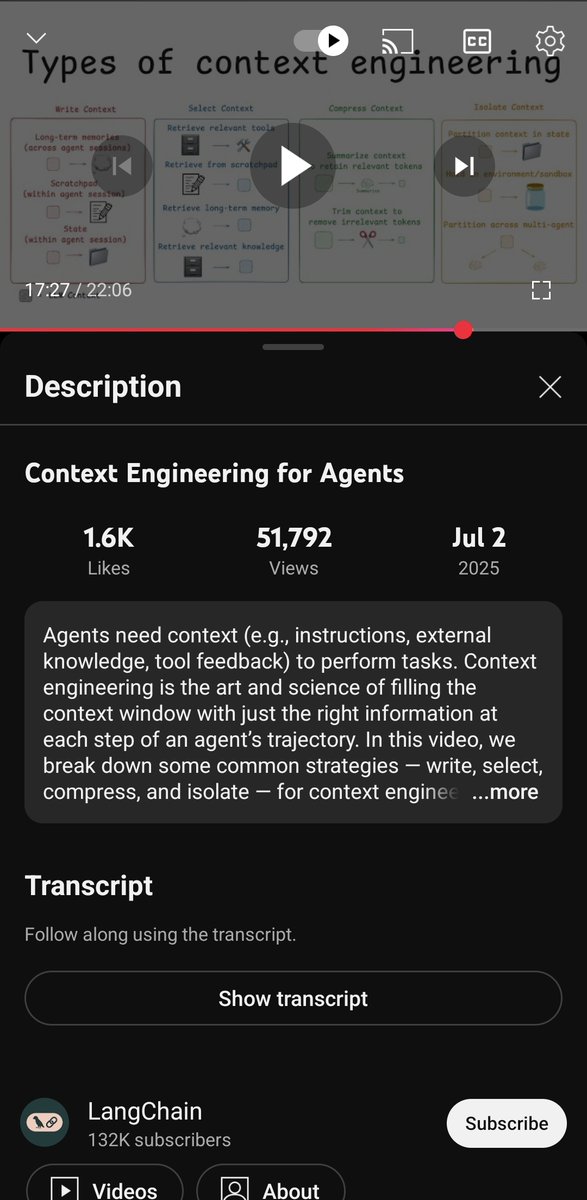
they dropped this 🔥 video last week on Context Engineering for AI Agents.
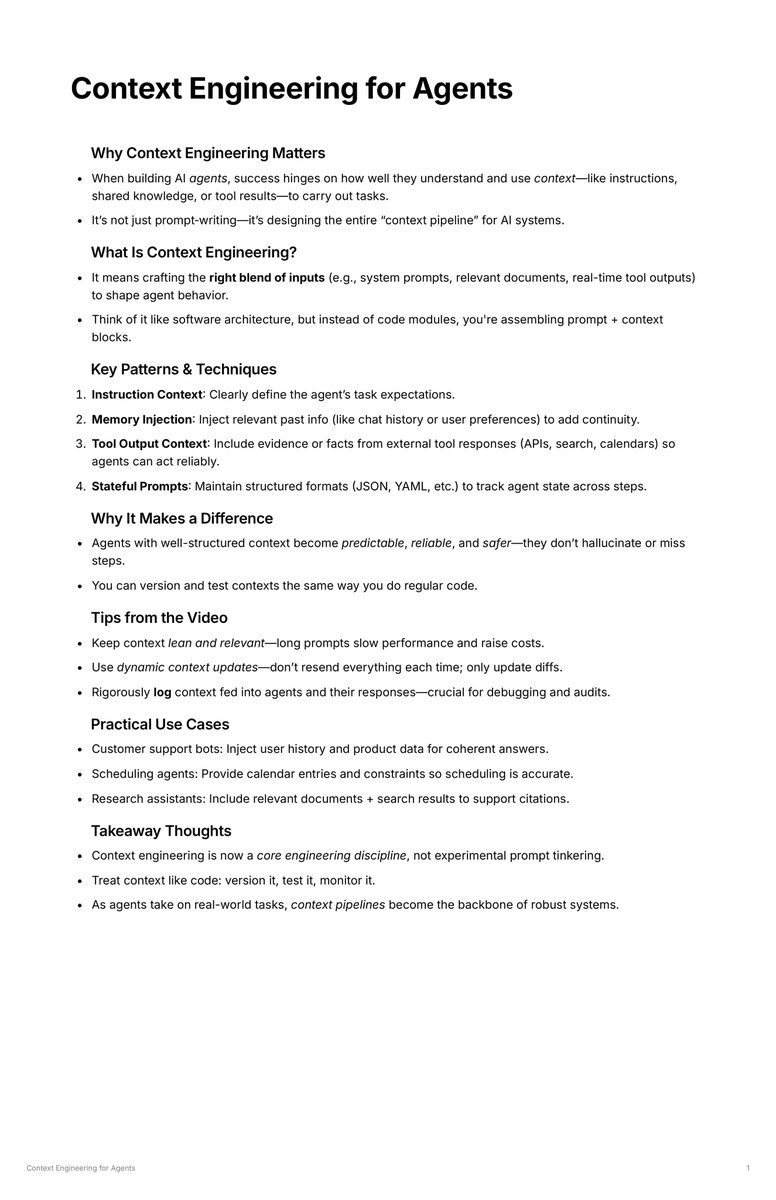
Here are the key takeaways you need to remember👇
Andrej Karpathy recorded 70 minutes
Breaking down how top AI users actually work with LLMs
And most people are making it way too complicated
Worth more than most $300 AI courses
Bookmark and watch it later
4 HOURS COURSE ON HOW TO RUN 1-PERSON AI BUSINESS JUST DROPPED
worth every minute if you have the time
if you don't, I wrote a full course on the same topic from running my own $40k MRR solo agency: every system, prompt and price
20 minutes to read, free, below ↓
12 free courses to master LLMs
▪️ Cohere LLM University
▪️ Hugging Face LLM Course
▪️ Hugging Face AI Agents Course
▪️ Google / Kaggle 5-Day Gen AI Intensive
▪️ DeepLearning. AI Short Courses
▪️ Hugging Face Context Course
▪️ Google / Kaggle 5-Day AI Agents Intensive
▪️ DeepLearning. AI Retrieval Augmented Generation Course
▪️ DeepLearning. AI Building Agentic RAG with LlamaIndex
▪️ Weights & Biases AI Academy
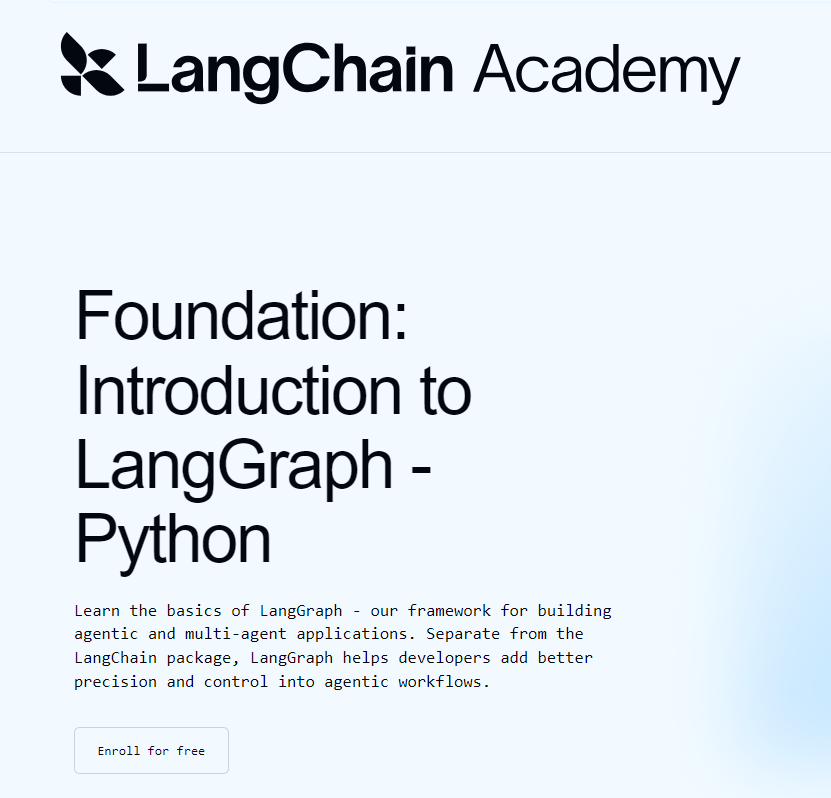
▪️ LangChain Academy: Introduction to LangGraph and Deep Agents
▪️ DeepLearning. AI AI Agents in LangGraph
+ Berkeley Advanced LLM Agents, Stanford CS25 and CS224N
Grab all the links here https://t.co/RwDNxD6BP0 :)
Local LLMs can answer prompts, but they can't reach the outside world on their own.
In this tutorial, Darsh shows how to build a local AI agent with tool calling and memory.
You'll use Python, LangChain, and other tools so the agent can call functions, handle follow-up questions, and run on your own machine.
https://t.co/ucAOn1R0Sv
I am more excited to try this pattern instead.
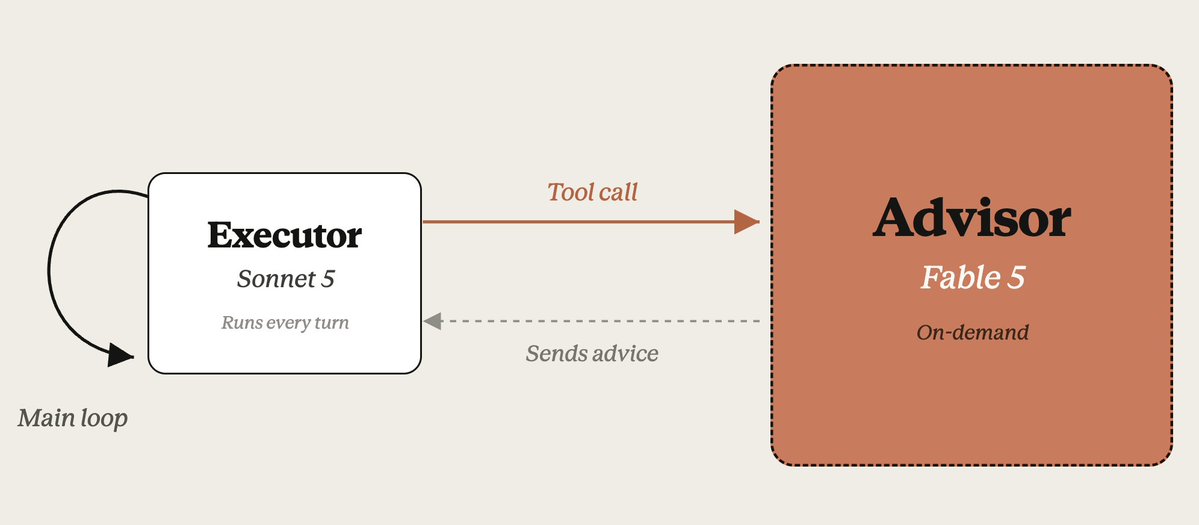
Same Executor-Advisor setup but with GPT-5.6 as the executor and Fable 5 as the advisor.
It already works wonderfully using GPT-5.5, so I think 5.6 should make it even stronger.
Full tutorial coming soon. :)
A few patterns we frequently use with Fable 5:
Use Fable 5 as an "advisor."
An executor (Sonnet 5) calls Fable 5 for guidance.
Most tokens are billed at the lower executor rate.
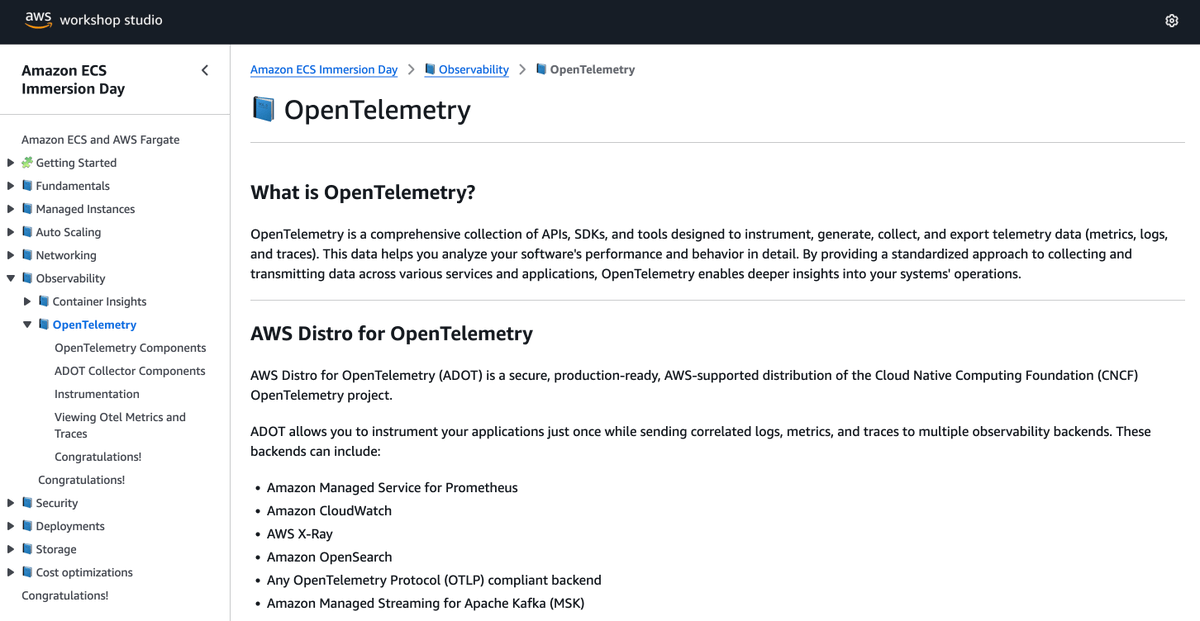
I honestly don't know why more engineers don't use https://t.co/0me2hOTFNe 🛠️
It's a collection of free, hands-on guides that work!
The ECS Immersion Day is one that I will keep recommending!
stop obsessing over finding the ℙ𝔼ℝ𝔽𝔼ℂ𝕋 AI tool.
the best AI stack is the one you can build and ship in a weekend.
SPEED of iteration beats perfect infrastructure every single time.
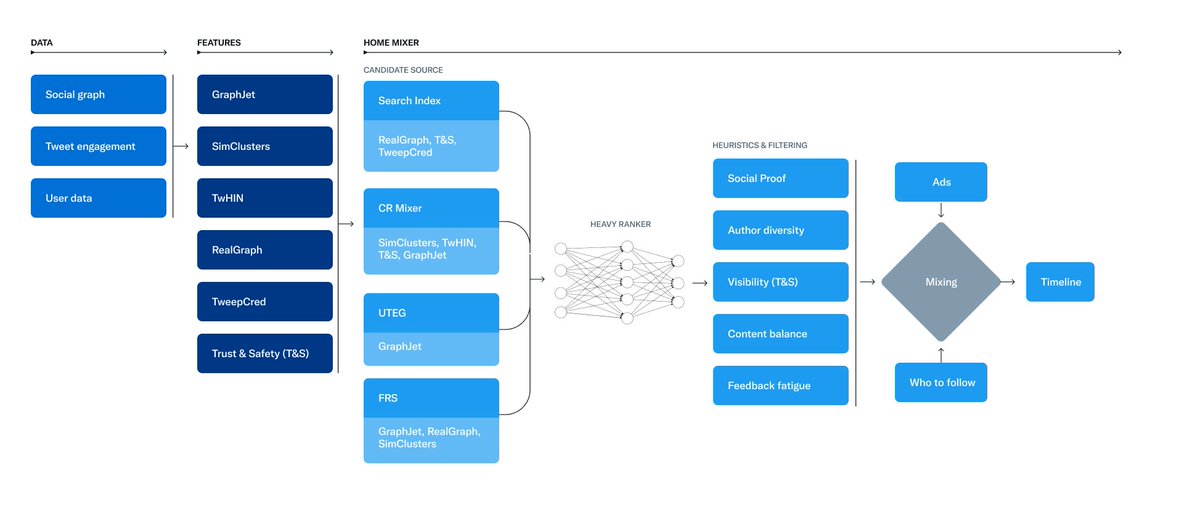
X just open-sourced the code for the “For You” algorithm
Everything you need to know in 1 tweet and 1 image:
1. The Raw Inputs (Data)
Everything starts with three big buckets of data:
- Social graph → who you follow, who follows you, your network connections.
- Tweet engagement → likes, retweets, replies, bookmarks.
- User data → your profile, behavior, what you click, what you ignore.
This is the “fuel” that powers the whole system.
2. Feature Engineering
The raw data runs through different models/features that try to make sense of it:
- GraphJet → real-time graph of tweets, retweets, follows.
- SimClusters → groups people and tweets into communities of interest (like “AI Twitter” or “NBA Twitter”).
- TwHIN → Twitter’s “heterogeneous information network,” basically a map of user-to-tweet relationships.
- RealGraph → predicts the strength of connections between users.
- TweepCred → credibility scoring.
- Trust & Safety signals → moderation, blocks, mutes, NSFW filters.
Think of this layer as the “filters” that figure out what’s worth even considering.
3. Candidate Sourcing (Home Mixer)
This is where tweets get pulled in as “candidates” to potentially show you:
Search Index (find relevant tweets directly)
- CR Mixer, UTEG, FRS (different mixers pulling tweets from clusters, graphs, and recency)
They pull from different pools so you don’t just see the same circle of people.
4.Heavy Ranker
Now the candidates run through a big neural network (the heavy ranker).
It scores tweets based on predicted engagement: likelihood you’ll like, retweet, reply, spend time reading.
5. Heuristics & Filtering
After the ML ranker, some hand-coded rules kick in:
Social proof → is it liked by people you follow?
- Author diversity → don’t show 10 tweets in a row from the same person.
- Visibility / T&S → block spam, NSFW, muted accounts.
- Content balance → avoid overwhelming you with one type of content.
- Feedback fatigue → avoid showing you the same tweet repeatedly.
6. Mixing
Finally, the ranked tweets get mixed with:
- Ads (obviously).
- Who to follow suggestions.
7. What does this mean for you?
Probably not much.
- Pick a niche
- Write valuable tweets
- Reply to people in your niche with value
- You'll grow and build an audience
X is a beautiful place to grow an audience to meet interesting people and get insight for what businesses to build for
It's worth being here.
Enjoy.
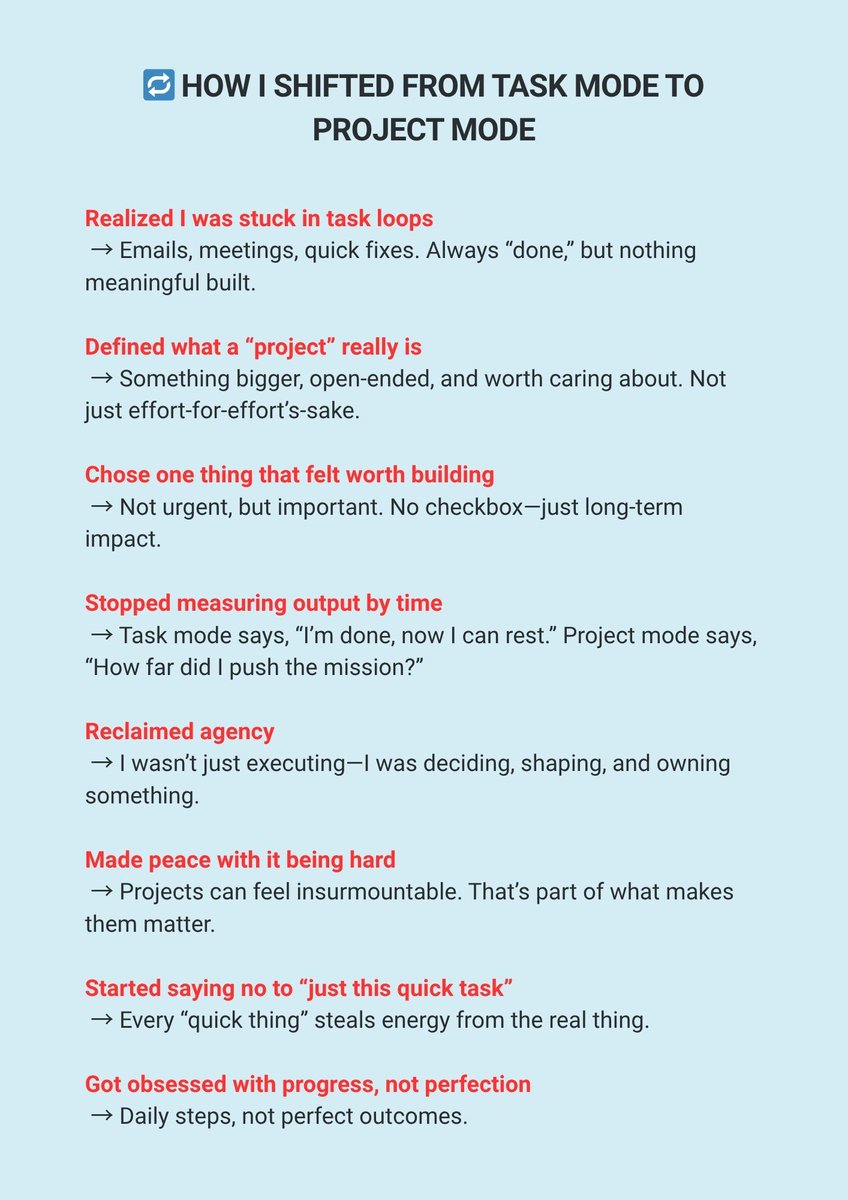
Few weeks ago I realized my day was filled with tasks. Emails, meetings, quick fixes... 😵💫
Reading Seth Godin reminded me: a project is different. It has purpose, progress, and makes you grow.
I swapped some busywork for a real project and it reignited my creativity.🚀
Bullet points of how I shifted are in the image below 👇
Lately, I’ve been asking myself:
– Did I finish something that mattered today?
– Or did I just check boxes to feel productive?
I realized I was hiding in tasks,
avoiding the discomfort of real projects.
That awareness changed everything.
Here’s a mind-bender:
AI can beat you at chess yet can’t identify a stop sign reliably.
That’s Moravec’s Paradox in action
Reasoning is easier than perception.
Our comprehensive source on AI Agents
Includes:
▪️ Your go-to Agents vocabulary
▪️ MCP
▪️ A2A
▪️ Building blocks of agentic systems:
- Profiling
- Knowledge
- Memory
- Reasoning
- Reflection
- Action
- Reward and value functions
▪️ Co-agency and multi-agent systems
▪️ Top coding agents
and more!
Find all guides here -> https://t.co/B2wRXZGgfi