Introducing Claude Design by Anthropic Labs: make prototypes, slides, and one-pagers by talking to Claude.
Powered by Claude Opus 4.7, our most capable vision model. Available in research preview on the Pro, Max, Team, and Enterprise plans, rolling out throughout the day.
The 7.84% stake FTX owned in Anthropic would be worth $62.72 Billion.
The total market cap of Coinbase today is $48.7 Billion.
(FTX's bankruptcy estate liquidated the entire stake for just $1.3 Billion in 2024)
Introducing Claude Managed Agents: everything you need to build and deploy agents at scale.
It pairs an agent harness tuned for performance with production infrastructure, so you can go from prototype to launch in days.
Now in public beta on the Claude Platform.
LLM Knowledge Bases
Something I'm finding very useful recently: using LLMs to build personal knowledge bases for various topics of research interest. In this way, a large fraction of my recent token throughput is going less into manipulating code, and more into manipulating knowledge (stored as markdown and images). The latest LLMs are quite good at it. So:
Data ingest:
I index source documents (articles, papers, repos, datasets, images, etc.) into a raw/ directory, then I use an LLM to incrementally "compile" a wiki, which is just a collection of .md files in a directory structure. The wiki includes summaries of all the data in raw/, backlinks, and then it categorizes data into concepts, writes articles for them, and links them all. To convert web articles into .md files I like to use the Obsidian Web Clipper extension, and then I also use a hotkey to download all the related images to local so that my LLM can easily reference them.
IDE:
I use Obsidian as the IDE "frontend" where I can view the raw data, the the compiled wiki, and the derived visualizations. Important to note that the LLM writes and maintains all of the data of the wiki, I rarely touch it directly. I've played with a few Obsidian plugins to render and view data in other ways (e.g. Marp for slides).
Q&A:
Where things get interesting is that once your wiki is big enough (e.g. mine on some recent research is ~100 articles and ~400K words), you can ask your LLM agent all kinds of complex questions against the wiki, and it will go off, research the answers, etc. I thought I had to reach for fancy RAG, but the LLM has been pretty good about auto-maintaining index files and brief summaries of all the documents and it reads all the important related data fairly easily at this ~small scale.
Output:
Instead of getting answers in text/terminal, I like to have it render markdown files for me, or slide shows (Marp format), or matplotlib images, all of which I then view again in Obsidian. You can imagine many other visual output formats depending on the query. Often, I end up "filing" the outputs back into the wiki to enhance it for further queries. So my own explorations and queries always "add up" in the knowledge base.
Linting:
I've run some LLM "health checks" over the wiki to e.g. find inconsistent data, impute missing data (with web searchers), find interesting connections for new article candidates, etc., to incrementally clean up the wiki and enhance its overall data integrity. The LLMs are quite good at suggesting further questions to ask and look into.
Extra tools:
I find myself developing additional tools to process the data, e.g. I vibe coded a small and naive search engine over the wiki, which I both use directly (in a web ui), but more often I want to hand it off to an LLM via CLI as a tool for larger queries.
Further explorations:
As the repo grows, the natural desire is to also think about synthetic data generation + finetuning to have your LLM "know" the data in its weights instead of just context windows.
TLDR: raw data from a given number of sources is collected, then compiled by an LLM into a .md wiki, then operated on by various CLIs by the LLM to do Q&A and to incrementally enhance the wiki, and all of it viewable in Obsidian. You rarely ever write or edit the wiki manually, it's the domain of the LLM. I think there is room here for an incredible new product instead of a hacky collection of scripts.
NEW EPISODE: @jack & @roelofbotha unpack @blocks 40% staff cut and rebuilding the entire company as a mini-AGI.
This isn’t “use AI to make people more productive.” It’s making the company itself the intelligence.
If you’re a founder or operator wondering what work looks like in the next 5 years… this is the episode.
The evolution looks like:
• Manager mode = Pyramid 🔺 (command & control)
• Founder mode = Flat ➖(founders decide fast)
• Dorsey mode = Circle 🔵 w/ AI at the center, humans at the edge, and decisions flow from customer inputs → AI → humans steering it
I’ve tried killing org charts before. Brutally hard. But we never had these tools.
This is rewriting the CEO playbook for the AI era.
Buckle up.
00:00 Existential Dread & Hope
02:56 AI Replaces Hierarchy
07:22 Block’s New Three Roles
26:47 Flattening the Company, Fast
35:23 Getting the Board to Buy-In, Fast
36:50 Building a Great Board
41:29 Founder CEO Lessons
48:18 Second Acts & Conviction
56:22 Timeless CEO Traits
Wow. Incredible amount of SOTA training data now just available to China thanks to @mercor_ai leak. Every major lab. Billions and billions of value and a major national security issue.
Since the Iran war began:
1. US has lifted sanctions on Russian oil for the first time since the Ukraine war began
2. Oil futures posted their largest weekly gain in history, rising +34.5%
3. The S&P 500 has erased -$2 trillion in market cap in 10 trading days
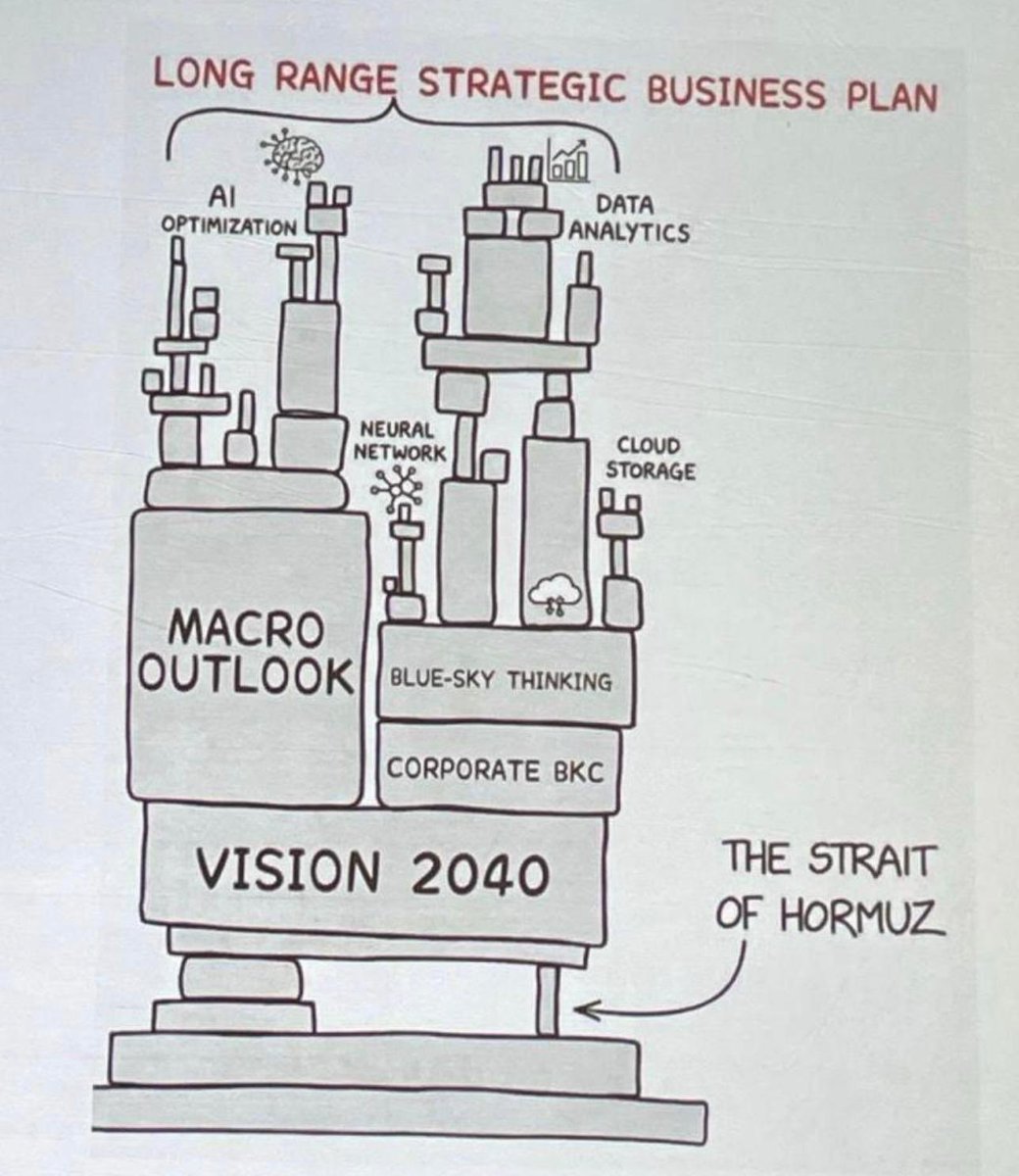
4. Iran is considering allowing oil trade through the Strait of Hormuz to resume if done with Chinese Yuan
5. The world has seen the largest disruption to global energy markets in history
6. US strategic oil reserves are set to hit their lowest since the 1980s
It has only been 2 weeks.
Arsenal trying to win corners all the time. Why won’t they? They are very good at corners.
This also shows where the game is right now. The best team in England playing for corners consistently
10/ i left thinking the “bitcoin vs fiat” debate is really “rules vs discretion.” and discretion always becomes politics.
11/ question i cannot shake: if inflation is a tax, who is actually consenting to it, and how do they opt out without leaving the system?
https://t.co/rvSrlem1LL
1/ ten years in the making: The Bitcoin Standard meets The Network State. @balajis and @saifedean in one room, finally.
my main takeaway: inflation is not an economic bug. it is a political feature. it is how modern states fund themselves without asking.
8/ zooming out: trust in currencies is downstream of trust in institutions. when institutions polarize, money becomes a referendum.
9/ the network state angle is basically this: when trust breaks, people route around. first in finance. then in work. then in community. the stack starts moving.