Okay, here is the anime-lore update for non-schizo-nerds on AI cybersecurity stuff
Basically AI kind of sucked for awhile, but now we've got pretty good with AI stuff. As a comparison, look at AI generated videos from 2 years ago and compare it to now. It's big brain.
Disclaimer: this isn't doomer posting, read fully if you care, or skip and look at the picture of the cat
Some frameworks, such as the infamous ARTEX, utilizes AI which has been trained on like, 40 years of cybersecurity material. Imagine a human being who could think faster, remember more, and troubleshoot faster, and had all cybersecurity knowledge encapsulated into their little mushy brain
Now imagine this person could work in conjunction with other like minded super schizo nerds and communicate with electricity, instead of words, making communication instantaneous with no way miscommunications.
These super schizo nerds don't need coffee breaks, or smoke breaks, or have meetings, or food, or sleep, friends or family. They can work infinitely with zero breaks.
When you take someone who is educated on offensive cybersecurity ("hacking") and give them something like ARTEX, you've essentially made a regular nerd into a super powered super schizo nerd. Likewise, if you give it to a complete noob, even this dorky noob is suddenly exponentially less nooby.
However, just because attackers have ARTEX, and can work faster, stronger, stinkier, doesn't mean defenders are cooked. Attackers can make mistakes, same as AI-powered attackers. But there is one problem I keep seeing now...
Historically defenders have had issues with budgets, fatigue, burn-out, or apathy from the company, customers, or employees. Suddenly defenders have to face supercharged schizo nerds using AI while the organization they are designated in protecting is understaffed, limited budget, doesn't follow properly security protocols (apathy). It makes defense astronomically more difficult.
Defense has always been hard, but when you're defending an organization and you've got 99 dork attackers, and 1 big brain attackers, it can be challenging. Now you've got 75 big brains (supercharged with AI and anime), and 25 dorks, their job is way, way, way more difficult and stressful.
The problem isn't organizations cannot defend with super mega fuck off AI charged attackers, it's that defenders are constantly chained to budget, executives, or employees. This means companies have to do this thing called "caring" about cybersecurity. This means they have to pay people appropriately, actually do updates, force employees (as much as they can) to care, and follow proper security protocols. If companies do not adapt, they're cooked.
This might be easier for large companies, but for small to medium sized businesses and governments (they're not known for their speed...) are in an extraordinarily difficult position. They either have to find the money in the budget, and care, or face the serious possibility to being obliterated by a stinky nerd super charged with AI. Unfortunately, cybersecurity is expensive. For small to medium sized businesses this places them in a really tough spot.
Anyway, that's my goofy layman talk on AI stuff.
pic unrelated (maybe, idk)
Been having way too much fun lately combining cloud security and detection engineering 😂
Deploying vulnerable infrastructure, getting Wazuh up, causing a little chaos and then seeing what I can catch. It’s quite tiresome, but I’m enjoying every bit of it .
A major Nigerian fintech lost a little over ₦3.5 billion to cybercriminals this week, people familiar with the attack tell me. Another lost ₦1 billion.
My sources say neither attack was reported to Nigeria’s data protection regulator.
1/3
I took some time off to build something for people learning networking and preparing for their first roles in tech.
Introducing Broken NetLabs
A collection of broken network labs for aspiring Junior Network Engineers, Data Centre Network Engineers, NOC Engineers, and anyone looking to build real-world troubleshooting skills.
Download a lab, find the faults, fix them, and document your solutions in public. You'll also sharpen your technical documentation skills along the way.
🔗 https://t.co/NkYsRrwMIA
Happy troubleshooting! Feel free to share this with someone in your network who could benefit from it.
If you are one of those people who lacks a sense of urgency and always hides behind “African Time” even when the situation is critical
- you are always 5 minutes away
- you are always almost there
- you are always whatever
I just want to let you know that you are a stupid person!
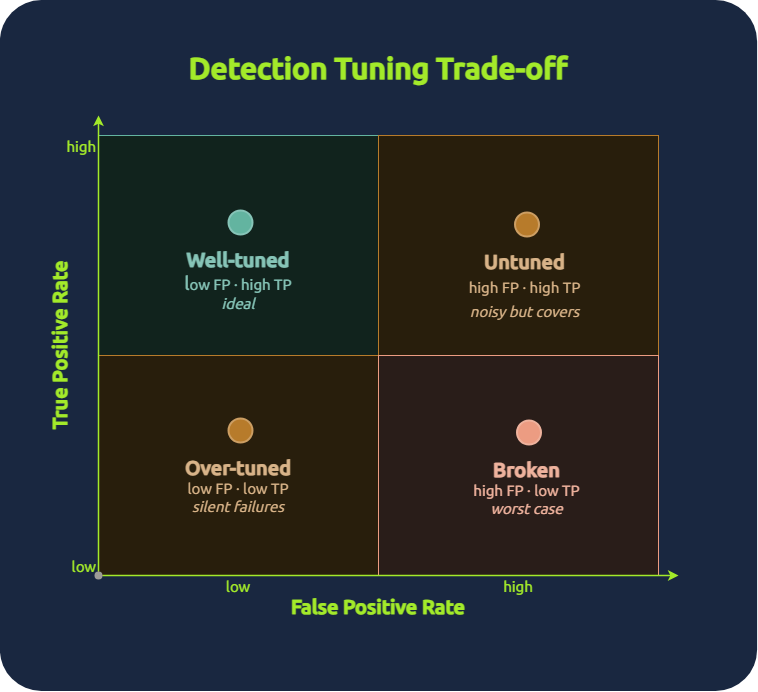
Detection tuning is the process of adjusting detection rules to maximize true positive coverage while minimizing false positives, keeping alerts actionable and severity calibrated to actual risk.
The image below is the Detection Tuning Trade-off Matrix. Each square represents a detection rule plotted by its true positive rate (how many real attacks it catches) against its false positive rate (how many benign events it flags).
The goal of tuning is to move every rule toward the top-left quadrant.