Social media and the press are shaping perceptions by selecting candidates for top posts in Public Sector Enterprises or their affiliates based on their proximity to influential political circles, most recently, the Petronet LNG MD. Is it a reality or rhetoric? Shouldn't the shortlisted candidates' vision, foresight, and complex problem-solving abilities be the criteria for elevation to top posts? If we overlook this, Indian PSUs will continue to have chairmen like that of Indian Oil Corporation Ltd., where vision led to scrapping several refinery-related projects (core activity) to market branded water. @Secretary_MoPNG@DoPTGoI@CMD__HPCL@ChairmanIOCL@ChairmanONGC@cmdbpcl@PMOIndia
While addressing the UPSC event, our visionary Honourable Prime Minister cautioned about navigating new battlegrounds of information warfare, deepfakes, algorithmic bias and climate justice and urged recruitment agencies to adapt to these global shifts by prioritising candidates' foresight and complex problem-solving abilities. All political parties taking cues from these perceived new battlegrounds must nominate Rajya Sabha candidates accordingly, at least. @lopindia_RG@HMOIndia@DefenceMinIndia@PMOIndia
Gen Z is changing the narrative from securing the future to living in the "NOW," and they don't hesitate to borrow to do it. They would rather spend money on buying happiness today by gaining experiences and status-driven consumer goods. Travel has transitioned from being an occasional indulgence to a lifestyle priority. Borrowing for travel is less about showing off and more about emotional well-being. With tourism as the biggest employer and Gen Z setting trends, wouldn't it be appropriate to develop spots that meet expectations, create jobs, and limit foreign exchange outflows? This would necessitate inducting professional young minds into the Rajya Sabha rather than those who have passed their prime. @HMOIndia@DefenceMinIndia@tourismgoi@LabourMinistry@FinMinIndia@PMOIndia
The same story repeats every time there is an accident in an Indian refinery. Contract workers are injured, killed or charred. A blast in the Coker Hydrotreater Unit of Mangalore Refinery and Petrochemicals Ltd. (MRPL) on September 30, 2026, left one contract labourer charred and another sustaining 35% burn injuries. Is it because only contract labourers work in Public Sector Refineries, while others enjoy it at their behest? What accountability do the management and permanent employees have for such accidents? Is disinvestment not the need of the hour to ensure accountability for each and every one employed, and save the lives of poorly trained contract labour? @LabourMinistry@MoHFW_INDIA@EduMinOfIndia@PetroleumMin@Secretary_MoPNG@Ongc_Mrpl@IndianOilcl@BPCLimited@HPCL@PMOIndia
Crude oil flows from Persian Gulf nations, except Iran, have recovered to over 80% of pre-war levels (Feb 28, 2026), but exports of gasoline, jet fuel, and diesel remain at around 50%. This diesel shortage from the Persian Gulf, along with the Russian export ban, has driven diesel cracks to unprecedented levels. Globally high diesel prices, including in the US, are pushing the US administration to consider diesel export curbs. The US exports over 1.4 million barrels of diesel per day. However, amid global diesel shortages, is it a boon for Indian export-oriented refineries? @RIL_Updates@BPCLimited@HPCL@IndianOilcl@NayaraEnergy@Ongc_Mrpl@chennaipetro@Secretary_MoPNG@PetroleumMin@CimGOI@PMOIndia
Are household borrowings in India becoming an integral part of everyday consumption? Credit cards, personal loans, consumer durable loans, digital lending, and buy-now-pay-later arrangements are bringing future income into the equation, a pointer to unequal employment and uneven growth. Despite India's household debt of 45.5% of its GDP as of September 2025, government emphasises that it is below many emerging-market pers. However, the challenge is to distinguish productive credit from distress credit and asset-building borrowing from consumption smoothing. Are policymakers looking to build an economy where households can live on their incomes rather than against their future incomes? @FinMinIndia@RBI@LabourMinistry@MoHUA_India@MoRD_GoI@MoHFW_INDIA@PMOIndia
The country's energy crisis is unprecedented. It needs an ignited mind like that of the current Railways, Information & Broadcasting, and Electronics & Information Technology minister to drive the energy sector through difficult times and help it achieve energy independence by 2047. Our Honourable visionary Prime Minister is fully aware of this necessity and will do everything possible to make it a success. It was quite disturbing to go through Business Today Desk news on the current Petroleum and Natural Gas Minister being nominated for the third time to a Rajya Sabha seat, this time from UP, a minister whose integrity is being questioned and who enjoys at the PSU's cost. Has the country been able to reduce oil imports and increase the gas share in the energy mix beyond around 6.4% since 2019, to achieve a 15% gas share in the energy mix by 2030, and make India a gas-based economy under his leadership? Rhetoric will not deliver; reality will, to fulfil the goals set by the government. @DefenceMinIndia@HMOIndia@RailMinIndia@PMOIndia
As digital transactions become a lifeline, fraudsters exploit ignorance and vulnerability while tracking digital participation to target those with resources. Fraudsters exploit social relationships and institutional credibility to prey on the desire to get rich quickly. Cybercrimes rose from 86,420 in 2023 to 1,01,928 in 2024, a 17.9% increase. By manipulating familiar relationships and situations, fraudsters can make deceptions appear legitimate. Fraud has become a tax on carelessness rather than connectivity, with the wealthiest people most vulnerable to financial fraud. @RBI@FinMinIndia@_DigitalIndia@PMOIndia
The West Asia war has not only led to a crude, LNG, and petroleum product crisis but also to a shortage of sulphur, a by-product of petroleum refining and natural gas processing. Despite producing around 3.7 MMT of sulphur in 2025, India imported around 2.25 MMT, with 90% from West Asian producers. Most of India's demand comes from the fertiliser industry, and international prices rose more than fourfold in one year, from $280 per tonne in July 2025 to $1050 per tonne in July 2026, adding to India's import and subsidy burden. Are Indian refiners making windfall profits? @PetroleumMin@Secretary_MoPNG@BharatUrvarak@PibMinistry@AgriGoI@FinMinIndia@CimGOI@PMOIndia
India is no longer an agriculture-dominated economy, with only 15-18% of its GDP now coming from agriculture; however, the agriculture sector still employs over 46% of India's workforce. Despite employing so much of the workforce, the biggest challenge is that about 86% of farmers hold less than 2 hectares of land, and they receive only a minuscule share of the final value of what they produce. Weak storage and processing infrastructure, fragmented supply chains and multiple intermediaries often leave cultivators with little bargaining power. @AgriGoI@MOFPI_GOI@LabourMinistry@FinMinIndia@PMOIndia
In India, major wholesale markets produce about 100 tonnes of organic waste every day. Of this, about a fifth reaches landfills, adding to about 3.5 million tonnes a year, which, if treated, can offset nearly 3.3 million tonnes of Carbon dioxide equivalent emissions or close to $30 million in carbon credits. India has the data, technology, and viable models, but it needs to close data gaps, attract investment, and make loss reduction part of agricultural, food-processing, urban, and climate policy. @moefcc@MOFPI_GOI@AgriGoI@mnreindia@PMOIndia
Is it the sufferings and martyrdom of the Shia Sect that have made the Islamic Republic of Iran (IRI) determined to face enemies with grit, guile and gumption? The U.S., with three times the population, 85 times the GDP, and twenty times the military budget, has been at war with Iran for over seven months. Despite weaponising "Operation Economic Outcast" against an already "maximum sanctioned" Iranian economy, the IRI has not capitulated, and the U.S. itself faces inflation, ammunition depletion and isolation. The U.S. fought its war of independence as an underdog about 250 years ago, while Iranians have often been the underdog against Greeks, Byzantines, Arabs, and Ottomans. @SpokespersonMoD@DefenceMinIndia@CimGOI@FinMinIndia@PetroleumMin@MEAIndia@PMOIndia
The U.S. strategy centred on a relationship with India as a bulwark against China. As the U.S. and China work toward a constructive relationship of strategic stability based on fairness, respect, and reciprocity, it is time for India to recalibrate its strategy. The tariff threats aimed at India over Russian oil imports stand in stark contrast to the measured language with which Washington has engaged Beijing, even though China is the biggest Russian oil importer. @MEAIndia@PetroleumMin@CimGOI@PMOIndia
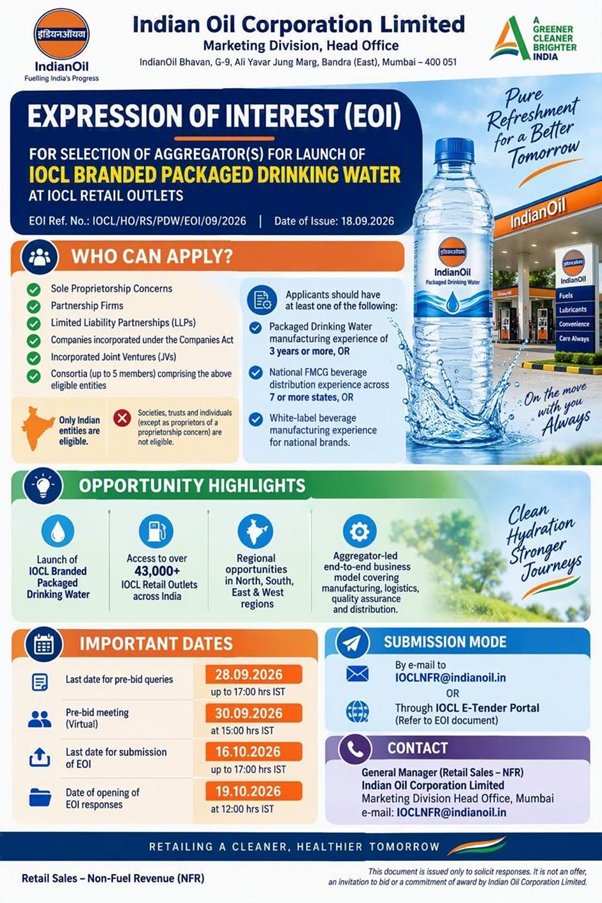
Indian Oil’s Expression of Interest (EOI) to select aggregator(s) to launch IOCL-branded packaged drinking water at IOCL retail outlets suggests its Chairman's clear intent to start selling water, even though it has no real intent to sell Oil and Gas. Or is it the vision of its visionary Chairman that it cannot compete with the private sector in Oil and Gas without government backing, but can compete with established private players in branded packaged water? Through this act, does its Chairman want to hand over the Oil and Gas trade to Vitol and IOCL so it can focus on packaged water? @IndianPSUs@Secretary_MoPNG@ChairmanIOCL@ChairmanONGC@cmdbpcl@CMD__HPCL@PetronetLNGLtd@PetroleumMin@IndianOilcl@PMOIndia
Government has no business being in business. The proposed PSU Banks strike amply justifies this, which, of course, has now been called off. Private banks deliver better service, higher customer satisfaction, and excel in time management, despite their employees earning less than PSU Bank employees. Government policies help PSU Banks survive, a fact its employees fail to understand. Has any PSU been able to withstand direct competition from the private sector, be it education, hotels, airlines, banks, the oil sector and even defence? If not, why does the public sector still exist? The RBI is enough to exercise the necessary control over private-sector banks. @FinMinIndia@PetroleumMin@Secretary_MoPNG@MoCA_India@tourismgoi@EduMinOfIndia@DefenceMinIndia@RIL_Updates@AdaniOnline@ITCHotels@OberoiHotels@IndianPSUs@PMOIndia
Indian Oil Chairman has scrapped most refinery projects and moved ahead with marketing water. What a visionary Chairman at IOCL, the country's largest oil refiner and marketer, has! Can an oil company of IOCL's size and stature survive under such visionaries?@PetroleumMin@Secretary_MoPNG@IndianOilcl@ChairmanIOCL@cmdbpcl@CMD__HPCL@ChairmanONGC
The US aimed to compete with Russia and prevent Chinese influence in the Arctic, seeking to achieve this by signing the U.S.-Denmark-Greenland security agreement on September 22, 2026. With the signing of the deal, the U.S. has indefinite rights to build military facilities, extract resources and have a say in Greenland's economic policies. The US seems to have secured almost everything except the ownership of the world's largest island. Let us see the future of Greenland's 50,000-person population amid competing giants Russia, China, and the US. @MEAIndia@SpokespersonMoD@PMOIndia
The current super El Niño, driven by central and eastern tropical Pacific temperatures about 3 degrees C above normal, is projected to cause 451,000 additional heat-related deaths. Projected deaths are around 19,300 in Indonesia, 19,400 across the Philippines, Vietnam, Thailand and Cambodia, 13,300 in Brazil, 66,800 across the Sahel and around 15,800 in India. India's national rainfall deficit has been around 15% up to September 22, 2026. Is it a glimpse of what lies ahead without new investments in environmental protection? @moefcc@DoWRRDGR_MoJS@LabourMinistry@MoHUA_India@MoRD_GoI@UNFCCC@PMOIndia
India's road network of 6.7 million kilometres surpasses the US's 6.59 million kilometres and China's 5.49 million kilometres. However, speeding, reckless driving, poor road upkeep and inadequate training lead to around 20 deaths an hour, or say 485 deaths a day, costing about 3.14% of India's GDP, much higher than what the country spends on innovation and R&D. @MORTHIndia@GoI_MeitY@LabourMinistry@MoHFW_INDIA@FinMinIndia@PMOIndia