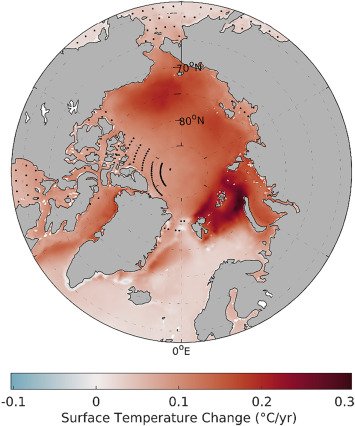
📢New study: Climate model simulations of central #Arctic surface temperatures are more accurate than appreciated, whereas the benchmark data from observation-based reanalyses are biased warm
https://t.co/3Hptu9Zcmq
@ShutingDK@jacobhoeyer@PEnglyst@dmidk#NCKF_DK@optimESM_eu
Are you engaged in #climatechange research focusing on global and regional climate #SST reanalyses and climate data records?
Submit your abstract for #GHRSST25 here: https://t.co/JQrGJXyCiG
🔴 Deadline: 1 March 2024 🔴
#GHRSST25 is co-hosted by @environmentca and @UQAM
📢Call for Abstracts! GHRSST invites abstract submissions for the 25th International SST Users’ Symposium #GHRSST25
Submit by 1 March 2024: https://t.co/JQrGJXyCiG 🔗
#GHRSST25 will take place from June 10-14, 2024, in Montreal, co-hosted by @environmentca and @UQAM 🇨🇦
The European Space Agency @ESA_EO launches the #CIMRL2PAD project, a 4-year initiative to advance #EO technology. @dmidk will contribute to this international effort led by @Meteorologisk with algorithms to retrieve sea and sea-ice surface temperatures for the CIMR mission
@JiK82285505 Not sure what ice you are referring to, but neither the Arctic sea ice or the Greenland Ice Sheet have been exspanding compared to the last decade.. follow the changes and read more here:
https://t.co/6rgqcpgsdu
https://t.co/BMo7HunPCX
Happy to see our paper out! The new combined gapfree Arctic sea and sea-ice surface temperature dataset shows an average warming of 4.5°C since 1982 and a peak warming of ~10°C in the north-eastern Barents Sea. https://t.co/J4Kl36SYGf
#arctic#climatechange#CopernicusMarine
Endelig kan vi præsentere vores nye artikel og datasæt med kombineret hav og havis temperatur for Arktis. Vi ser en gennemsnitlig opvarmning på 4.5°C i perioden 1982-2021! Læs artiklen (på engelsk) her:
https://t.co/J4Kl36SqQH
@DTUSpace@dmidk#Arktis#klimaforandringer
Overfladen af Barentshavet er blevet 10 °C varmere siden 1982. Det afslører Nationalt Center for Klimaforskning ved DMI, der vha. satellitter leverer et samlet billede af ændringer i overfladetemperaturen af hav og havis nord for 58. breddegrad. Læs mere: https://t.co/WhStVFaxs8
New @DTUSpace@dmidk paper out on the impact of channel selection on #SST retrievals from passive microwave observations focusing on the @ESA_EO@CopernicusEU Microwave Imaging Radiometer #CIMR https://t.co/gfBeXp3iCX
Discussion open for comments: Deriving Arctic 2 m air temperatures over snow and ice from satellite surface temperature measurements https://t.co/QpP9cInrYd
Back from a field trip onboard Norröna @smyrilline with @JacobHoeyer@dmidk. Using a drone we measured the spatial sea surface temperature field around the ship @ships4sst. Crucial for validating @ESA_EO satellite observations.
Arriving in Torshavn with @smyrilline after a calm and nice journey. Many interesting drone @ships4sst@dmidk obs. of the spatial sea surface temperature field around the ship. Several degrees difference between ship wake and outside. Crucial for validating @ESA_EO satellite obs
Servicing @dmidk ISAR Radiometer in @ships4sst project with @PEnglyst to get Fiducial Reference Measurements of sea surface temperature. Sailing along to Torshavn and testing drone with IR camera to assess the spatial temperature field. Thanks to @Smyrilline for great support
Communities in #Greenland rely on the sea ice for transport, hunting and fishing. Extreme events, here flooding of the ice by abrupt onset of surface melt call for an incresed predictive capacity in the Arctic @BG10Blueaction@polarprediction@dmidk
New research article: In situ observed relationships between snow and ice surface skin temperatures and 2 m air temperatures in the Arctic https://t.co/ItN0RQXf5K
For high spatial resolution on microwave radiometers it is important with a large antenna and also high frequency. The animation is showing the simulated sea ice concentration (Bristol using 19 and 37 GHz channels) for different antenna sizes 1 to 11 m #CIMReu