Today is the official launch of PLATracker, a site dedicated to providing data-driven analysis of Chinese military activity and regional security developments in Asia.
https://t.co/VXDv78ZxYB
For the first time ever, Taiwan deliberately slowed its mobile internet speed across central and northern Taiwan, as the island democracy holds its largest annual war games to practice fending off a potential Chinese attack.
@whannyuanc@OfficialBen_L@PLATracker@JohnMeesCNN
Happy to report that @PLATracker's three Japan-focused datasets are up to date:
- PLA Activity Around Japan
- Russian Military Activity Around Japan (now with past ship names and pennant numbers!)
- Air Activity Around Japan
You can find them and more at https://t.co/k7HM8DlNdv
China’s recent maritime law enforcement activities fit into a broader pattern of behavior that could have dangerous implications for region.
Glad to share some thoughts with @AaronMatthew_L on behalf of @PLATracker.
For nearly two weeks, Chinese fighter jets stopped buzzing Taiwan. It’s the longest lull since Taipei began releasing daily military data.
Today, five planes appeared. The pause baffled observers. So why did it happen? And is it over?
w/ @whannyuanc
https://t.co/N7yrjjJEus
Tight piece by @joyuwang@WSJ on recent shifts in China's military operations around Taiwan.
Some nuggets:
“A period of this length with little or no air activity, while maritime activity remains consistent, is highly unusual,” said @OfficialBen_L, whose research organization, @PLATracker, documents Chinese military activity.
“Everybody has a theory, but nobody has an answer,” said Drew Thompson, a former Pentagon official responsible for China and Taiwan and now a senior fellow at Singapore’s S. Rajaratnam School of International Studies @RSIS_NTU. “The weapon is uncertainty.”
“What concerns me is we don’t know what it means,” he said. “It’s perpetual threats without communication, without dialogue, without thresholds.”
@MoNDefense Taiwan Defense Minister Wellington Koo said Tuesday that the Taiwanese military remains vigilant because “Beijing’s intent to annex us remains.”
“We cannot rely on a single indicator like the absence of aircraft. Chinese naval vessels still surround us daily,” Koo said.
U.S. and Philippine officials agreed to step up their collective defense efforts in support of first island chain deterrence initiatives last week, indicating a new dimension of the alliance going beyond the SCS. Includes some insight from @OfficialBen_L:
https://t.co/xFZ485bUMU
In this episode, we are joined by @OfficialBen_L, Founder of @PLATracker, to go over various war game scenarios China might take to militarily seize Taiwan.
Spotify: https://t.co/yQchUGom2O
Apple: https://t.co/wFUrX7zt3t
Taiwan MND reports that a PLA reconnaissance UAV was detected in the airspace surrounding Dongsha (Pratas), but departed following radio warnings.
In recent months, Dongsha has been the target of increased pressure from the PRC, specifically through the presence of the China Coast Guard, but this represents a significant escalation in coercion by Beijing.
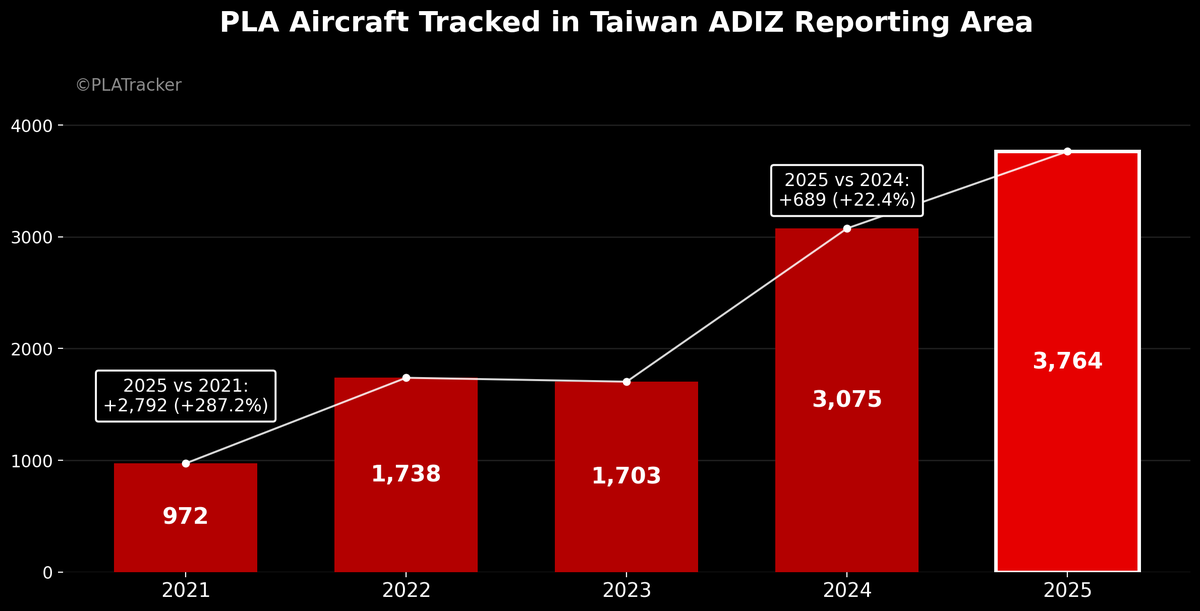
Thread detailing key trends in PLA air activity in Taiwan's ADIZ for 2025
Based on daily reports released by @MoNDefense, the total number of PLA aircraft tracked in Taiwan's ADIZ reporting area in 2025 was 3,764
+689 (+22%) from 2024
+2,792 (+287%) from 2021:
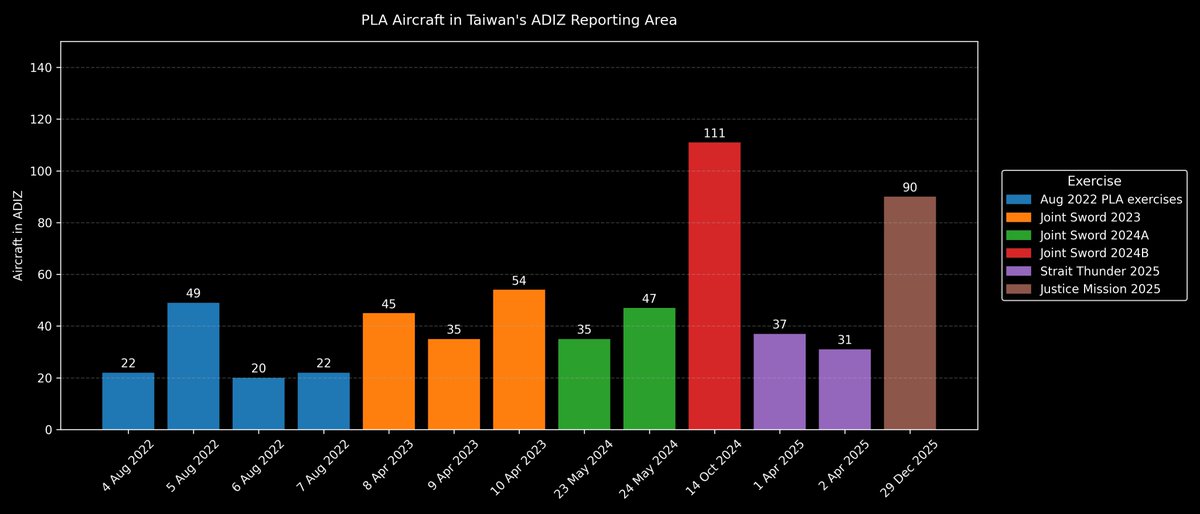
Here is a quick graphic comparing the number of PLA flights into Taiwan's ADIZ reporting area during major exercises, using data from @PLATracker.
The largest single-day total of sorties into Taiwan's ADIZ reporting area occurred on 14 Oct 24, during Joint Sword 2024B.
The PLA Eastern Theatre Command has announced Ex Justice Mission 2025 around Taiwan. The drills will include elements of the ETC Ground Force, Navy, Air Force, and Rocket Force.
Chinese state media has released a map showing five large exercise zones surrounding Taiwan.
Happy to share my newest article with @PLATracker, focusing on the expanding role of the U.S. Army's 1st Multi-Domain Task Force in the Philippines.
https://t.co/z4memuc0bd
In the piece, @CarsonKell27632 explains how the U.S. Army's Typhon battery in the Philippines fits into a new cutting-edge formation, one designed to counter the PLA's anti-access/area denial (A2/AD) network.
New from PLATracker:
Beyond the Typhon: 1st Multi-Domain Task Force and Sea Denial in the Philippines
Written by @CarsonKell27632
https://t.co/WCG9Izty3X