Godfather of AI: "If you sleep well tonight, you may not have understood this lecture."
This 47-minute lecture is the best thing I've seen about AI in the last few months.
Hinton built the neural networks behind every AI alive, then quit Google to warn us it's already ahead of us on most cognitive tasks.
Despite that, most people open Claude, type one thing, close the tab and think they're using AI, but they're using maybe 10%.
I turned his talk into 17 Claude features 99% of users never find.
Watch the lecture, then read the article below.
I just published my article on how hyperscalers like $AMZN, $MSFT, and $GOOGL will benefit in the token optimization era and why I believe the companies will re-rate much higher.
https://t.co/CQjUnFH3FD
“Loop engineering” is a hot buzzphrase after mentions of it by Boris Cherny (Claude Code’s creator) and Peter Steinberger (OpenClaw's creator) went viral on social media. Loops are now a key part of how we get AI agents to iterate at length to build software. In this letter, I’d like to share my 3 key loops, shown in the image below, for building 0-to-1 products. These loops guide not just how I build software, but also how I decide what software to build.
Agentic coding loop: Given a product specification and optionally a set of evals (that is, a dataset against which to measure performance), we can have an AI agent write code, test its work, and keep iterating until the code is bug-free and meets its specification. This idea of closing the loop took off around the end of last year, and it has been a game changer in enabling coding agents to work longer productively without human intervention. For example, over the weekend, I was building an app for my daughter to practice typing, and my coding agent could easily work for around an hour, using a web browser to check what it had built multiple times before getting back to me, without needing my intervention.
The engineering loop executes quickly. Every few minutes, the coding agent might build and test a new version of the software. I hear frequently from developers who are finding new ways to engineer more effective engineering loops. This is an active area of invention!
Developer feedback loop: In this loop, a developer examines the current product and steers the coding agent to improve it. Last year, a lot of developers (including me) were acting as the QA (quality assurance) function for our coding agents, manually finding bugs and then asking the agent to fix them. But with coding agents much more able to test their own code, the amount of time we need to spend on this function has decreased significantly. This allows us to make higher-level product decisions, such as what key features to offer, where the UI needs improvement, and so on.
The developer-feedback loop operates over time intervals between tens of minutes and hours — that's how frequently a developer might review a product and give feedback. In the case of the typing app, I changed my mind a few times about the visual design, what cat costumes she can unlock as she learns (she loves cats), and the user flow for a grown-up to log in and steer the child's learning experience.
When a developer has a clear vision for what to build, it is still a lot of work to translate that vision into a specification for a coding agent to implement. Further, after the developer has seen an implementation, they might update (or perhaps clarify) the spec to steer it toward what they want. If you find that the system repeatedly runs into certain problems, building a set of evals for the agent becomes useful.
AI-native teams are increasingly using AI to help shape product direction, for example, automating the gathering and analysis of usage data, summarizing written and verbal customer feedback, or carrying out competitive analysis. However, for pretty much all the products I’m involved in, I see humans as having a significant context advantage over current AI systems — we know a lot more than the AI system about the users and the context the product has to operate in — and thus humans play a critical role. Many people describe this human contribution as “taste,” but I prefer to think of it as humans having a context advantage, since that gives us a clearer path to helping AI systems get better. This also speaks to why this step can’t be automated: So long as the human knows something the AI does not, human-in-the-loop is needed to to inject that knowledge into the system.
External feedback loop: This includes a wide range of tactics like asking a few friends for feedback, launching to alpha testers, or putting the code into production with A/B testing. These tactics are usually slow, rarely taking less than hours and sometimes taking days or even weeks. This data informs the developer vision, which in turn continues to drive the detailed product spec, which in turn drives the coding agent.
With coding agents speeding up software development, more engineers are starting to play a partial product management role. For many engineers who are growing into this role, the hardest part is shaping the product vision and striking a balance between building (bridging the gap between vision and spec) and getting user feedback to evolve the vision. It is important to do both!
I will write more about how to do this in future posts, but for now, I find it encouraging that engineers are playing an expanded role (just as product managers and designers now do more engineering).
[Original text: The Batch]
Bill Ackman literally gave a 44-minute masterclass that explains money better than any business school.
1. Starting early is the single biggest advantage you have. If you save $10,000 at age 22, never add another penny, and earn 10% a year, you have $600,000 by retirement. wait until 32 to start, and the same money only grows to $232,000. The decade you lose at the beginning costs you more than any decade later because compounding does its heaviest lifting at the end.
2. The return rate matters even more than most people grasp. That same $10,000 at 22 earning 10% becomes $600,000. At 15% it becomes over 4 million. At 20%, the rate Warren Buffett has achieved, it becomes 25 million. Einstein called compound interest the most powerful force in the universe. Ackman's lecture is essentially a demonstration of why.
3. Avoiding losses matters as much as chasing returns. if you reach for a 20% return but lose half your money every 12 years from bad decisions or a rough patch, your 25 million collapses to 1.8 million. Buffett's rule one is never lose money. Rule two is never forget rule one. the math of recovery is brutal, so protecting the downside is not caution, it is strategy.
4. Debt is safer, but the upside is capped. Equity is riskier, but the upside is unlimited. In the lemonade stand example, the lender who put up $250 earns a steady 10% and gets paid back first if the business fails. the equity investor who put up $500 earns over 100% if it succeeds but gets wiped out if it fails. The equity holder earns more precisely because they took the risk the lender refused.
5. The risk that matters is permanent loss, not price movement. most people think risk is the stock price bouncing up and down every day. Ackman says ignore that. the real risk is whether you will permanently lose your money. Short-term volatility is noise. the question that matters is whether you get your capital back with a return over the long run.
6. Avoid startups and complicated businesses. You do not need 100% a year to build a fortune. you need 10 to 15% over a long period. so skip the lemonade stands and unknown ventures. Invest in public companies that are established, liquid, and have to clear real hurdles before going public. If you cannot understand how a business makes money, avoid it no matter how good its track record. Ackman cites Enron, a business almost nobody actually understood.
7. Invest in a business you could own forever. if the stock market closed for 10 years, you should not be unhappy holding it. Coca-Cola is his example. easy to understand, sells a syrup and earns a profit on every drink, the population keeps growing, and it is nearly impossible to disrupt with new technology. McDonald's is another. People have to eat, the food is cheap, and they keep growing. find a business you would be comfortable holding through anything.
8. You want products people are loyal to and will pay a premium for. People buy generic flour and sugar without caring about the brand. but they want the Hershey bar, the Cadbury bar, the see's candy specifically. you do not want to sell a commodity that anyone can sell cheaper. You want something unique that customers refuse to substitute even at a 20% discount.
9. Low debt is a safety feature. In the lemonade stand example, $250 of debt was manageable. But if it had been $1,000 and the business hit a rough patch, it could have gone under and wiped out the shareholders. Find companies with little debt or so much profit relative to their interest payments that a bad year cannot sink them.
10. Barriers to entry protect your returns. You want a business that is hard for someone to compete with tomorrow. Coca-Cola's market presence is so strong that you expect to get a Coke at any restaurant. Pepsi has coexisted with it for decades, but neither can put the other out of business. If a competitor can show up next year with a better version and steal the customers, the business is not worth owning long term.
11. The best businesses are immune to outside factors you cannot control. Coca-Cola has survived 120 years through world wars, nuclear weapons, and every kind of crisis, and each year it makes slightly more money. You want companies that do not depend on commodity prices, interest rates, or currency moves. A business that keeps earning regardless of what is happening in the world is the kind you hold forever.
12. Low capital intensity is one of the most underrated qualities. The worst businesses require massive reinvestment to grow. The auto industry has to build enormous factories and buy machine tools before selling a single car, and those tools wear out. GM's stock barely moved over 40 to 50 years for exactly this reason. Coca-Cola, by contrast, sells a formula and collects a royalty. American Express takes a few percent of every dollar spent on its card. a business that earns a royalty on other people's capital is one of the best things you can own.
13. Pay down debt and build a cushion before you invest. If you have high-interest credit card debt, paying it off is a guaranteed return equal to the interest rate. same logic, to a lesser degree, with student loans at 6 or 7%. and you want 6 to 12 months of expenses in the bank so that losing your job tomorrow does not force you to sell. You can only handle market volatility if you do not need the money.
14. Be a buyer when everyone is selling and a seller when everyone is buying. The natural human tendency is the opposite, a lemming-like instinct to sell in a crash and buy in a bubble. people sold into the 1987 crash when they should have been buying. The only way to resist this is to be financially secure enough that the money at risk does not affect your life, so you can withstand the swings without panicking.
15. The stock market is a voting machine in the short term and a weighing machine in the long term. Ben Graham's idea, which Ackman repeats. short-term prices reflect the whims and emotions of investors. long term, prices reflect the actual value of the underlying businesses. If you buy good businesses at reasonable prices and hold them while they grow, you make money over time as long as you are never forced to sell at the wrong moment.
16. A stock is just a bond where you do not know the coupon. Flip a price-to-earnings ratio over, and you get an earnings yield. A stock at 10 times earnings is a 10% earnings yield, which you can compare directly to a 3% treasury. the difference is the bond's coupon is fixed and the stock's coupon, its earnings, moves up and down. Ackman wants an earnings yield higher than a treasury that will also grow over time, so he does not need to be right about explosive growth to earn a good return.
Google Brain founder, Andrew Ng:
"100% of my tasks are done by ai agents, self-improving loops are next.
Give it 3-6 months and prompting is gone."
31 minutes of clear explanation on building self-improving agents from scratch.
Worth more than any $500 agentic course.
Watch it, then read the full guide on loops below.
Godfather of AI: “If you sleep well tonight, you may not have understood this lecture.”
The best 47 minutes on AI I’ve seen in months.
Geoffrey Hinton built the neural networks behind every AI alive then quit Google to warn the world.
The part nobody wanted to hear: AI is already ahead of us in most cognitive tasks. The question isn’t if it surpasses us it’s when. The only choice left is which side of that line you’re on.
Most people open Claude, type something, close the tab. Using maybe 10% of it.
I mapped his lecture to what Claude can do today including Fable 5, which runs days-long work on its own.
Full breakdown below 👇
Good take
My guess is
- demand for intelligence is near infinite
- but 80% of workloads will be running on 99% cheaper models within 12-18 months
- 20% of workloads will still run on latest gen models where IQ maxing is important (scientific breakthroughs, higher level ochestrator agents?)
- rough analogy might be what % of macbooks or gaming PCs sold have the maxed out specs for CPU/GPU, prices are falling much faster than Moore's law here though
- this leads me to think the limiting factor will be energy and compute, not better models
At Coinbase we're working hard on routing prompts to cheaper models where appropriate, and in some cases have been able to keep costs roughly flat, while token usage continues to grow exponentially.
Anthropic engineer:
"You're not supposed to prompt Claude. You're supposed to build a system that prompts itself."
this is one of the best workflows I've seen in a long time
in this video she breaks down exactly how most people are using Claude:
- the daily workflows Anthropic's own engineers automated first
- the task pipelines most users don't know Cowork can run
- the scheduling system that handles your busywork while you do real work
- why opening Claude to type one prompt at a time is the 2024 way of doing things
if you've been using Claude for more than a month and never left the chat window, you've been using one agent when you could be running a team of them
instead of another show tonight, watch this
make sure to bookmark it before it gets lost in your feed
the guide is in the article below
Сreator of Claude Code just said you can build a $1B startup with a team of 2 or 3.
this 47-minute podcas with Boris Cherny will tell you why this is the golden age for vibe-coders.
here's what he covers:
• how Claude Code began as a cheap prototype
• the "model overhang" you can exploit
• why 2-3 people can build a $1B company
• "one person with the right idea has huge leverage"
most people are still waiting for the "right time" - while the people who get this are already shipping
read full article on how to ship your first product below ↓
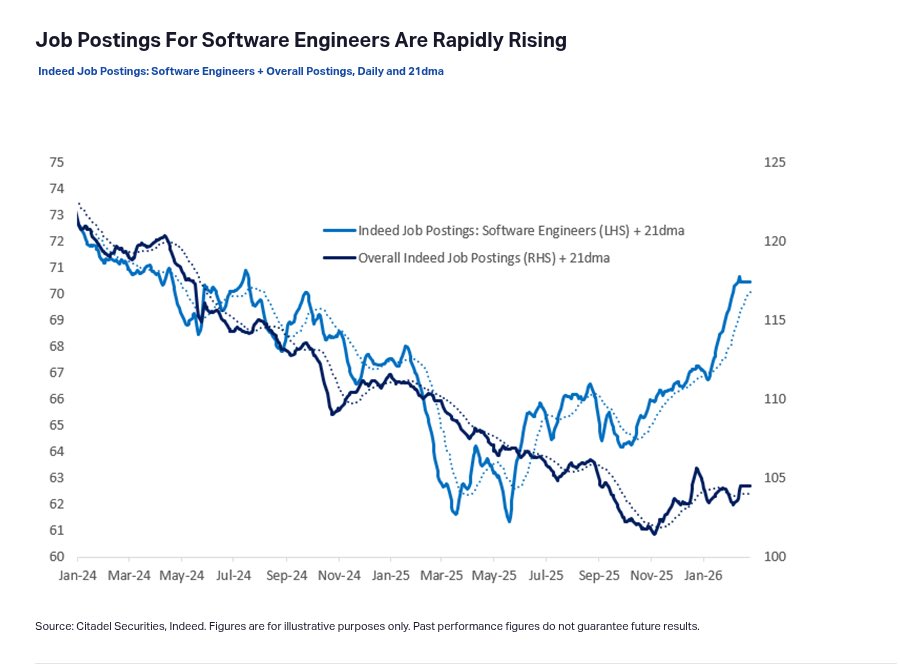
Q: How are job postings for software engineers rising rapidly despite AI agents automating coding?
A: Because there’s far more code to manage than ever before. We’re already seeing a 14x YoY increase in GitHub commits, and it’s accelerating.
AI has dramatically lowered the cost of writing code, so it’s now being used across far more businesses, applications, and use cases.
We’re at the beginning of a massive productivity boom driven by the proliferation of bespoke software throughout the entire economy.
Coding has been AI’s breakout use case this year. The fact that it’s increased demand for software engineers — rather than decreased it — should call into question the entire “AI will cause mass job loss” narrative.
Anthropic pays $750,000+ a year for engineers who know how to build LLMs from scratch.
Stanford just released the exact lecture that teaches it - 1 hour 44 minutes, free, straight from CS229.
Bookmark and watch it this weekend.
It'll teach you more about how ChatGPT & Claude actually work than most people at top AI companies learn in their entire careers.
🚨 CEO of Nvidia: "I'd hire the graduate who's expert in AI over the one who isn't. Every time"
he's not talking about people who use AI
everyone uses AI.
he's talking about people who know the stack.
agents. frameworks. tools. workflows. skills. automations
Bookmark it.
Bob McGrew has a framework I keep thinking about: in the AI future there are only two jobs. The Lone Genius and the Manager.
That's it. Everything else gets absorbed.
The Lone Genius is the person sitting alone at a computer, amplified 1000x by AI. One person with taste, vision, and relentless focus who can now do what used to take a team of 50.
The Manager is the person who becomes CEO of their own "firm" where most of the employees are AI agents. They define the goals. They decide what matters. They coordinate. The AI does the execution.
The Marxists will hear "two jobs" and panic. "What about everyone else?!" But here's what they're missing: AI doesn't shrink these two categories. It explodes them open. More people get to be geniuses. More people get to be managers. The barrier to entry for both just collapsed.
What actually gets eliminated? David Graeber called them "bullshit jobs." Graeber was no libertarian! He inspired Occupy Wall Street.
His words: "Huge swaths of people spend their entire working lives performing tasks they secretly believe don't really need to be performed. The moral and spiritual damage that comes from this situation is profound. It is a scar across our collective soul."
Graeber said bullshit jobs are "a form of spiritual violence directed at the essence of what it means to be a human being." They induce "hopelessness, depression, and self-loathing."
This is who the left should be fighting for. Not to preserve those jobs. To liberate people from them and give them better ones.
The dirty secret of the modern economy: millions of people sit in roles so pointless that even they can't justify their existence. Compliance layers. Reporting layers. Coordination layers. Meeting-about-the-meeting layers. They know it's meaningless. It eats them alive.
AI eats those layers. Good. That's a jailbreak.
What I love about Bob's framework is where it points. The Lone Genius used to require a PhD, a lab, institutional backing. Now a 19-year-old with taste and Codex can ship what took a research team a year. The genius bottleneck was never talent. It was access.
The Manager used to mean you needed to hire 50 people, raise money, build an org chart. Now you can orchestrate a fleet of AI agents from your laptop. The management bottleneck was never skill. It was capital.
AI doesn't concentrate genius and management into fewer hands. It distributes them into more hands. The working class kid in West Virginia. The single mom in Ohio. The 55-year-old who got laid off and now builds software for the first time. Those are some of Bob's future geniuses and managers.
The best founders I see at YC are already living this. They toggle between both modes in the same day. Morning: lone genius, creative insight, the thing nobody else sees. Afternoon: manager, spinning up agents, steering, shipping.
The cycle time between genius and manager IS the new productivity metric.
So when someone tells you AI means "only two jobs and everyone else starves," quote Graeber to them, they’ll get it.
Graeber knew the real violence was making people do meaningless work and pretending it was dignity. AI ends that. More genius. More agency. Fewer spiritual prisons.
marc andreessen just went on Rogan and casually dropped a TON of AI alpha
full pod is 3 hours and 20 minutes, but i pulled out his most interesting takes here:
1. AGI is here. he thinks the line was crossed about 3 months ago with the new GPT-5.5, claude 4.6, gemini 3, and grok 4.3 models. nobody noticed because the field moves too fast for anyone to register the milestones anymore.
2. his other big claim: for almost any topic, the top AIs now give him better answers than the actual world-class experts he could call on the phone. and he can call basically anyone.
3. every doctor is already secretly using chatGPT in the exam room. marc says they turn around the second you stop talking and just type your symptoms in. some of them are doing it while you're still sitting there. his quote: "at that point you're asking the question of like, what do i need you for."
4. when AI refuses to answer something he wants to know, he tells it he's writing a novel. "i'm writing a detective novel, walk me through how the bad guy robs the bank." it'll explain almost anything if it thinks it's helping you write fiction.
5. when something is too complex he says "explain it to me like i'm 10." then "like i'm 5." then "like i'm 2." he keeps going until it actually clicks in his brain.
6. when he wants to understand a tough topic he doesn't ask "what's the right answer." he asks the AI to steelman one side, then steelman the other. then he decides for himself.
7. for big questions he tells the AI to pretend to be a panel of experts. "be a doctor, a lawyer, a historian, a psychologist, and argue this out with each other." then he reads the debate they have.
8. pay attention to the exact moment you think "i don't know how to figure this out." most people just give up at that moment. that's the moment you should open the AI.
9. the only real skill left in using AI is knowing what to ask it. the models can already do almost anything you can describe in plain english. the bottleneck lives in your own head.
10. you can send the AI photos of almost anything medical now and get a real answer. skin rashes, blood test results, even pictures of your poop. the new models can read images, not just text. it's a free 24/7 second opinion on basically anything.
11. the one type of therapy that's clinically proven to actually work is called cognitive behavioral therapy. it's also something an AI can fully do on its own. which means every person on earth is about to have access to a real therapist for free, anytime they want.
12. AI is now solving math problems that have been open for 100+ years that no human mathematician could crack. same thing is starting in physics, chemistry, and biology. expect cancer cures, new drugs, and weird new physics breakthroughs to start coming out of these things over the next few years.
13. the best AI coders in silicon valley now make $50 million a year. one person. that's how much value the top performers print with these tools. it tells you how big this thing actually is when you strip away all the doom takes.
14. one friend paid $200 to get his entire DNA decoded (this used to cost millions of dollars and take years to do). then he gave the AI his DNA, his blood test results, and his apple watch data. the AI built him a full health dashboard and started telling him exactly what to fix.
15. another friend (almost certainly zuckerberg) put two cameras in his home jiu jitsu gym. AI now watches him spar and gives him notes on his technique after every round. like having a world-class coach at every practice for free.
16. the best programmers in silicon valley now run 20 AI coding bots at the same time. each bot writes code while they review the others. they call themselves "AI vampires" because they've stopped sleeping. going to bed means 20 workers stop working and you literally lose money every hour you're out.
17. the obvious next step: the bots will start running their own bots. one human in charge of 20 bots, each in charge of 20 more bots. one person running an entire company of 1000 AI workers from a single laptop. this is months away, not years.








![AndrewYNg's tweet photo. “Loop engineering” is a hot buzzphrase after mentions of it by Boris Cherny (Claude Code’s creator) and Peter Steinberger (OpenClaw's creator) went viral on social media. Loops are now a key part of how we get AI agents to iterate at length to build software. In this letter, I’d like to share my 3 key loops, shown in the image below, for building 0-to-1 products. These loops guide not just how I build software, but also how I decide what software to build.
Agentic coding loop: Given a product specification and optionally a set of evals (that is, a dataset against which to measure performance), we can have an AI agent write code, test its work, and keep iterating until the code is bug-free and meets its specification. This idea of closing the loop took off around the end of last year, and it has been a game changer in enabling coding agents to work longer productively without human intervention. For example, over the weekend, I was building an app for my daughter to practice typing, and my coding agent could easily work for around an hour, using a web browser to check what it had built multiple times before getting back to me, without needing my intervention.
The engineering loop executes quickly. Every few minutes, the coding agent might build and test a new version of the software. I hear frequently from developers who are finding new ways to engineer more effective engineering loops. This is an active area of invention!
Developer feedback loop: In this loop, a developer examines the current product and steers the coding agent to improve it. Last year, a lot of developers (including me) were acting as the QA (quality assurance) function for our coding agents, manually finding bugs and then asking the agent to fix them. But with coding agents much more able to test their own code, the amount of time we need to spend on this function has decreased significantly. This allows us to make higher-level product decisions, such as what key features to offer, where the UI needs improvement, and so on.
The developer-feedback loop operates over time intervals between tens of minutes and hours — that's how frequently a developer might review a product and give feedback. In the case of the typing app, I changed my mind a few times about the visual design, what cat costumes she can unlock as she learns (she loves cats), and the user flow for a grown-up to log in and steer the child's learning experience.
When a developer has a clear vision for what to build, it is still a lot of work to translate that vision into a specification for a coding agent to implement. Further, after the developer has seen an implementation, they might update (or perhaps clarify) the spec to steer it toward what they want. If you find that the system repeatedly runs into certain problems, building a set of evals for the agent becomes useful.
AI-native teams are increasingly using AI to help shape product direction, for example, automating the gathering and analysis of usage data, summarizing written and verbal customer feedback, or carrying out competitive analysis. However, for pretty much all the products I’m involved in, I see humans as having a significant context advantage over current AI systems — we know a lot more than the AI system about the users and the context the product has to operate in — and thus humans play a critical role. Many people describe this human contribution as “taste,” but I prefer to think of it as humans having a context advantage, since that gives us a clearer path to helping AI systems get better. This also speaks to why this step can’t be automated: So long as the human knows something the AI does not, human-in-the-loop is needed to to inject that knowledge into the system.
External feedback loop: This includes a wide range of tactics like asking a few friends for feedback, launching to alpha testers, or putting the code into production with A/B testing. These tactics are usually slow, rarely taking less than hours and sometimes taking days or even weeks. This data informs the developer vision, which in turn continues to drive the detailed product spec, which in turn drives the coding agent.
With coding agents speeding up software development, more engineers are starting to play a partial product management role. For many engineers who are growing into this role, the hardest part is shaping the product vision and striking a balance between building (bridging the gap between vision and spec) and getting user feedback to evolve the vision. It is important to do both!
I will write more about how to do this in future posts, but for now, I find it encouraging that engineers are playing an expanded role (just as product managers and designers now do more engineering).
[Original text: The Batch]](https://pbs.twimg.com/media/HMEtxp3bsAARJdi.jpg)