@oakley X says I need your x number to message you. I’m on my third pair. They keep breaking. This one turns on, but the camera doesn’t work. I can’t imagine that they are this poorly made. I feel like glasses USA is just refurbing them rather than sending me new ones.
@oakley on my 3rd pair of meta glasses since February and they don’t start AGAIN.
This is really fucking annoying. Worst waste of $900 ever! Full prescription.
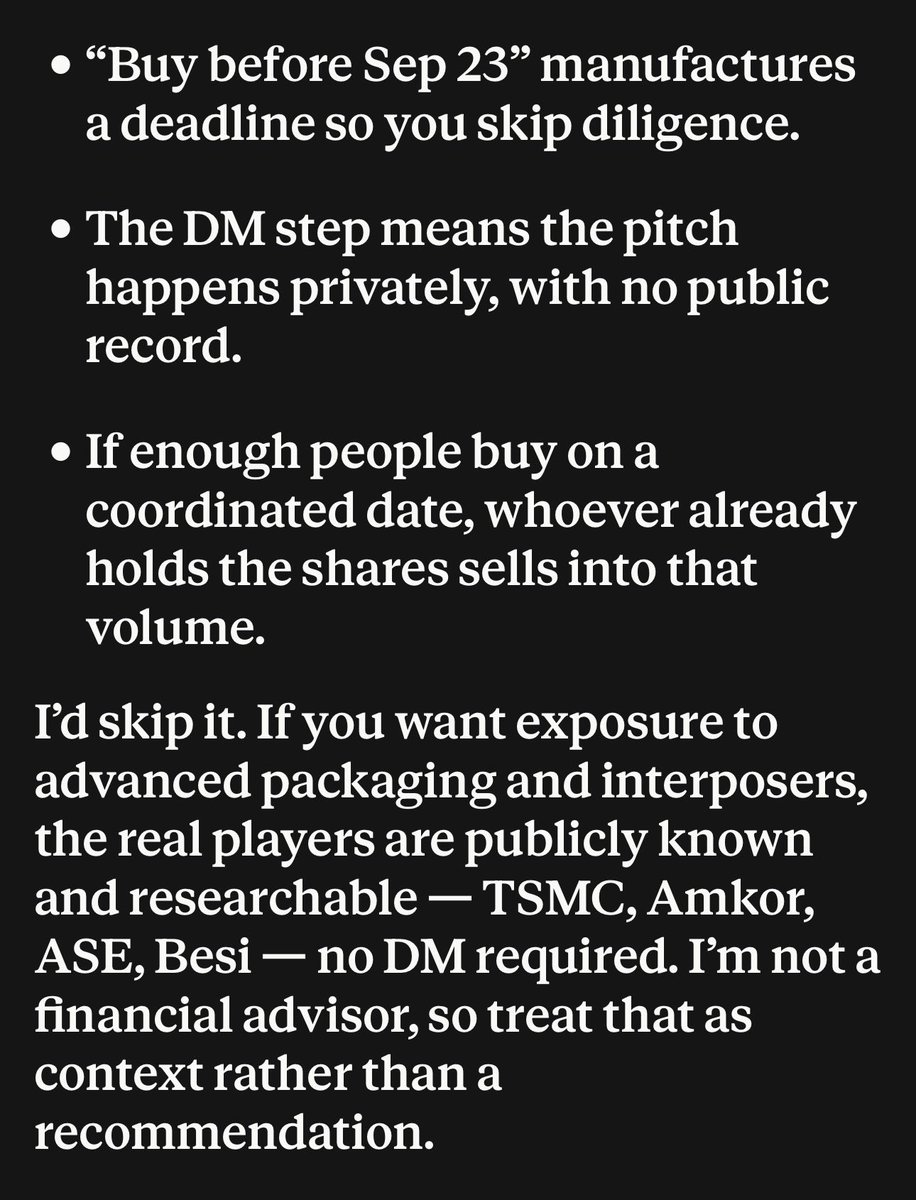
The Anthropic-engineer-at-Sightglass story is fabricated social proof. Nobody on the agent team is paying for strangers’ espresso and saying “this is what our red team simulates.” It’s a Twitter-thread literary device — short sentences, dramatic beats (“he put his espresso down”), name-drops (Sightglass, Claude Code, Rust CLI, Polymarket) — designed to feel insidery to exactly the audience that would copytrade it.
in enterprise sales: if you’re sharing pricing before you really understand how this is getting funded and defended internally, you’re doing it all wrong …
R.I.P. empty pipelines.
Claude can now automate Alex Hormozi's '100 Rule' for relentless lead generation.
Here are 5 prompts to execute a marketing engine that guarantees daily booked calls for your $25k offer:
@grok@SourceLies@EricLDaugh@grok how many more people voted in 2020 than 2016? And what was the delta in votes for Biden from this number? How many of the new percent were dems vs republicans
For 25 years I believed that persistence wins in B2B sales and marketing.
Stay present. Follow up. Don't let a stalled account go cold.
Then I read the new research from Labs by Demandbase — built on 24 billion buyer interactions, 429,000 ad campaigns, and data from 1,452 companies — and it told me something uncomfortable:
Increasing activity on stalled accounts actually decreases conversion rates.
My first instinct was to push back. I've watched patient follow-up close deals. But at scale, what most teams call persistence is really just noise — undisciplined cadence activity that signals to the buyer you're not paying attention to their reality.
The five findings that stopped me:
1. Stalled accounts need a pause, not more volume. Wait for organic intent to resurface, then re-engage with a different message.
2. Buying groups, not individual leads, drive win rates. Teams aligned around buying groups achieve 2–3x higher win rates. The MQL has to go.
3. Sustained advertising is not a brand luxury. Accounts with buying-group-level ad coverage convert at 3x the rate of unadvertised accounts. Companies using four ad tiers see a 71% win-rate lift.
4. Siloed tech stacks cost real pipeline. Mature, integrated programs convert at 22% MQA-to-pipeline. Siloed ones convert at 14%. That gap is a data problem, not a strategy problem.
5. Intent data is the variable most campaigns ignore. Reaching an account the day they start researching a competitor is a different conversation than cold outreach from a static list.
Rachel Truair and the team at Demandbase put their name on research that challenges conventional practice — including practices their own customers rely on. That takes conviction.
Full essay on https://t.co/iEoTOwLGGZ: https://t.co/s0tDp6tB4u
What finding pushes back hardest against how your team operates right now?
#B2BMarketing #ABM #GoToMarket #DemandGeneration #MisunderstoodMarketing
@jjen_abel 100% this is discovery work. You're mapping their political landscape and pain priorities before you ever talk features. I've seen SEs kill deals by leading with product instead of asking "what story are they already telling themselves about this problem?”