🔥BREAKING: Wall Street successfully tests 5-second Treasury settlements on the XRP Ledger.
A new cross-border tokenized redemption pilot was just completed by a powerhouse lineup:
🔹 JPMorgan
🔹 Mastercard
🔹 @OndoFinance
🔹 @Ripple
By cutting settlement times down from 3–5 business days to a mere 5 seconds, this test highlights the massive efficiency gains tokenization brings to traditional banking rails.
A quantum migration shouldn't force you to re-issue tokenized assets or re-paper every system that references your accounts.
On Stellar, the account will keep its address and history. Only the signing key changes while the holdings and integrations around them stay put.
How that's possible:
https://t.co/eeVmi87BMu
The speed of XRP’s growth will shock everyone.😶🌫️
Years ago, Ripple ran a pilot for XRP-based payments across the U.S. to Mexico corridor.
The pilot succeeded.🤝
Every participant saw positive results. And one detail stood out above everything else.
Mexican banks asked Ripple to SLOW DOWN the payments. 🙇♂️
XRP was processing transactions FASTER than the banks could handle on their end.💨
Think about that.
XRP settles a standard bank transaction before the bank itself can finish processing it.💯
That was one corridor.
Ripple has payment corridors mapped across the globe. 🌎
When XRP is activated across ALL of them, the volume and velocity of settlements will be unlike anything the banking system has ever operated at before.☝️
The same way Mexican banks were introduced to a new standard of speed in that pilot, financial institutions worldwide will experience that same upgrade at scale.📈
Processing speeds they have never had access to.
Settlement windows that free up capital faster.
Efficiency the current system has been waiting for.
XRP will sit at the center of that upgrade.🌐
Moving faster than anyone can comprehend.😏💨
Listen closely.👇
2/6 Tokenized assets on-chain went from basically nothing two years ago to tens of billions today (according to https://t.co/GQrvYvL3Df data), against a traditional market measured in trillions.
Asheesh's read: blockchain ends up like the internet. Invisible infrastructure nobody thinks to ask about.
1/6 @ashgoblue sat down with @FintechFrank on the @GSR_io podcast to break down what it actually takes to move financial markets on-chain.
Start here: why XRP? It moves tokenized value efficiently and has an exchange built into the ledger. But the real moat is the years of licensing and bank connections Ripple laid down. That connective tissue to the real world can't be shortcut. 🧵👇
This content is for informational purposes only and does not constitute investment advice. Digital assets involve risk, including potential loss of principal. Learn more about Evernorth: https://t.co/f1nPiu5BZ8
INSIGHT: @Ripple launches a developer toolkit for building agentic payment apps on the XRP Ledger, with support for autonomous AI transactions using $XRP and $RLUSD.
1/5 Total tokenized real-world assets on the XRP network reached $4.18 billion market cap last month — up roughly 28x in 12 months.
Here's what's inside the number.🧵👇
This content is for informational purposes only and does not constitute investment advice. Digital assets involve risk, including potential loss of principal. Learn more about Evernorth: https://t.co/f1nPiu69OG
As AI agents begin transacting on behalf of businesses, payments need more than speed. They need trust, controls, and clear rules for how value moves.
We're helping build the infrastructure for trusted agent-driven payments, with the XRP Ledger and $RLUSD helping lay the foundation for the future of commerce.
We're pleased to be part of the ecosystem supporting @Mastercard's Agent Pay for Machines initiative, helping validate new use cases, establish common rules, and accelerate adoption.
→ https://t.co/KHUcHqblXg
As AI agents begin to act, payments move into the background — at machine speed and massive scale.
Today we’re introducing Mastercard Agent Pay for Machines — bringing structure, governance, and trust to this new class of payments.
Launching with 30+ partners to bring this to life from day one.
This isn’t just more payments. It’s a new operating model for commerce.
👉 Learn more: https://t.co/TeS6Lj8jLO
Stellar unveils its quantum defense plan
Stellar (@StellarOrg) just put a date on the quantum problem. Every account gets quantum-safe keys by the end of 2027, same address, no migration. Enterprise wallets can switch as early as this year.
Research the foundation (@BuildOnStellar) cites suggests that cracking Stellar's cryptography needs far fewer qubits than previously thought, and NIST has pulled its danger zone forward to 2029.
The last stage is the big one: a future cutoff where old keys stop working entirely. Dormant accounts could be locked forever.
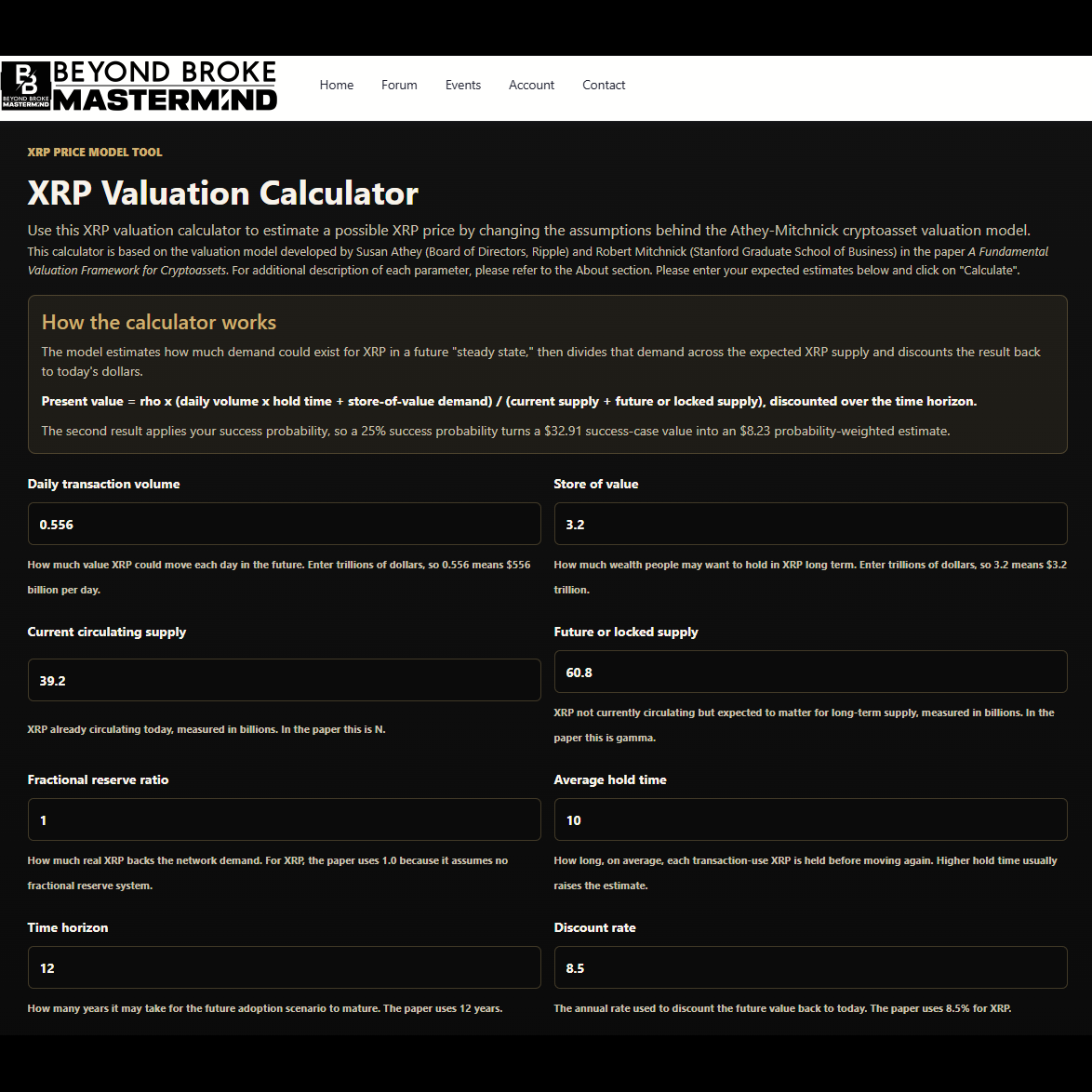
We recreated Robbie Mitchnick's XRP valuation calculator on the BBMM site:
https://t.co/qCCeImDGit
Try this XRP valuation calculator to estimate a possible XRP price by changing the assumptions behind the Athey-Mitchnick cryptoasset valuation model
🚨 EVERYTHING THAT COULD GO WRONG FOR MARKETS WENT WRONG TODAY.
S&P 500 down -1.65%, wiping out $1.14 trillion.
Nasdaq down -2.60%, wiping out $1.11 trillion.
Gold down -3.38%, wiping out $1 trillion.
Silver down -6.9%, wiping out $280 billion.
Bitcoin down -6.31%, wiping out $80 billion.
In total $2.5 TRILLION wiped out in a single session. These were not isolated moves. Everything started breaking at the same time.
It started with the jobs report this morning.
The US economy added 172,000 jobs in May. Wall Street expected 88,000. That is almost double.
On any normal day, strong jobs is good news. But inflation is already at 3.8% and oil is sitting at $90. A labor market this strong tells the Fed it cannot cut interest rates and may actually need to raise them.
The probability of a rate hike this year went from 40% to 57% in a single day. That spooked every investor holding tech and growth stocks because higher rates mean those stocks are worth less today.
Then the AI trade started cracking.
Yesterday Broadcom reported record earnings: revenue up 48%, AI chip sales up 143% and the stock still crashed 12.6%. The reason was simple.
Broadcom did not raise its AI revenue targets for the year. Investors had expected it to. That single miss made people ask a question they had been avoiding for months: are we paying too much for AI stocks?
That question got louder today when a research firm called SemiAnalysis revealed that Nvidia's next-generation AI chips will need significantly less memory than everyone assumed, roughly half of what the market was pricing in.
Memory chips are what companies like SK Hynix and Samsung make. SK Hynix fell nearly 10% today. Samsung fell over 6%.
South Korea's entire stock market crashed 5.5% in a single session. Japan's semiconductor stocks did the same.
And then Anthropic added fuel to the fire by publishing a report warning that AI is getting close to the point where it can improve itself without human help and calling for a global pause in AI development.
Coming on the same day as the memory demand news and Broadcom's miss, it fed a single growing fear across the market: what if the AI boom is moving faster than the business models can keep up with?
Underneath all of this, there is a liquidity problem nobody is talking about.
SpaceX goes public next week at a $1.75 trillion valuation. Anthropic just filed to go public. OpenAI is next.
These three companies together are worth $4 to $5 trillion. Fund managers need cash to buy into these listings.
But cash levels are already at their lowest since early 2024. The only way to raise cash is to sell what they already own. That selling is happening right now.
The new Fed Chair Kevin Warsh will also hold his very first policy meeting in 11 days. He was appointed by Trump with the expectation of cutting rates.
He is now walking into a situation where inflation is high, oil is high, and the job market is running hot. Investors do not know what he will do.
When nobody knows what the most powerful central banker in the world will decide in less than two weeks, the safest move is to reduce risk today.
Everything that could go wrong, went wrong at the same time. A hot jobs report, a collapsing ceasefire, a crack in the AI trade, a trillion dollar liquidity drain, and a Fed meeting with no clear outcome.