1/2
The Dual Orexin Receptor Antagonists seem to work well for many pts with #MECFS#LongCovid.
Daridorexant is approved in Germany, quite expensive (one month package about 90 EUR).
Vornorexant is approved in Japan and cheaper (100 pills a 10 mg=150 EUR)
Even better... --> 2/2
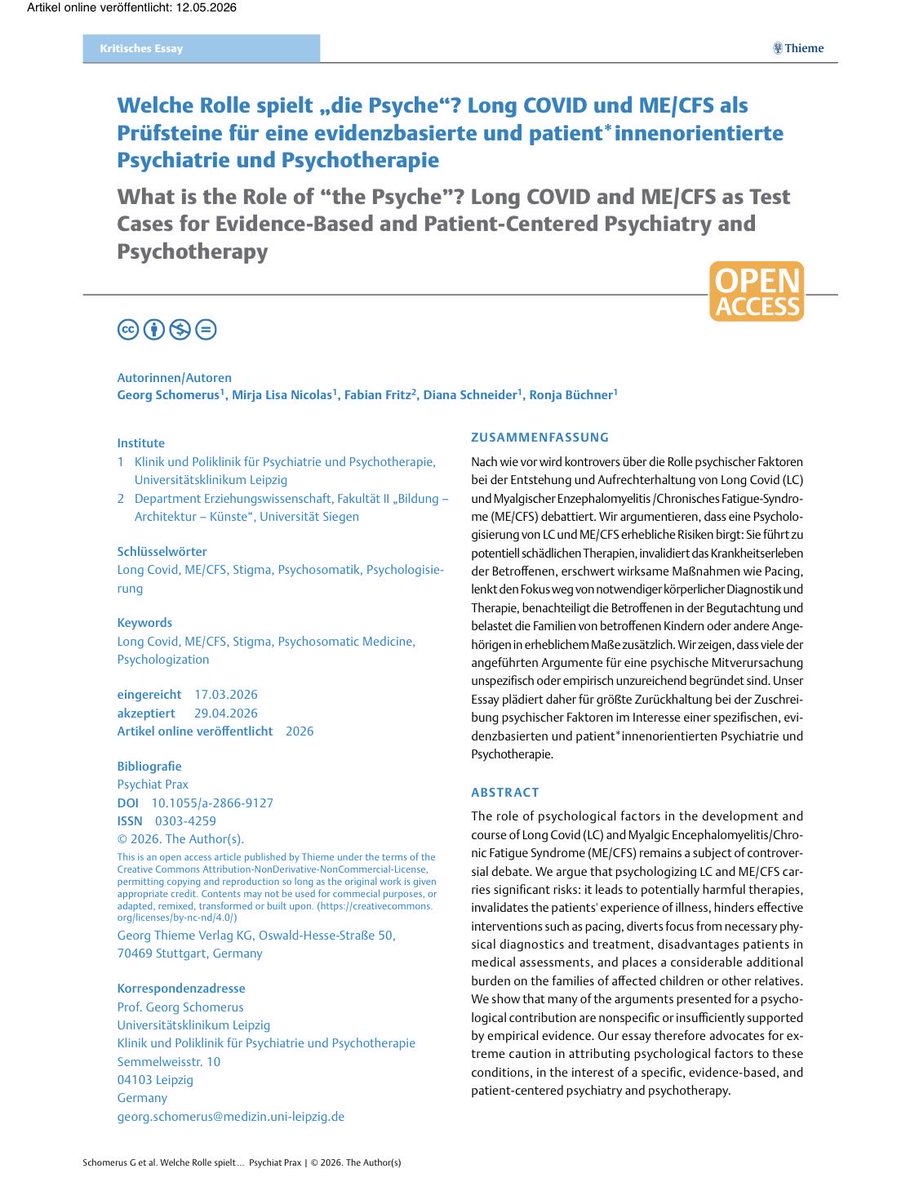
Our paper is out- a critical essay (🇩🇪 language): What is the Role of "the Psyche"? Long COVID and ME/CFS as Test Cases for Evidence-Based and Patient-Centered Psychiatry and Psychotherapy.
@geschom Mirja Lisa Nicolas, Fabian Fritz, Ronja Büchner
https://t.co/A4kKbNjQZA
This is maybe the single best trial in Long COVID.
I submitted an application requesting a keytruda trial in Long COVID 3 years ago and it was initially rejected as a suggestion.
I know multiple anecdotes of cancer patients achieving remission of Long COVID after Keytruda.
NIH researchers shared new progress on long COVID.
Four treatments low-dose naltrexone, baricitinib, GLP-1 agonists and stellate ganglion block are now moving into clinical trials to ease symptoms like fatigue and brain fog.
https://t.co/MocGAwRPGz
1/8) We are excited that our paper has been published with lead author @maxinewaters250 and @dbkell
In this study, we investigate Post-Vaccination/Post-Infection Syndrome (PV/PIS) and its underlying biology.
🔗 https://t.co/RjREJW9Jef
Eine japanische Forschergruppe untersucht das #PostVac Syndrom in Nature Scientific Reports
Characterizing persistent Post-COVID-19 vaccination symptoms using MedDRA system organ class and preferred term classifications
https://t.co/c9i4VUWQPZ
⚠️🦠The surge in meningitis and other invasive infections following the COVID-19 pandemic is increasingly understood not just as a result of "immunity gaps" from lockdowns, but as a direct biological consequence of how the SARS-CoV-2 virus interacts with the human body.
Research from 2024 through early 2026 has identified several specific physiological mechanisms—ranging from the degradation of physical barriers to long-term immune remodeling—that explain why individuals may be more susceptible to bacterial and viral pathogens after a COVID-19 infection.
1. Disruption of the Blood-Brain Barrier (BBB)
The most direct link to meningitis is the virus's impact on the brain's protective lining. SARS-CoV-2 doesn't just affect the lungs; it significantly compromises the integrity of the Blood-Brain Barrier.
* Increased Permeability: The virus increases the expression of matrix metalloproteinase-9 (MMP-9), an enzyme that degrades type IV collagen in the basement membrane of the BBB.
* Endothelial Damage: By infecting neurovascular cells, the virus triggers "mast cell activation" and restructuring of the cellular cytoskeleton. This creates "gaps" in the barrier that normally keep bacteria like Neisseria meningitidis (meningitis) out of the central nervous system.
* Trojan Horse Entry: COVID-induced inflammation increases the transmigration of infected or activated leukocytes. These cells can "carry" secondary pathogens across the weakened BBB into the brain.
2. Mucosal Barrier Breakdown and "Ciliary Loss"
Bacteria that cause meningitis often live harmlessly in the nasopharynx (the upper part of the throat). For these bacteria to become "invasive" and enter the bloodstream, they must bypass the mucosal immune system.
* Mechanical Failure: SARS-CoV-2 causes ciliary loss—the destruction of the tiny hair-like structures that sweep bacteria and mucus out of the airways. Without this "escalator," bacteria can settle and colonize the tissue more deeply.
* Epithelial "Leaking": The virus damages tight junctions (the "glue" between cells) in the respiratory lining. This allows bacteria to slip between cells and enter the bloodstream, a prerequisite for bacterial meningitis and sepsis.
3. Systematic Immune Dysregulation (T-Cell Exhaustion)
While the "immunity gap" theory focuses on a lack of exposure, the "immune dysregulation" theory focuses on the damage done by the virus to the immune system's architecture.
* T-Cell Exhaustion: Post-COVID patients often show signs of "T-cell exhaustion," a state where T-cells (the "generals" of the immune system) are functionally impaired and express high levels of inhibitory receptors. This limits the body's ability to mount a rapid defense against secondary viral and bacterial threats.
* Lymphopenia: SARS-CoV-2 frequently causes a drop in total lymphocyte counts. Studies in 2025 have shown that even 12 months after a "mild" infection, some patients retain a signature of immunological hypofunction, making them significantly more likely (up to 46% more likely in some cohorts) to test positive for non-SARS-CoV-2 infections.
* Interferon Suppression: The virus is highly effective at suppressing Type I and III interferon responses. These interferons are the body's first line of defense against both viruses and bacteria; when they are "dampened," the threshold for a secondary infection to take hold is much lower.
1/2
Vaccines save millions of lives.
Unfortunately, a small fraction of people develop debilitating diseases after vaccination.
Thank you @WSITYpod for having me on the show to discuss post-vaccination syndrome. Please listen and understand what the patients are going through and why many of them lost trust in the medical and scientific establishment. We must do better.
#HAMBURG#HELP#HILFE Mir geht die ganze Zeit im Kopf herum, wie man @ChrZacharias jetzt helfen kann? 😭 In dem Krankenhaus (Altona) kann er nicht bleiben, er soll nach Lübeck, laut Artikel, das bedeutet für die 82 jährige Mutter über 3 Stunden Fahrt. Wir brauchen eine Einrichtung in HH für ihn, die ihn aufnimmt und die ihn engmaschig betreuen kann, unter diesen schlimmen Umständen. @ninawarken Wo sollen schwerst Betroffene hin? Gibt es jemanden, der/die in Hamburg helfen kann? Auch 24/7 h Assistenz fiel als Vorschlag. Diese Assistenz müsste aber beantragt werden und eingearbeitet werden #HilfeFuerChristian #Dringend
This tribute truly brought tears to my eyes. What a beautiful and loving way to honor your friend, who endured the unimaginable with very severe #MEcfs.
https://t.co/BUsNopPL9T
🖤
To do this, we have created a short (~5 min) survey, open to English-speakers age 18 years or older from any country who is:
• A patient with diagnosed or suspected MCAS, OR
• A carer of a patient(s) with diagnosed or suspected MCAS
Link: https://t.co/eP6qhwv884