🚀Poster Session 6 has started at FENS 2024! Do not miss to visit these four exciting posters:
📌 Poster #435
"Next-Generation Electrophysiology for Functional Characterization of Human Neural Organoids"
👤Presented by Dr. Laura D'Ignazio, Senior Key Account Manager at MaxWell Biosystems
📌 Poster #424
"The Importance of High-Density Microelectrode Arrays for Recording Multi-Scale Extracellular Potential and Label-Free Characterization of Network Dynamics in iPSC-Derived Neurons"
👤Presented by Francesco Modena, Data Scientist at MaxWell Biosystems
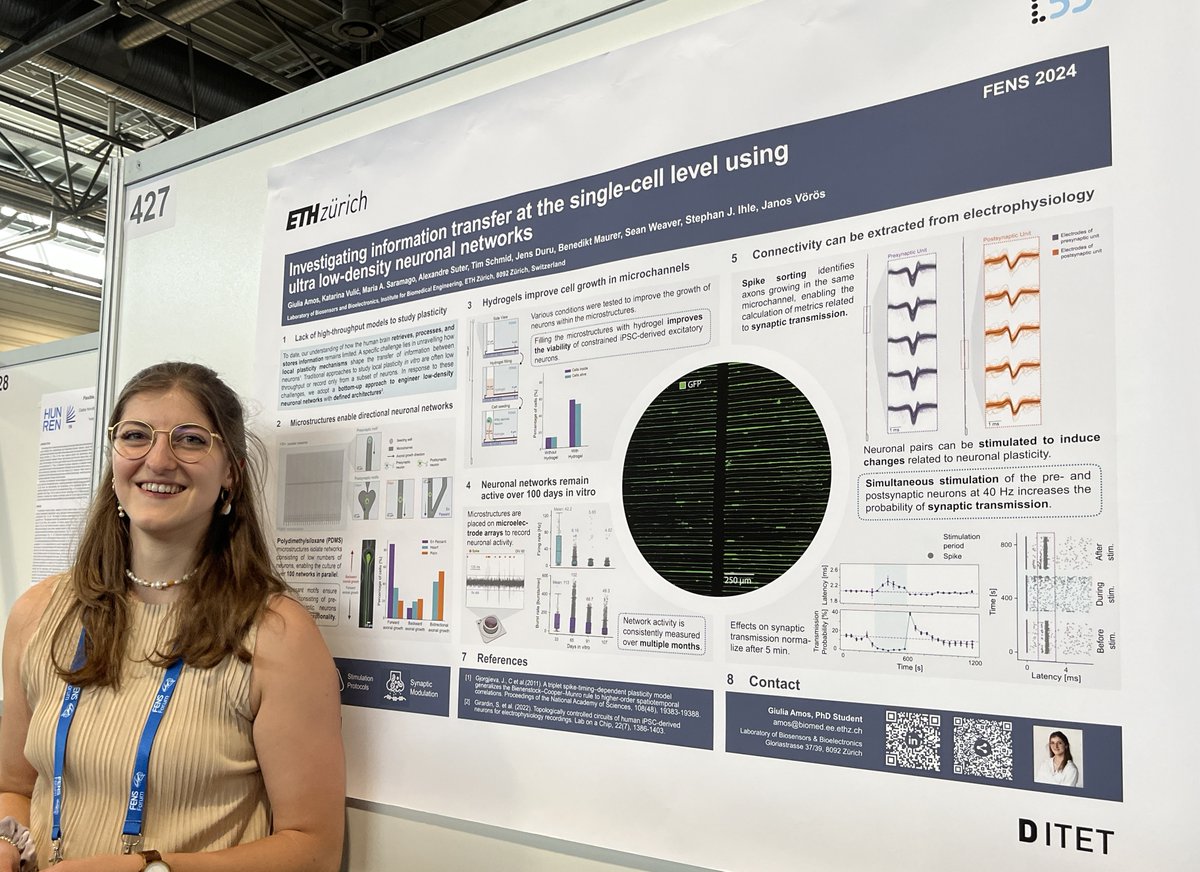
📌 Poster #427
"Investigating information transfer at the single-cell level using ultra low-density neuronal networks"
👤Presented by Giulia Amos, PhD student @ETH_en
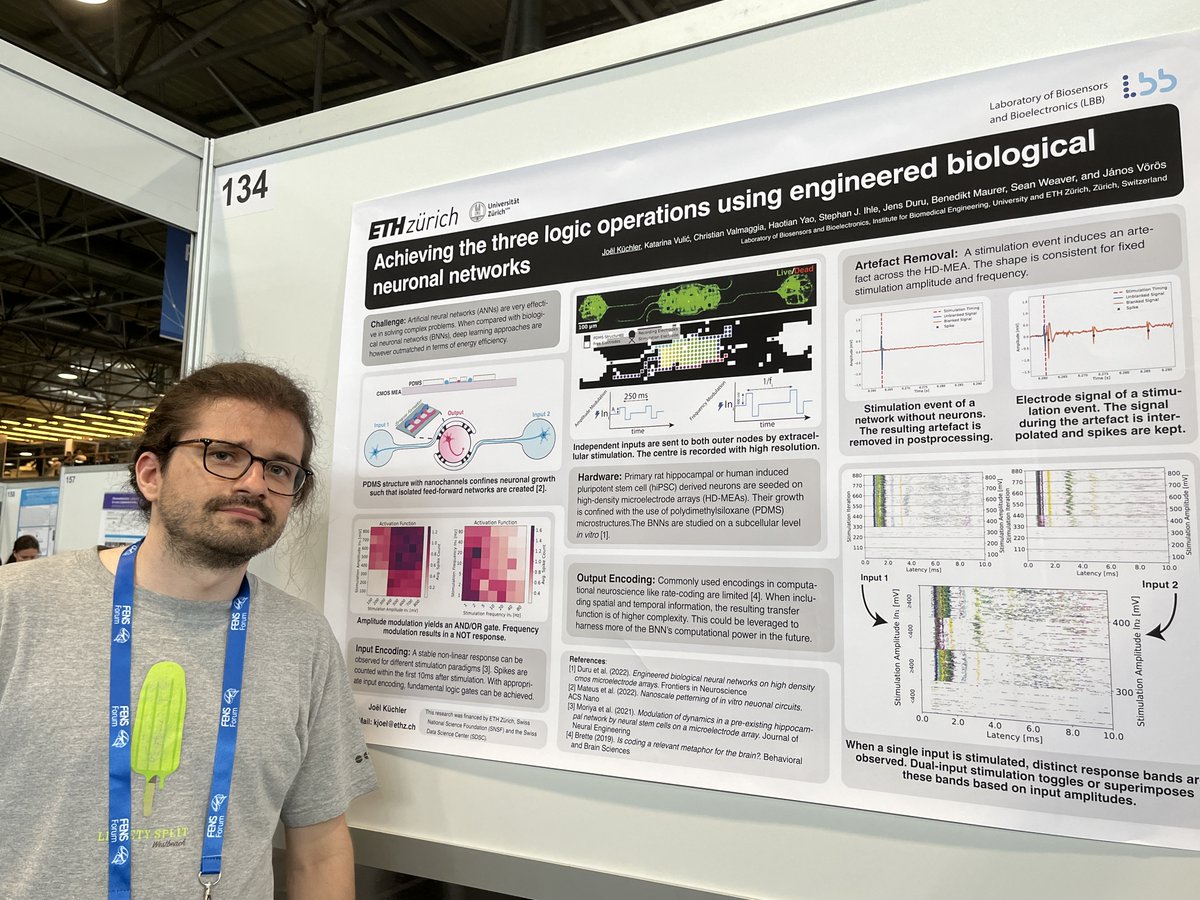
📌 Poster #134
"Achieving the three logic operations using engineered biological neuronal networks"
👤Presented by Joël Küchler, PhD student @ETH_en
See you soon! 🙌
#FENS2024 #neuroscience #electrophysiology @FENSorg
We are attending the AD/PD-Advances in Science & Therapy conference in Lisbon, March 5-9!
Visit booth #76 and poster presentation #0397 during shift 2, to meet Dr. Silvia Oldani and Dr. Praveena Manogaran. They will answer your questions & discuss the benefits of our HD-MEAs!🚀
🚨 Have you submitted your #travelgrant application for #MxWSummit24 yet?
🗓️ Make sure to send us your application by Monday, February 26!
Find out more and apply now! 👇
https://t.co/IMALIyT3sq
Exciting News! 🎉
🔬 Scientists have uncovered a new protein in a pathway for neurotoxicity and cell death with therapeutic development potential in the fight against amyotrophic lateral sclerosis (ALS).
This new study, published today in Nature from @NaturePortfolio, takes us one step forward in understanding the key mechanisms behind ALS.
With the urgent need for human cellular models to study such pathologies, scientists have developed a new 2D cell culture model with features mirroring those of human brains. 🧠
Delving deeper into the effects of the abnormal accumulation of TAR DNA-binding protein 43 (TDP-43), involved in diseases like ALS, scientists identified a new player – a protein called neuronal pentraxin 2 (NPTX2) – that teams up with TDP-43 to induce neurotoxic effects.
👏 Congratulations to Dr. Marián Hruška-Plocháň from Prof. Dr. Magdalini Polymenidou’s lab at the Department of Quantitative Biomedicine, University of Zurich, and all authors for this groundbreaking study!
🤝 The work was done in collaboration with the ETH-Department of Biosystems Science and Engineering (D-BSSE), ETH Zürich; the Department of Molecular Life Sciences, SIB Swiss Institute of Bioinformatics, Brain Research Institute, and Institute of Neuropathology, University of Zurich; Masaryk University Brno, Czech Republic; UCL Institute of Neurology, UK; the University of Bern; and NCCR RNA & Disease Technology Platform, Switzerland.
#MaxOne high-density microelectrode arrays (HD-MEAs) were utilized in the functional characterization of the induced pluripotent stem cell (iPSC)-derived neuronal cell lines developed in the study.
💯 With the high resolution and high data quality provided by the HD-MEAs, it was possible to extract the activity of these neurons at unprecedented detail, accessing network, cellular and subcellular features, revealing developed interconnected networks and coordinated firing.
💡 The study findings not only propose NPTX2 as a potential new therapeutic target but also highlights the human cellular model developed by the authors as a promising tool for uncovering key human-specific characteristics of neurodegenerative diseases.
We can’t wait for the future outcomes of this project!
Find the summary of these findings and other details from this groundbreaking study in our most recent blog post 👉 https://t.co/VdvwGVCd2b
#neurodegenerativediseases #brainresearch #therapies
🎉 The early bird registration and short talk abstract submission deadlines have been extended until February 19!
Take advantage of this opportunity to join the amazing speakers list at the #MxWSummit24.
Register and submit your abstract today!
👉 https://t.co/8xibHV7S0u
Join us at the 4th In-Vitro 2D & 3D Neuronal Networks Summit: 📅 April 8-10📍Zurich, Switzerland
🔬 The summit is open to everyone interested in #neuroscience, #cellbiology, #drugdiscovery, #diseasemodeling, #bioengineering, or #neuroengineering.
Register today! 👉 https://t.co/TtVJ3hN4VR
Join us to listen to inspiring talks from our already confirmed keynote speakers:
➡ Dr. @CedricBardyLab from SAHMRI, Australia
➡ Dr. @FrankFengGuo from Indiana University Bloomington, USA
➡ Dr. @AptaWineClub, Ph.D., from Neuro-X Institute, École polytechnique fédérale de Lausanne, Switzerland
➡ Dr. Tomasz Jan Nowakowski, from University of California, San Francisco, USA
➡ Prof. Dr. Magdalini Polymenidou from University of Zurich, Switzerland
We promise an exciting program showcasing the latest research in iPSC-derived neurons, neural organoids, applications of microelectrode arrays (MEAs), and much more! 🙌
📹 Experience the insights of the 3rd Edition with engaging highlights, testimonials, and memorable moments! 🔽
#MxWSummit24
A capacidade humana de ser surpreendido diminui à medida que o cérebro se desenvolve. Estas conclusões explicam porque, enquanto para as crianças o mundo é cheio de surpresas, os adultos são mais difíceis de surpreender.
Saiba mais: https://t.co/N9yLOaZwTd
Thank you @UniBasel_en for such a nice article about our fresh off the press research article! Have a read and learn more on how the brain develops an understanding of surprising sounds 🧠 #auditory#brain#development#neuroscience
For children, the world is full of surprises. A research team led by @tania_barkat@DepBiomedicine has been using mice to decode how reactions to the unexpected develop in the growing brain.
https://t.co/dX2TR1ASpD
Happy to share that a study developed during my #PhD has just been published in @ScienceAdvances!
We shed a light on how the brain develops an understanding of surprising sounds and how experience can influence such development 🧠👇
https://t.co/N8OKta61sI
The environment in which we grow up can also influence how we react to surprising sounds. We observed that rearing the young mice in a noise-neutral environment significantly delayed the processing of unexpected sounds in the auditory cortex.
Published today in @NatureElectron, Hongwei Cai and colleagues describe a hybrid system consisting of brain #organoids, MaxOne HD-#MEA system, and #AI setup known as Brainoware, as capable of performing speech recognition and nonlinear equation prediction: https://t.co/oR8Bwv7KpM
Last day at #SfN23!
If you haven't already stopped by booth #900, make sure to visit today to learn more about our next-generation electrophysiology platforms and their applications from our amazing team!
@SfNtweets#ipsc#organoid#MEA
#SfN23 has kick started and poster session is already filled with amazing science!
Laura D'Ignazio, our Senior Application Scientist, is presenting an exciting poster about #organoids recorded with high-density #MEAs
Come to board no. VV36 and learn all about it!
@SfNtweets
📣Join our #MaxWellWebinar with Prof. Dr. Mircea Teodorescu & @kvoitiuk from @ucsc and learn more about their automated laboratory for cerebral #organoid experiments👩🔬👨🔬
Register to Attend👉 https://t.co/VzajnJyeCh
📅Tuesday 24th October
@braingeneers@ucscgenomics
Today on #WorldAlzheimersDay, we're celebrating Alzheimer's research advancements & acknowledging scientists & tools unlocking disease mysteries through research papers highlighting the essential role of electrophysiology in Alzheimer's research🧠
Read👉 https://t.co/y8Q1lsqfWB