@ChadDKollas@GoogleAI Anytime I have tries to use AI, it seems good enough to give you some ideas, but you've got to check and double-check every detail. By the time you've done this, you've spent whatever time you might have saved. Not ready for primetime by a long shot!
Google AI pissed me off yesterday. Iasked it if Andrew Kolodny had ever publicly called for litigation against opioid manufacturers, and it said it could not find a specific statement to that effect.
Well, @GoogleAI, here you go!! “Consider legal action against opioid manufacturers”
Kolodny A. Responsible Prescribing Practices (Slide 45 of 47). National Rx Drug Abuse Summit, Orlando, FL. April 11, 2012. Available at: https://t.co/CcMONgSTYY. Last accessed on November 19, 2026.
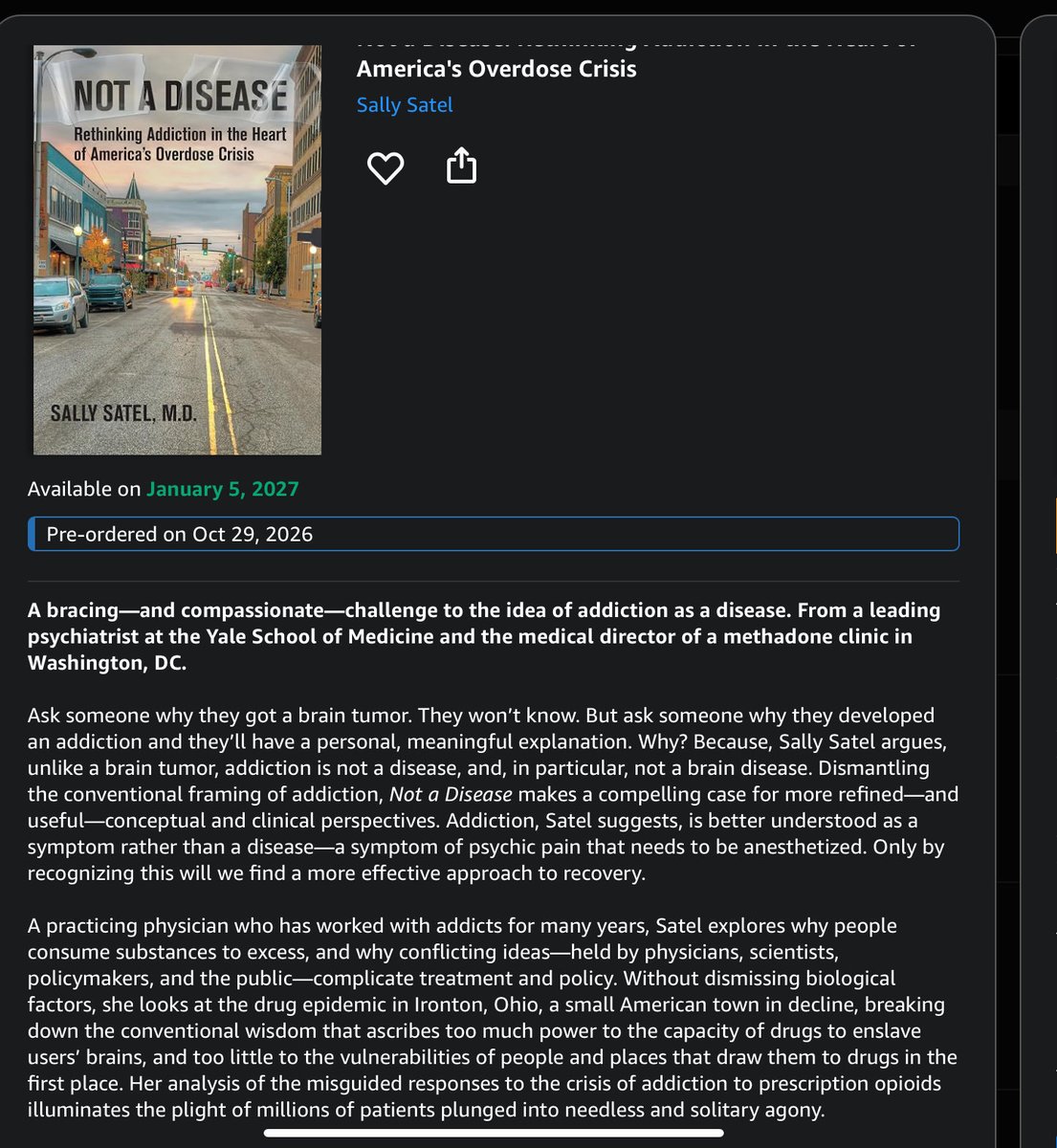
I’m very happy to have preordered Dr. Sally Satel’s new book on addiction: Not a Disease, available for pre-order now and published January 5, 2027.
A look at the content:
@StefanKertesz went back and made a recording of the lecture he gave on 10/5 at #AHSR2026 so that those who weren't in attendance would be able to hear his talk too. Make sure you give this a watch!
https://t.co/WSW9jAimKs
@LadyAg72@FLSpacePort I'm still here @LadyAg7, grateful for every day!
I *think* the patient that Sarah is talking about might be Jessica Minerd-Massey ... or is this someone else @FLSpacePort ?
A friend in our community recently left the hospital AMA after going back sick and vulnerable following surgery.
And it made me think about how casually medicine treats those three letters:
AMA. Against medical advice.
People see AMA and think: difficult patient.
But I think clinicians should sometimes ask a harder question:
What happened before the patient decided leaving felt safer than staying?
How many of us in chronic pain or chronic illness have lived this?
I’ll raise my hand.
You press the call button.
You wait.
You ask when the specialist is coming.
“They’ll round today.”
Morning becomes afternoon.
Afternoon becomes tomorrow.
Nobody tells you why.
A resident comes in without answers.
The nurse is waiting on orders.
The attending is somewhere else.
And somehow the person lying in the bed knows the least about what is happening.
Then there’s inpatient life itself.
Hospital gown.
Peripheral IV taped into your arm.
Tubing, alarms, monitors.
You finally fall asleep and here comes phlebotomy at 2 a.m.
The vampires.
Then vitals.
Then another blood draw.
Then housekeeping rustling a trash bag at 3:30 in the morning.
Then someone asks later, “Did you sleep okay?”
No.
You’re sick, hurting, exhausted, overstimulated, half-dressed, tethered to equipment and still expected to be endlessly patient and pleasant.
Then communication disappears.
Pain becomes a number.
Fear becomes “anxiety.”
Symptoms get minimized.
Questions feel like an inconvenience.
And eventually the patient starts asking:
“Am I actually safer staying here?”
Yes, some people leave AMA for reasons no clinician can control.
But when someone leaves because they feel ignored, undertreated, disbelieved, or abandoned, that should not be shrugged off as “noncompliance.”
That should bother us.
Because AMA tells you how the patient left.
It does not always tell you why.
Sometimes the fuller story is:
The patient left because they had already lost confidence that the hospital was going to help them.
A thread in which a doctor speaks about her cancer patients in pain cannot get their prescriptions filled! All based on the OUTRAGEOUSLY false claims about "prescription opioid medications" coming from inside the health agencies and their Advisory Committees!
Why does it have to be framed as “non-opioid?” It’s not like that’s a magic phrase that means it’s a better drug. Just say “a new therapy for acute pain,” instead of the constant virtue-signaling. 🙄