Peter is not correct about me in this case.
I have always known that dangers from Earth will also pose dangers to Mars. Obviously so. However, the immense difficulty of traveling to Mars means that there is a much higher likelihood of mitigating risks originating from Earth.
A clear example of major risk reduction would be a deadly pandemic. Since it takes 6 months to reach Mars, there is an automatic 6 month quarantine!
Even traveling at the speed of light, a deadly computer virus or AI attack can potentially be stopped due to Mars being ~4 to ~20 light-minutes from Earth.
This doesn’t mean that a Mars civilization eliminates all risk, but it absolutely greatly reduces the risk of consciousness being extinguished.
Moreover, Mars is a stepping stone to extending consciousness broadly within our solar system and ultimately to millions of stars within our galaxy, which would extend the probable lifespan of consciousness as we know it by many orders of magnitude.
That said, what I personally find most motivating is not the risk reduction aspect of extending life beyond Earth, but rather the inspiring nature of exploration and being out there among the stars!
Perhaps we will meet aliens or find the remains of long-dead civilizations that lasted millions of years …
Strawberry Milkshake
A delicious strawberry milkshake is a classic. Ditch the dairy and heavy fats normally found in milkshakes for this healing and incredibly tasty version, which draws its creaminess from frozen bananas. You can also use coconut milk, gluten-free oat milk, or almond milk for an extra-creamy milkshake or leave it out and use water or coconut water for an even more healing version. Make this wonderful milkshake for yourself, loved ones, or your children for an easy breakfast or snack or shake on the go.
Strawberries are filled with antiviral and antibacterial phytochemical compounds that inhibit viral and bacterial growth. Strawberries also contain phytochemical compounds that repel unproductive fungus in the gut. Straw- berries help cleanse and purify the stomach lining, including the stomach glands, helping to bring back their vitality, which translates to stronger digestive strength.
RECIPE: https://t.co/SjPjCTvHQk
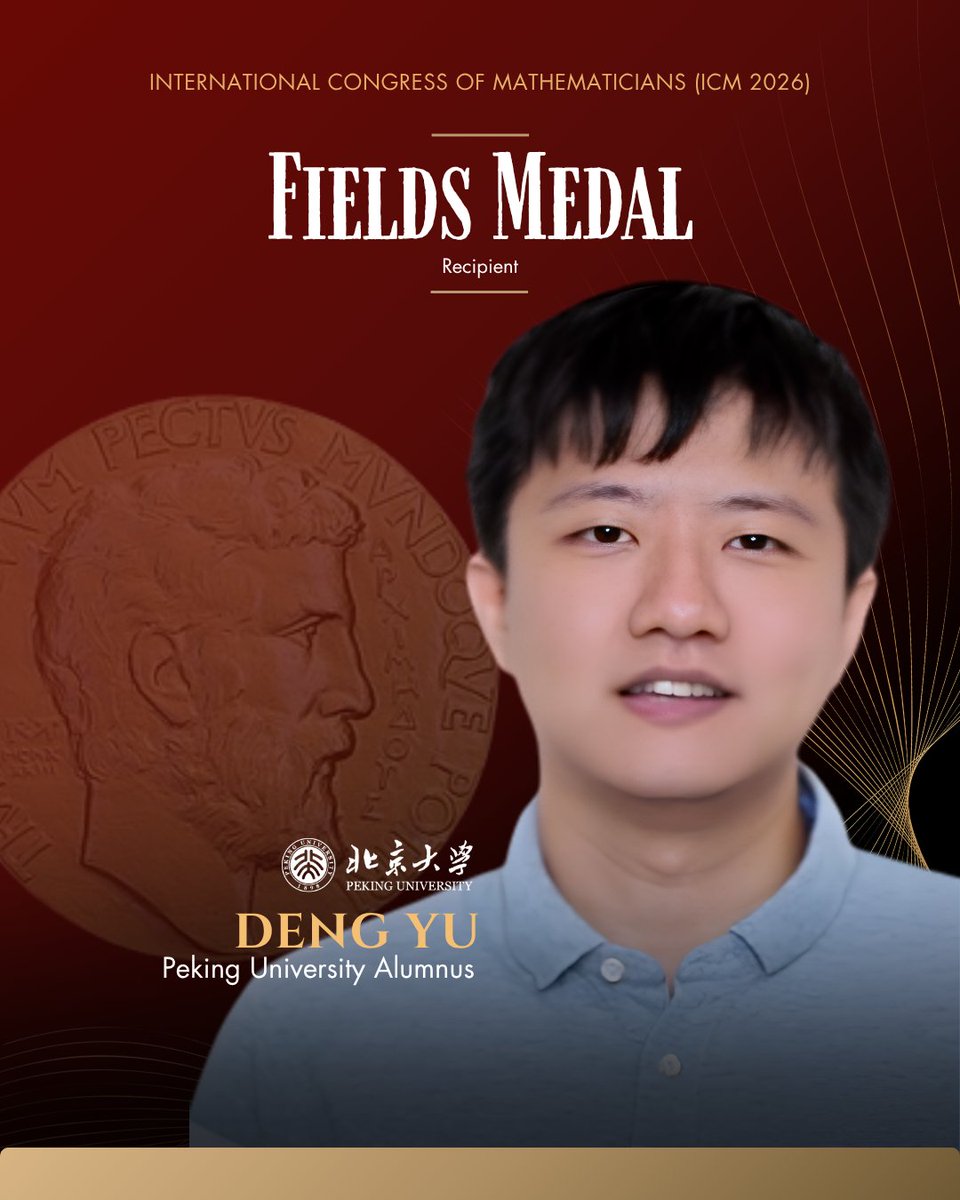
Huge congratulations to PKU alumni Wang Hong and Deng Yu, recipients of the 2026 Fields Medal — mathematics’ highest honor! 🧮
Announced at the 2026 International Congress of Mathematicians (ICM) in Philadelphia, the pair are among four mathematicians worldwide to claim this prestigious prize, awarded every four years to outstanding scholars under 40.
The awards are historic on several levels.
—First time two mathematicians who completed undergraduate studies in mainland China win the Fields Medal in the same year.
—Both joined Peking University as undergraduates in 2007.
—Wang Hong becomes only the third female Fields Medalist ever, the first Chinese woman, and the first recipient with a bachelor’s degree from a mainland Chinese university.
We are immensely proud of their extraordinary breakthroughs and lasting contributions to global mathematics.
Chairman Xi Jinping in his opening speech at WAIC 2026, Shanghai today, just laid out China’s bold play for global AI leadership: Open-source as a ‘global public good,’ massive capacity-building for the Global South, and the new World AI Cooperation Organisation (WAICO) with 29 founding members.
The AI race is no longer just about who builds the best model.
After listening to the key messages from Chairman Xi’s speech at WAIC 2026, one thing became clear:
China is positioning itself not only as an AI powerhouse, but as an architect of the global AI ecosystem.
Here are my takeaways:
🔹 AI should be open and accessible.
China reaffirmed its commitment to open AI collaboration, arguing that innovation accelerates when technology, knowledge and AI capabilities are shared rather than concentrated in the hands of a few.
🔹 AI is now national infrastructure.
Just like electricity, the internet and finance, AI is being treated as critical infrastructure that will shape economic competitiveness and national development for decades to come.
🔹 Developing nations shouldn’t be left behind.
A strong emphasis was placed on helping emerging economies access AI through technology sharing, talent development and international cooperation, reducing the risk of a widening AI divide.
🔹 Global AI governance is becoming a priority.
Rather than allowing AI standards to be defined by a handful of countries or companies, China called for broader international collaboration to establish common rules, safety frameworks and governance mechanisms.
🔹 AI must serve humanity.
Rapid innovation should be balanced with safety, ethics and human oversight to ensure AI delivers long-term benefits to society.
We’re witnessing the beginning of a new global AI landscape.
The competition is evolving from models to ecosystems.
It’s no longer just:
• OpenAI vs. DeepSeek
• Anthropic vs. Qwen
• Google vs. Alibaba
It’s becoming a competition between AI ecosystems, governance models, developer communities and international influence.
Whether you agree with China’s approach or not, one thing is undeniable:
The future of AI will not be shaped by Silicon Valley alone.
Business leaders who understand both the Western and Chinese AI ecosystems will have a significant advantage in the decade ahead.
The AI race has entered its next phase, and it’s no longer just about technology.
It’s about influence, collaboration and who helps define the rules of the AI era.