@elonmusk This is going to be an exciting time!
Not only has the Falcon 9 proven to be a brilliant breakthrough, but the Starship could ultimately be the game-changer that ushers in a new era.
It marks the beginning of many new possibilities.
https://t.co/i483uXfJuD
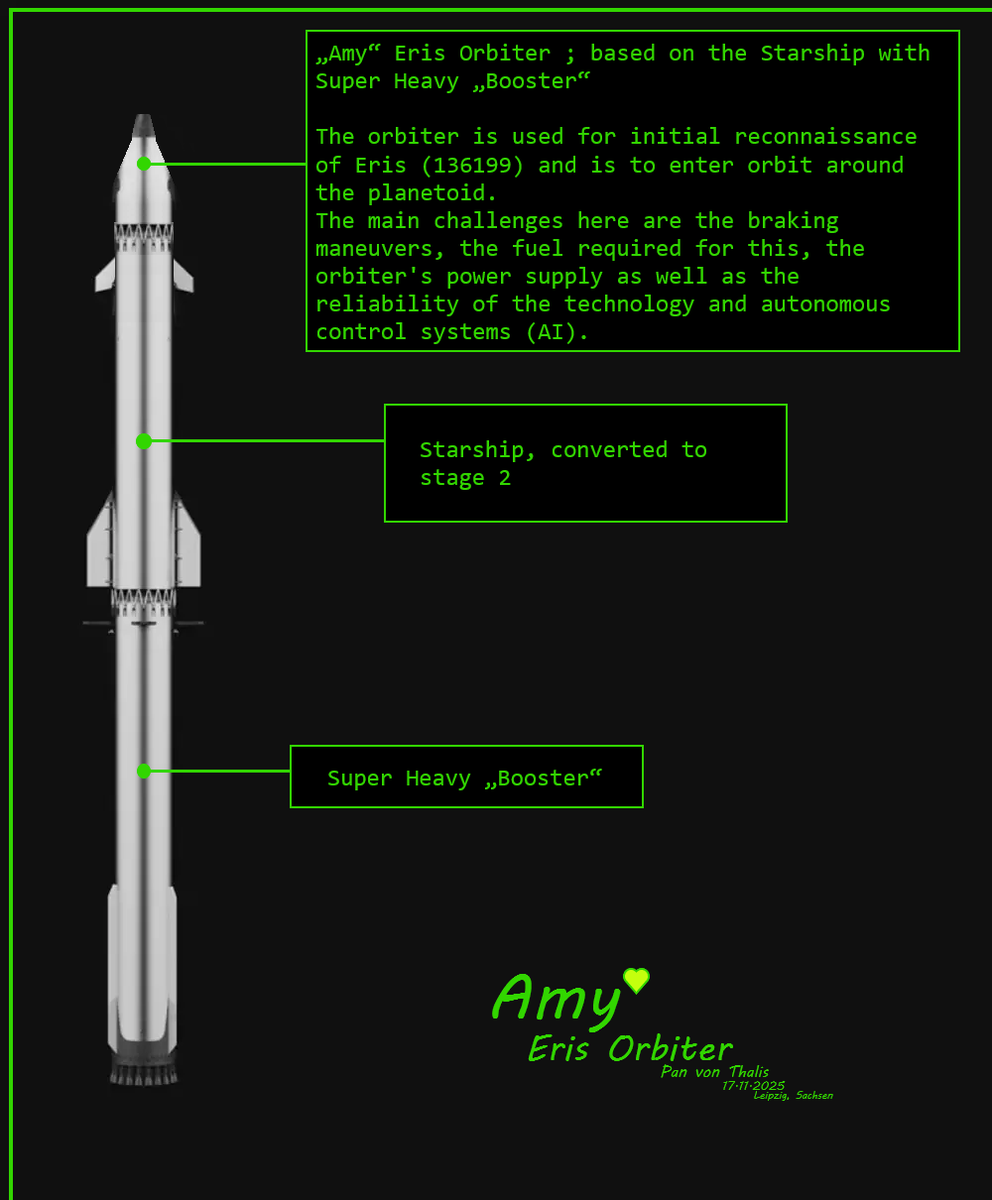
Eris (136199): The distant dwarf planet as a destination for future space travel
Eris, the most massive known dwarf planet in the Kuiper Belt, was discovered in 2005 and, with a diameter of approximately 2,326 km, is almost as large as Pluto but more massive. It orbits the Sun in a highly elliptical orbit with a period of 557 years and an average distance of 68 AU (astronomical units). The surface is extremely cold (-217 to -243 °C) and consists mainly of frozen methane and nitrogen, with evidence of geothermal activity in the interior, as recent observations by the James Webb Telescope have shown. Eris' discovery led to the IAU redefining the term “planet” in 2006, causing Pluto to lose its status.
First possible orbiter missions and timelines
So far, there are no officially planned missions to Eris, as the extreme distance (currently up to 97 AU) and costs pose enormous challenges. Nevertheless, there are concepts for flyby or orbiter missions inspired by New Horizons (Pluto 2015). With conventional chemical propulsion and gravitational assistance (e.g., Jupiter), a launch around 2032 could enable arrival at Eris around 2051 – a flight time of about 19 years. Advanced propulsion systems such as Direct Fusion Drive (DFD) could shorten the journey to 10 years, with a rendezvous at 78 AU (near perihelion). Realistically, a first mission could launch in the 2040s-2050s, depending on technological developments and funding.
Advantages, challenges, and approaches
Advantages: A mission to Eris would deepen our understanding of the Kuiper Belt, investigate geological processes (e.g., cryovolcanism), and compare Eris with Pluto to gain insights into the formation of the solar system. In the long term, it could serve as a precursor for interstellar exploration.
Challenges: The enormous distance causes flight times of decades, weak communication signals (13+ hours delay), and energy problems, as radioisotope generators (RTGs) lose power over time. High costs and the need for autonomous systems make implementation difficult.
Possible solutions: Mini reactors such as NASA's Kilopower (KRUSTY) offer constant power (e.g., 8.5 kWe) without decay, ideal for ion engines and instruments in deep space. They enable shorter journeys and long-term operations. Other approaches include nuclear propulsion (e.g., DFD) and improved RTGs to make Eris reachable as the “ultimate outpost.”
Potential applications of AI and autonomous robots
Artificial intelligence (AI) and autonomous robots will play a crucial role in future missions to Eris, as the enormous distance (up to 97 AU) causes communication delays of over 13 hours and requires a high degree of autonomy. AI can be used for autonomous navigation to detect obstacles and adjust routes in real time, as demonstrated by current Mars rovers such as Perseverance. Autonomous robots could explore the surface, collect and analyze samples without constant control from Earth – ideal for searching for cryovolcanism or resources such as water ice. Other applications include deep reinforcement learning (DRL) for mission planning, hazard detection (e.g., avoiding hazards such as ice sheets), and in-situ resource utilization (ISRU) to extract fuel from local materials. Swarms of robots could work cooperatively, supported by multi-agent AI, to build habitat structures or process data in real time. Combined with mini-reactors, these technologies enable long-term operations, increase mission safety, and reduce human risk, as proposed in concepts for Kuiper Belt exploration.
The exploration of Eris could mark the decisive milestone that transforms humanity from an Earth-bound civilization into a truly multiplanetary, even interstellar species, breaking the boundaries of our solar system and paving the way to the stars.
✨Eris, a tiny dot on the edge of our system.✨
#Eris #DeepSpace #multiplanetary #Future
https://t.co/AYS4qmiJUD
SpaceX continues to conquer space with its Starlink network! After all, we want to have plenty of bandwidth for all those alien documents, right?
And with the launch of the next Starship, Flight 13, the third-generation Starlink satellites will soon be in operation! Good luck, SpaceX!
And to all you UFO hunters and Martians out there, have fun watching!
https://t.co/zGH7qbAJgN
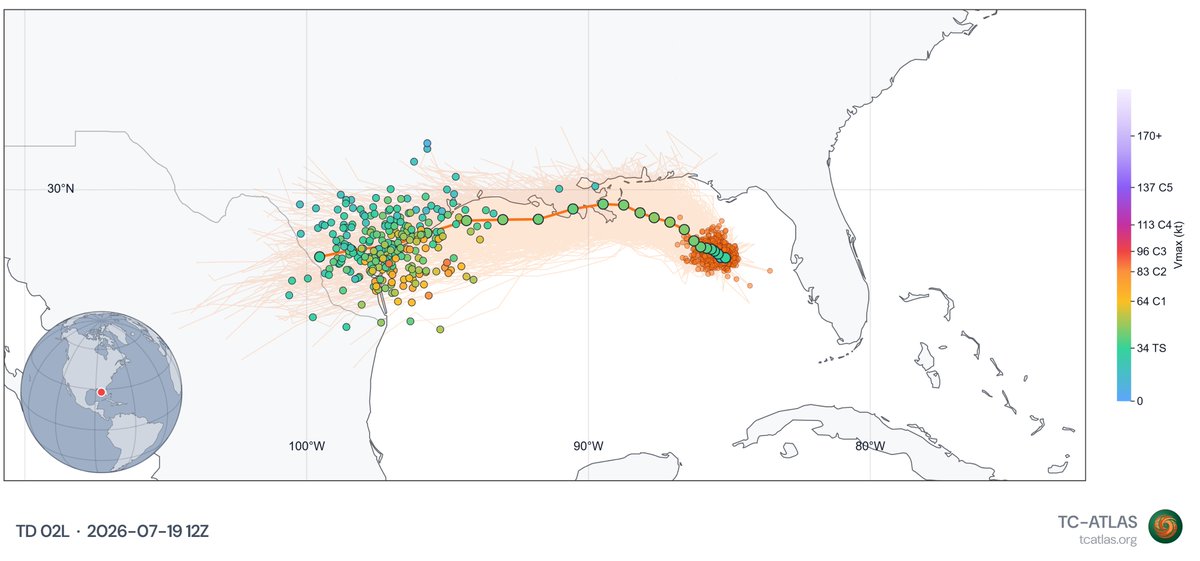
Ok weather boy time, I'm actually really skeptical about Thursday (or according to Elon, Friday) launch because of TD02 (soon to be Bertha). This system is being forecasted to drag west and reach the state of Texas by Thursday/Friday.
If 02 stays south it will be potentially a hurricane. Regardless on its strength on arrival, Starbase could see heavy rain and 30mph wind gusts.
Rocket launches by country over time.
You can see that Russia used to completely dominate but not anymore, and that SpaceX is now the largest by far (I broke SpaceX out to highlight how impressive its growth has been)
I just realized today that this whole time there was a way to upload high quality photos to twitter and I had no idea about it until now.
You guys have only seen the compressed versions of all my graphics when in reality they are actually huge! My space coast graphic for instance is 8193x10000!
I’m so sorry that I learned this so late but at-least now y’all can see my graphics in such higher quality!
B20’s abort telemetry with video from SpaceX and audio from NSF.
This is probably the best I can personally do with this, but I know someone else can create a better version than mine.
In case you missed it, check out the 2nd episode of our Starship series. “Critical Path” follows SpaceX engineers through the final days before launch of the first Starship V3 and the challenges that come with development of the world’s most powerful and fully reusable rocket → https://t.co/0nNgKtf7M5
Before Starship 40—which we rocket geeks have been eagerly awaiting—takes to the skies on Friday, Agent X must head out on another secret mission aboard a Falcon 9!
In fact, as early as tomorrow, Thursday, a Falcon 9 will launch from California into orbit on the highly mysterious mission Tranche 1 Transport Layer E. The relatively new booster B1103 will be used for this mission, marking its fourth flight. So good luck, Agent!
And to all you conspiracy theorists and satellite spotters out there, have fun watching! Here’s to good rocket weather!
🛰️Tranche 1 Transport Layer E🛰️
Scheduled launch time:
Liftoff Time (CDT) 03:32:00 PM
Liftoff Time (EDT) 04:32:00 PM
Liftoff Time (CEST) 10:32:00 PM
Thursday July 16, 2026
Liftoff Time (JST) 05:32:00 AM
Friday July 17, 2026
Falcon 9 Block 5 | SpaceX
Vandenberg SFB, California, USA🇺🇸
04:22 PM (EDT) / 10:22 PM (CEST) / Window Open
05:09 PM (EDT) / 11:09 PM (CEST) / Window Close
To the Mission: https://t.co/xlupP58Ja2
#SpaceX #Falcon9
https://t.co/HQn7upfeOW
What is the Tranche 1 Transport Layer?
As always, let’s take a quick look!
The Transport Layer forms the backbone of a resilient, low-latency military communications network in Low Earth Orbit (LEO). It is designed to provide U.S. and allied forces worldwide with fast, secure, and jamming-resistant data links (e.g., for Command & Control, Sensor-to-Shooter, and Link-16).
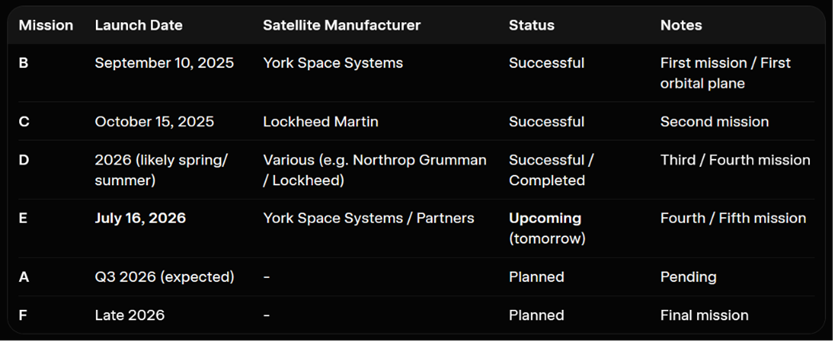
Tranche 1 comprises a total of 126 transport-layer satellites (plus tracking-layer satellites for missile warning). The satellites are distributed across multiple orbital planes and form a mesh network with optical inter-satellite links (OISLs) for high-performance laser connections between the satellites, as well as RF communication (including Ka-band and Link-16) to Earth and to users. Each satellite costs an average of approximately 14 million U.S. dollars—a key aspect of the “proliferated” (mass-produced) and cost-effective architecture.
The six missions (A through F) distribute the satellites across different orbital planes. Earlier missions (e.g., B, C) were launched as early as 2025.
So they’re really stepping up their game up in the sky, huh? ET and his nasty alien gang better watch out! 👽🛸
LightPort has been delivered!
Developed by Volta Space Technologies, LightPort will be hosted on top of our Blue Ghost lander on the far side of the Moon. This small but mighty power receiver will demonstrate capabilities to support a future wireless lunar power grid.
LightPort is one of six payloads flying on our Riders 2 the Dark mission and marks the final payload delivery to our facility.
Next step: payload integration in our cleanroom.
And that brings us to the launch of the infamous Ship 40 with Booster 20! Flight number 13, which all you rocket enthusiasts out there have been eagerly awaiting.
Are you excited yet?
Let's take a quick look at the scheduled launch times!
🚀Starship Flight 13🚀
Scheduled launch time:
Liftoff Time (CDT) 05:45:00 PM
Liftoff Time (EDT) 06:45:00 PM
Thursday July 16, 2026
Liftoff Time (CEST) 12:45:00 AM
Liftoff Time (JST) 07:45:00 AM
Friday July 17, 2026
Starship-Super Heavy v3 | SpaceX
Starbase, Texas, USA🇺🇸
06:45 PM (EDT) / 12:45 AM (CEST) / Window Open
08:15 PM (EDT) / 02:15 AM (CEST) / Window Close
We're heading toward another grand finale in space exploration, and excitement in the rocket community is reaching a fever pitch!
Here's hoping everything goes smoothly tomorrow and we get to see a successful launch! So it looks like things are going to get pretty wild again tomorrow in beautiful Texas! Good luck, SpaceX, and may the launch be a success!
And to all you rocket enthusiasts and alien lovers out there, have fun watching—enjoy a wonderful, inspiring time, and off to the stars!
To the Mission: https://t.co/vvgRciwG1X
#Starship #Flight13 #SpaceX
https://t.co/tUuWNwtUGe
And the weather looks like it’s going to be good, too! The sun is shining brightly here in beautiful Texas—just right for an evening rocket launch, don’t you think?
Let’s hope it stays that way and that no one messes with the weather! Enjoy the sun!
#Starbase#Weather
📸: https://t.co/i2Pj3kLKDX
https://t.co/sN71G4IZnF
The pathway to the Moon and beyond starts in Texas. 🤠⭐
This @bbgoriginals video explores why Texas is leading the space race. Watch and learn how we’re building the next era of space exploration – right here in the Lone Star State.
Thanks to @NASA, @TXSpaceComm and all our partners for their continued support along the way.
Full video here: https://t.co/C1ipgOUYYt
What NASA just posted is exactly the kind of stuff we Rocket Foxes love!
It's really fueling the hype!
Yeah, we're getting another full dose of SpaceX today, huh? 😁
Click here for the article: https://t.co/5GEKb2YtPF
@dpoddolphinpro@NASA@SpaceX@blueorigin The next few years are going to be really wild! 😎
Please fasten your seat belts, everyone—we're taking off!
Thank you for choosing SpaceX for your flight to the moon.
https://t.co/vTPBztPl2C