Today at @money2020, we're introducing Logos: the evidence layer for acceptance of tokenized assets and stablecoins.
We're building shared evidence infrastructure so institutions can put more assets to work on blockchains, in custody, lending and payments.
At the ParaFi Investor Day this week, I presented an overview of digital capital, credit and equity, and then joined Jeff Park (@dgt10011) for a fireside chat on digital assets, digital intelligence, and the future of finance.
01:23 – Bitcoin as Digital Capital: bull market tailwinds and scarcity in the AI era
05:05 – CLARITY, regulatory tailwinds, and Bitcoin banking adoption
06:06 – Reinventing gold-backed credit with $STRC
10:10 – Returning $STRC to par: USD Reserve, buybacks, and investor feedback
17:24 – Amplifying Bitcoin Per Share and Strategy’s triple flywheel
21:06 – From quarterly to daily dividends: liquidity and volatility
25:42 – Digital Money: the vision for a Bitcoin-backed stablecoin
29:11 – Digital Credit adoption and the path to institutional acceptance
34:12 – Beyond Bitcoin: digital currencies, derivatives, exchanges, and regulation
38:51 – Advice to founders: build a magic product in the AI era
Up/Down markets, popularized by prediction market venues, turn price moves into simple binary bets: will BTC rise or fall over the next 15 minutes?
These contracts generated $9.3B in notional volume in September 2026, up ~12x YTD and more than 78x YoY. Crypto accounts for 90% of volume, but commodities activity has surged, potentially fueled by oil-price volatility tied to the U.S.-Iran conflict.
We see binary contracts as an emerging financial primitive and an evolution of 0DTE options. In our view their growth points toward hyper-financialization: more assets, shorter time horizons, always-on markets.
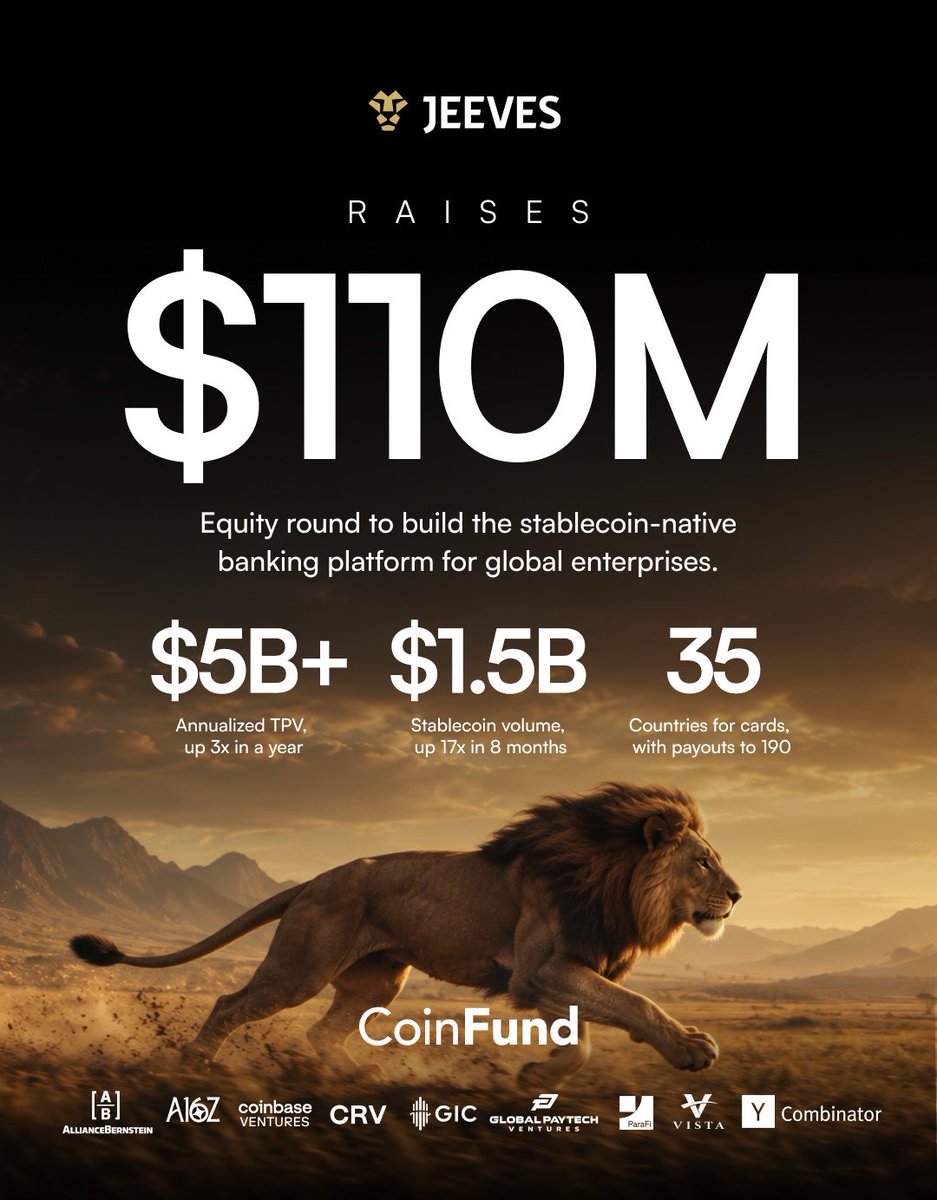
Excited to announce our $110M raise to scale our stablecoin-native banking platform for global enterprises across 35 countries (10 new countries!) 🚀🦁
Our stablecoin business crossed $1.5B annualized volume in just 8 months, driven by exponential enterprise demand. Since signing the Series C-1 term sheet, revenue has grown more than 50% in a few months. The pace is accelerating.
As we go deeper into the stablecoin ecosystem, I'm pumped to have @coinfund lead the round, joined by @AB_insights, @a16z, @cbventures, @CRV, GIC, @gpt, @paraficapital, Vista, @wmt_ventures, @ycombinator and others.
Also grateful to have the best founders building in the space joining the round: @zcabrams (Bridge, OUSD), @psneville (Circle, Catena), @sternhenri (Privy), @prabhakar2reddy & @karan705 (OpenFX), @SamBroner (Better Money Co.) and Ricardo Marino (Global Chairman at Itaú), among others.
Over the last year, AI & stablecoins have powered us to an inflection point. Today, we have fewer employees than we did two years ago, while revenue and volume have grown more than 10x crossing $5B in annualized TPV. AI is embedded across Jeeves and has fundamentally changed how we build and operate.
Alongside the round, we're launching:
💸 Jeeves stablecoin wallets: Our custom built wallets supporting USDC and USDT, with payouts to 190 countries, all in one platform.
💳 Cards in 10 more countries: Argentina, Peru, Paraguay, Uruguay, Panama, Guatemala and others. The same award winning expense management platform used by BMW, Burger King and H&M are now available in these markets.
🧾 Accounts Receivable (AR): Alongside our core Cards and AP modules, we're launching our AR module, starting with Brazil 🇧🇷 This was one of the biggest customer requests!
📊 Jeeves Global AI Spend Tracker: We all know AI spend is growing but if you operate in six countries, with Claude spend in pesos & OpenAI spend in pounds, how do you actually know what you spent across models, countries, currencies & what drives ROI? Well now you do with our Global AI spend tracker across the globe 🌎
🇪🇸 Lastly, we opened our doors in Madrid to accelerate our expansion across EMEA, with a focus on stablecoin payment corridors between Europe & the world.
The next decade of global banking will be agentic and seamless between stablecoin and fiat. To build this companies need to own the primitives directly. This chapter is being written right now, and small teams with big ambition, powered by AI and stablecoins, will write it. We intend to be the company that defines it 🌎
Thank you to our customers, teammates and investors for the trust you put in us every day 🙏
If you want to shape the future of global money at the cutting edge of stablecoins and AI, come build it with us. It won't be easy but it will be fun 👉 https://t.co/ylDYGqlszL
Day one of this next chapter starts now. It's time to build.
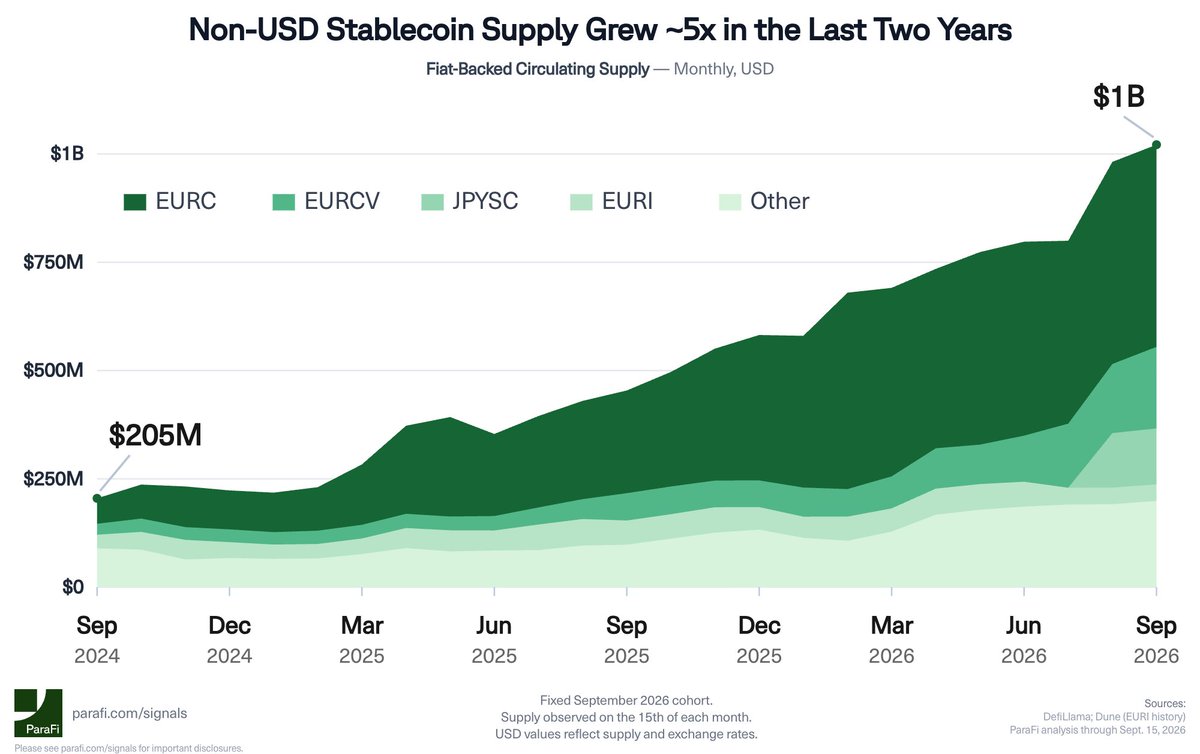
Non-USD stablecoin supply grew approximately 5x over the past two years, as clearer regulation, particularly MiCA, enabled regulated issuers and institutions to enter the market. We believe usage has developed along two distinct paths: EURC, Circle’s Euro-backed stablecoin, serves as the primary liquid onchain euro for trading, FX and DeFi, while other local-currency stablecoins are increasingly being integrated into local payment rails for payments, payroll and settlement.
As of September 15, 2026, EURC accounted for 45.7% of tracked supply and 90.1% of reported 30-day trading volume, which we believe reflects its deeper liquidity and integrations with Aerodrome, Uniswap, Aave and Morpho, and other DeFi protocols. Excluding EURC, approximately 80% of non-USD stablecoin activity involved simple transfers consistent with payments, payroll and settlement. This suggests that EURC is more oriented toward onchain financial activity, while other non-USD stablecoins may be gaining adoption through local payments and settlement.
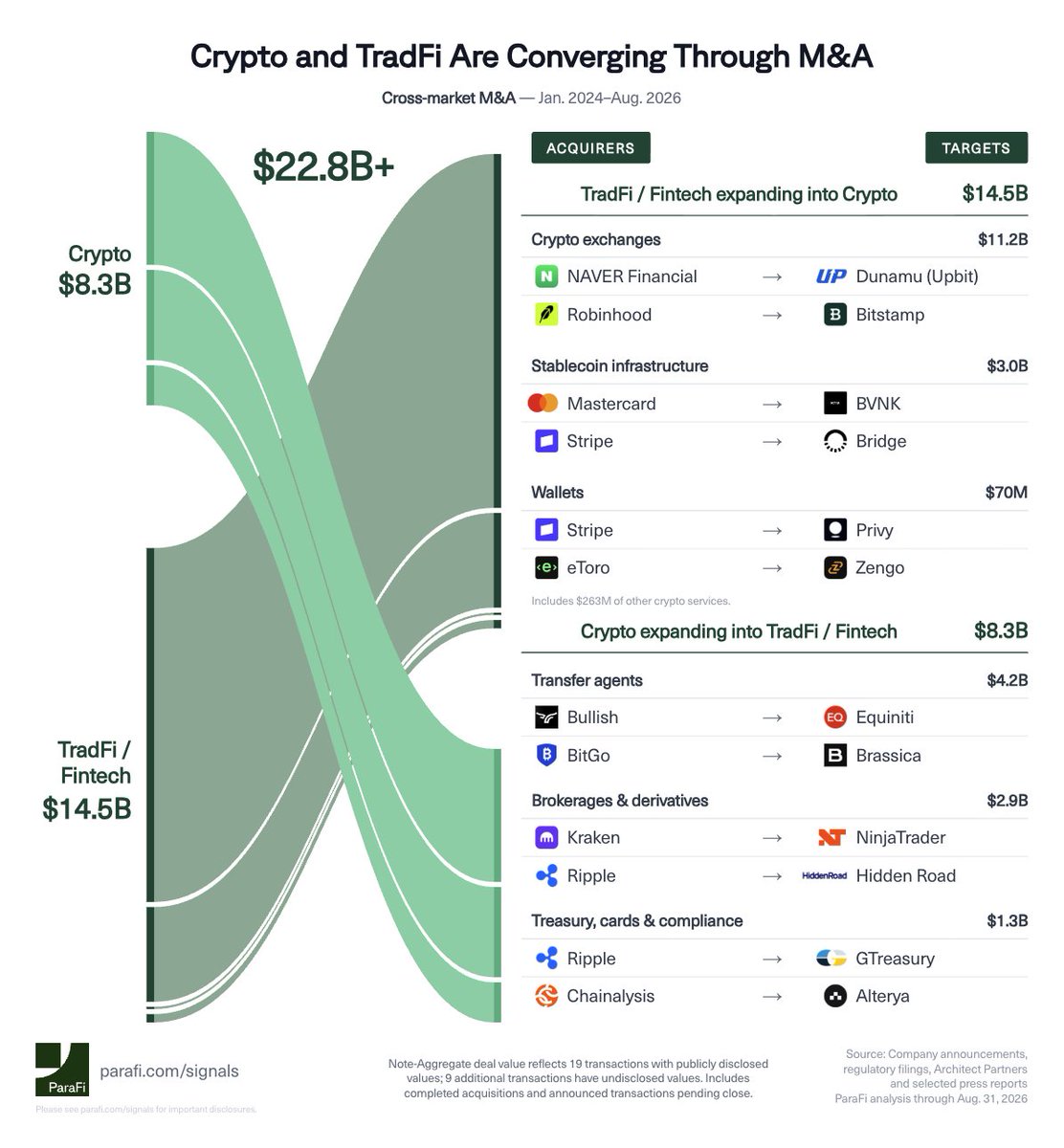
Crypto and TradFi are converging through M&A.
Cross-market M&A between crypto and TradFi has exceeded $22.8B in announced deal value since January 2024, with $15.4B of deal value in 2025 alone.
TradFi and fintech firms are acquiring crypto exchanges, stablecoin infrastructure and wallets, while crypto firms are buying transfer agents, brokerages and derivatives infrastructure. Both sides are buying what they lack to expand beyond their native markets.
Non-US market hours still drive Bitcoin’s largest moves. Despite the swift rise of Bitcoin spot ETFs, IBIT being the fastest ETF on record to hit $50 billion in AUM, a 10% or greater price move week still usually prints outside NYSE hours. Since January 2021, Asia has owned 51 of the 85 weeks with at least a 10% one-way move, and the largest share of the variance. Even so, US market hours have taken a larger piece of those big weeks, 24% of the variance before the January 2024 spot ETF listings, 33% after. While Asia is still the default, US hours have become a bigger part of the move than they used to be.
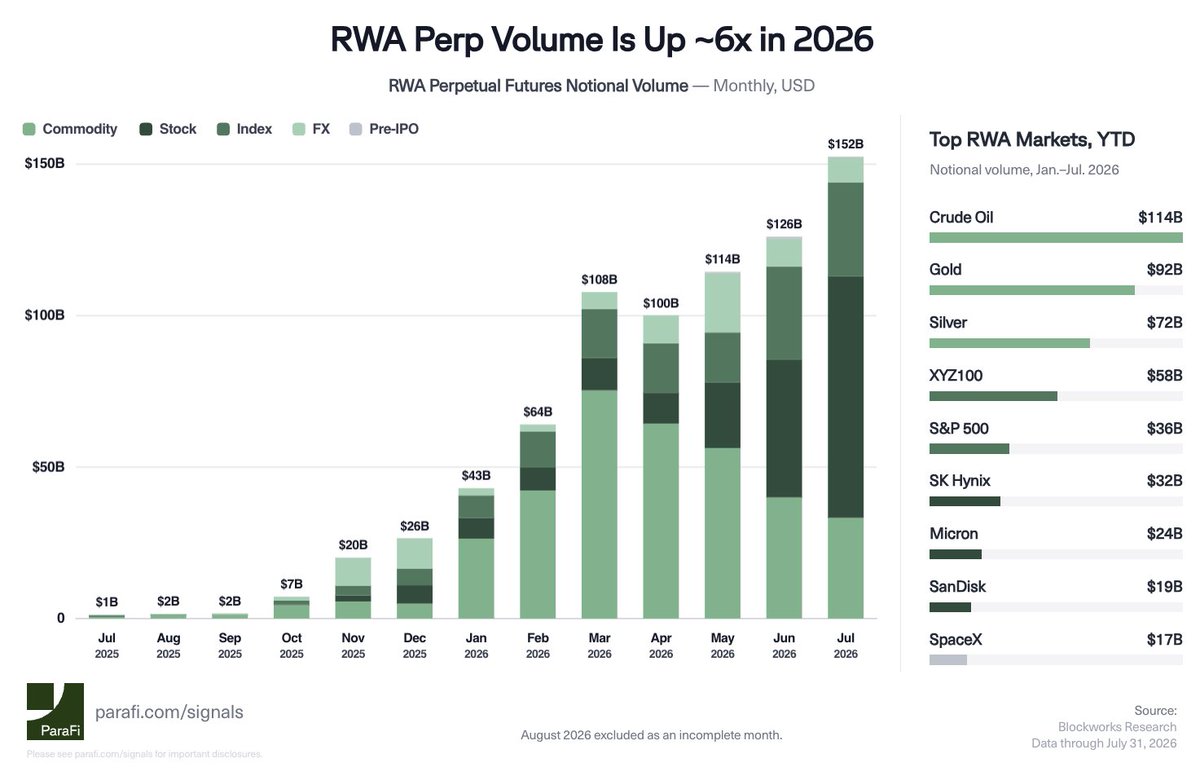
Perpetual futures trading volume linked to Real World Assets (“RWAs”) reached $152 billion in July 2026, up ~6x since the start of the year and more than 100x YoY. RWAs now represent 33% of all perp decentralized exchange (DEX) volume.
Trading spans commodities such as crude oil, gold and silver, major indices including the Nasdaq-linked XYZ100 and S&P 500, and equities such as SK Hynix, Micron, SanDisk and SpaceX.
Perp DEXs have emerged as a 24/7 global derivatives layer, offering continuous access, liquidity, leverage, price discovery and cross-market arbitrage for assets historically constrained by market hours, geography and private-market access.
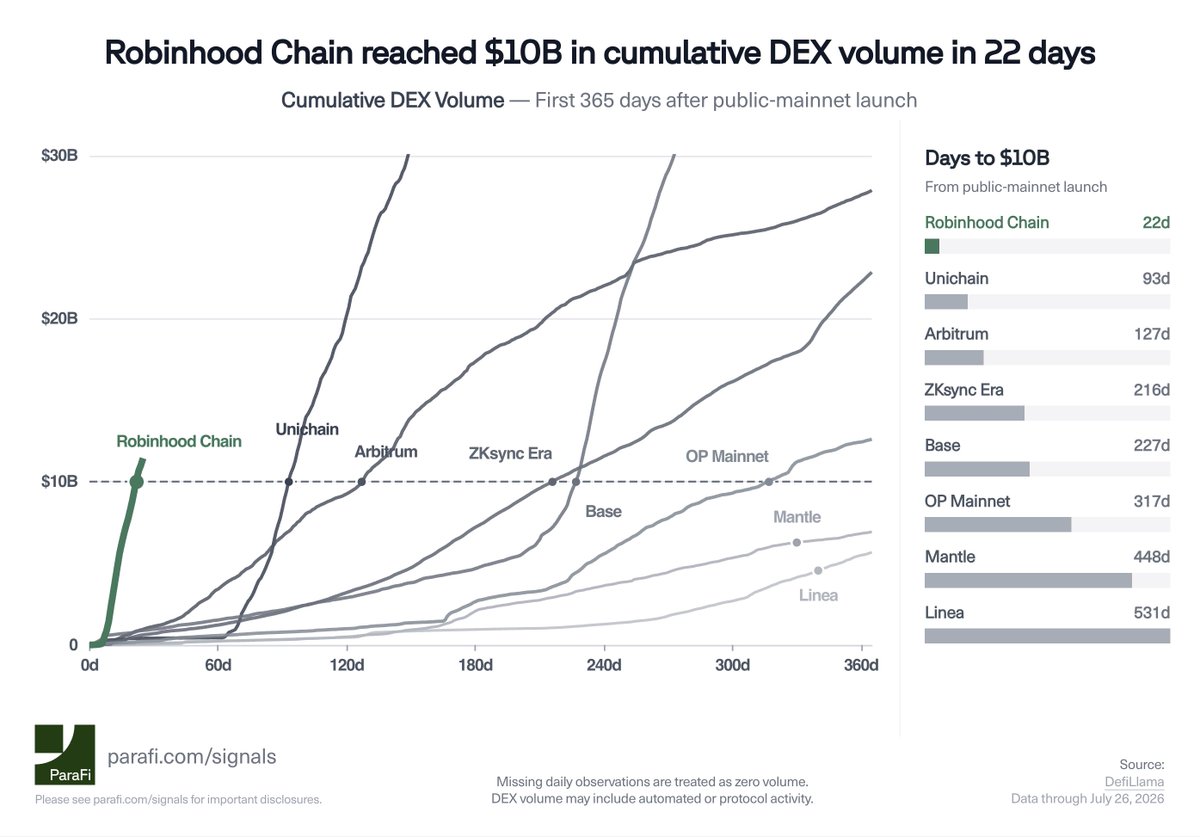
New-chain launches are far from over, but the playbook is changing. Robinhood Chain crossed $10 billion of DEX volume in 22 days, showing how an established consumer platform can bootstrap liquidity and activity far faster than a standalone network building distribution from scratch. More than 80% of early DEX volume was memecoin-driven, but roughly $70 million of tokenized real-world assets and more than $400 million of stablecoins point to a broader financial stack taking shape. Building on the success of chain integrations by Coinbase and Telegram, Robinhood may be the turning point where app-owned chains become a repeatable vertical integration strategy across distribution, trading, settlement, and economics.
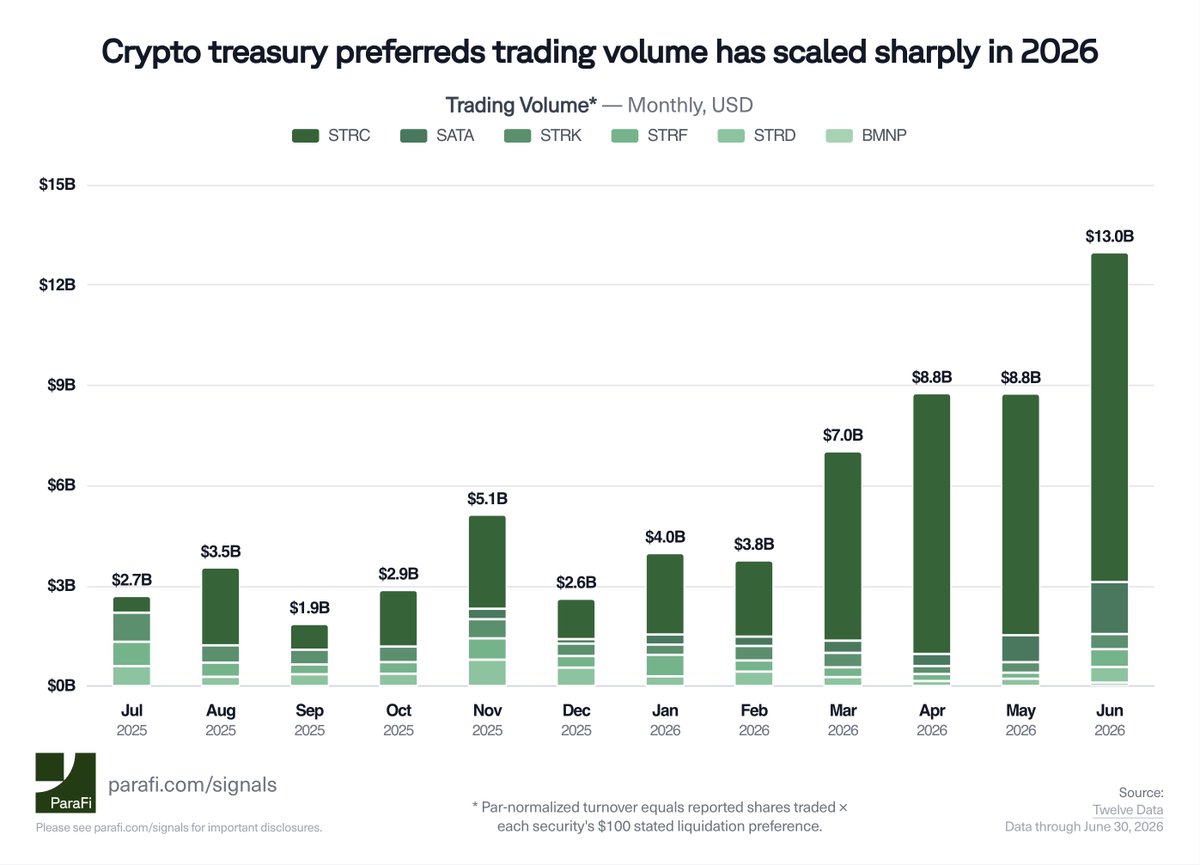
Trading activity in crypto treasury preferreds has accelerated sharply in 2026, with monthly par-normalized volume reaching approximately $13B in June. The step-change has been driven by STRC and a growing number of new preferred listings, transforming what was once a niche market for bespoke financing dominated by financial institutions (banks and insurers) into a broader, more liquid, and increasingly evergreen asset class.
Beyond higher trading volumes, the key signal is the maturation of the preferred equity market itself. As liquidity deepens, these instruments become increasingly more efficient not only on coupon and issuer quality, but also on secondary-market depth, relative value, and the durability of investor demand. This evolution is beginning to extend beyond crypto: in June, Alphabet launched its first convertible preferred offering as part of an $80B + equity raise to fund AI infrastructure, while Super Micro Computer announced a $3.75B convertible preferred issuance within a $7B capital raise for AI expansion, underscoring the growing role of preferred equity as a scalable financing instrument across sectors.
Solana apps like @phantom, @Pumpfun, and @JupiterExchange now generate meaningfully more revenue than the chain itself. In May 2026, Solana apps generated ~$94M in monthly retained revenue versus ~$18.6M in Solana Real Economic Value (REV), a measure of chain fees plus MEV tips.
That gap has persisted even after chain fees normalized following the TRUMP/MELANIA memecoin frenzy in January 2025. In our view, the data suggests that Solana is increasingly behaving like a platform economy where applications capture multiple times more value than the base chain itself.
Tokenized equities reached ~$1.6B AUM (>60x YoY) after xStocks and Ondo released permissionless products. Total holders of tokenized equities reached ~300K (35.6% share of RWA market), overtaking commodities to become the most widely held RWA asset class. Nvidia, Tesla and S&P 500 lead distribution with over >100K holders. We believe the rapid adoption reflects a simple but powerful unlock; for the first time, anyone in the world with an internet connection can access U.S. equities.