Almost everyone you meet is sure of what they “know” to be true.
Absolutely certain. Everyone that disagrees must be a moron.
This is more powerful and more useful to your speculative efforts than any indicator, newsletter or tipster pick.
Start with the things that don't change.
Humans are bad at thinking. Even worse in groups.
What’s the current thing “everybody knows for sure”?
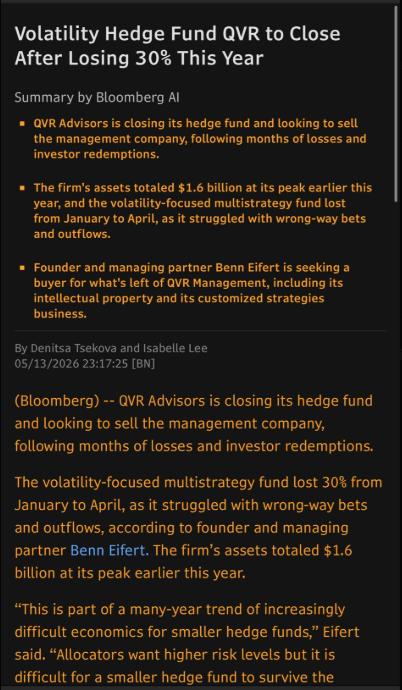
I know peeps will dunk on @bennpeifert tonight over this but props to him for taking a shot and building a firm to trade his vision. This can happen to any of us taking serious risk, the glory is in the comeback and we haven't seen the last of Ben.
Selling volatility gets a bad reputation. But most people confuse it with doing something that exposes you to terminal risk. Although often used synonymously, selling uncapped convexity with an extreme tail nature to it is different than selling vol.
There is absolutely nothing wrong with selling volatility as a trade. So here’s what you should look for and what you should avoid.
There are many factors that you can look at to determine if you should be selling volatility. Simple implied vol over realized, extreme spot vol beta of a specific tenor due to an end user dislocation, etc. But the main and only thing that goes into this consideration is if the risk you are taking is well compensated. Naturally, short vol trades like selling puts will be a concave bet, but strategically certain moments in time warrant that. If someone tells you, “hey I’ll bet you my $1 to your $2 that if I spin this roulette wheel I will get 00,” you aren’t going to say “no, I won’t take that because it’s not a convex bet.” That would be misunderstanding the whole point of derivatives trading, which is to take bets in areas that are not priced accordingly. If you see that bet you would take it all day long because the bet on the table well compensates you for the minimal risk you are taking in relation to the odds. This is a core feature that separates good opportunistic short vol traders from the yield harvesting guppies that blow up every few years.
So in summary, you want to sell vol when two main things are met. One, you have some statistical validation as to why you believe the future pricing will be lower. And two, you are being compensated for taking on that risk in a way that makes it economically feasible.
Here’s what is something you should avoid. There are two main pockets where I see “vol sellers” deteriorate. The first one is the yield harvesters. This always ends the exact same way. You will get a system that sells vol indiscriminately, completely agnostic to value, but more focused on the target return it wants to yield. What this ends up doing is forcing the system or trader to sell vol at discounted prices and sell more units, which in turn takes on more risk in order to meet a target return. This shifts the seesaw in the direction of not being compensated enough for the embedded risk you are taking on. The other thing I often see is a psyche cope around put selling to generate income, with the view that they will just be executed long the stock. This sounds good until you operate in practice, mainly because the situation of a security changes on a second by second basis. You can say “hey if XYZ drops 20% in a week I will be a buyer.” Sure, but that is based on the current condition of XYZ. Now include some type of fraud concern and the appeal to be executed on your contract changes because the material facts have changed.
As with many things in markets, you get paid to take risk. You have to risk it for the biscuit. But the baker does not have good deals every day. So make sure you are waiting for when the deals are good, and make sure you are not risking your mortgage for three day old stale bread.
🚨 In 2013, Ben Polak gave a Yale lecture that quietly changed how smart people make decisions.
Most people have never seen it.
And instead of teaching theory, he showed how decisions actually play out in real life.
One hour that can completely shift how you think.
He broke down game theory into something practical. Not equations, but thinking patterns. Like dominance where the best move becomes obvious once you remove weak options. Or backward induction starting from the end and reasoning your way back to the present to make smarter choices.
And then there’s something subtle but powerful: proactive bias. Most people wait, react, and adjust. The best decision-makers move first, shape the game, and force better outcomes.
What makes this lecture different is how usable it is. It’s not about being “right” it’s about thinking ahead, understanding incentives, and making moves with clarity.
Because in negotiations, business, and even everyday life…
Better decisions don’t come from more information.
They come from better thinking.
If you are interested in asset allocation read Ilmanen's books Expected Returns: An Investor's Guide to Harvesting Market Rewards (2011), Investing Amid Low Expected Returns (2022), and his articles at the AQR site. Other good books are
Asset Allocation: From Theory to Practice and Beyond (2021) by Turkington, Kritzman, and Kinlaw
Beyond Diversification: What Every Investor Needs to Know About Asset Allocation (2020) by Sebastien Page
Pioneering Portfolio Management (2009) by David Swensen
The Story of Mr Crude
I start my journey as a fossil fuel all the way in the Middle East (probably the dinosaur was my ancestor). I get loaded onto a ship called a Very Large Crude Carrier (VLCC) and get discharged into somewhere in Asia, with so much refining capacity but limited availability of domestic crude.
Then in the refinery, I get distilled (i.e. split up) and upgraded into various fractions. The light ends: LPG, naphtha, mogas. The middle distillates: jet fuel, diesel. The bottom of the barrel: fuel oil.
All these little fractions are called refined products. If you don't have little old me (i.e. Mr Crude), and if the refineries are not having enough to run, there will be no refined products.
What's the big deal then? Are you on your phone or computer reading this post? In a room with air conditioning? Almost everything you see has links with me, whether the fuel to generate electricity (in some countries), or the material to make the phone and computer (plastics, from naphtha), to the delivery of goods to your home (transport fuel).
So if 20% of the world's oil supply is blocked for more than 3 weeks, I think we have a problem, sir.
Yours sincerely,
Mr Crude
#oott
Here is the compilation of all my posts regarding the basics of crude, condensates and refined products to help you make sense of how bad the situation is for each product.
1) Crude - The tussle for crude leading to high crude premiums and the mismatch of crude qualities to replace the medium sour crude that Asia sorely needs
2) Condensates - The impact of Qatar LNG outage to the oil and petchem world
3) Naphtha + LPG - The basic building blocks of plastics and the bare necessities of life
4) Mogas - the most politically charged barrel but the easiest to solve in the current crisis
5) Jet fuel - The most stressed barrel because you can only get jet fuel from refineries
6) Diesel - The workhorse of the barrel. You need this fuel in industry, power gen, mining, fishing.
7) Fuel oil - The forgotten, unloved barrel but is now priced higher than crude. This is used predominantly as bunker fuel in many of our ships, so again - no crude for refineries = no bunker fuel produced
Sharing is caring. Repost if you care. #oott
As a volatility trader, my philosophy on trading might be a little different than most other participants.
VIX is variance that generally trades at a premium to S&P implied, which means that if VIX is at a certain point, you can have a general understanding of what the market is implying.
When VIX is above 30, it’s like the opportunity set unlocks. Almost like a video game. Vol control funds start stepping in, RV traders begin to take more risk, passive players start blowing through lines, and yield focused vol sellers start adding. The opportunity to make a year in a month becomes very attractive.
When VIX is above 40, I categorically view this as when you can really make a few years’ worth of P&L. The edge in some pockets becomes very attractive as we start to step into a true “outlier” environment.
Anything above 50 VIX is really home run territory. This is where lines start breaking and you can make your career in a flash.
This is all obviously a trading heuristic. Most of the time what I do is boring. It’s about hitting singles and keeping the lights on when there is no volatility. But whenever it eventually arises, it’s all lights shining down, with a core focus to make as much as possible within those small windows.
If you are a newer trader in the vol space, I would suggest you try to frame your thinking this way. If that doesn’t fit well, volatility trading might not be the asset class for you as it might create more mental havoc than monetary opportunity.
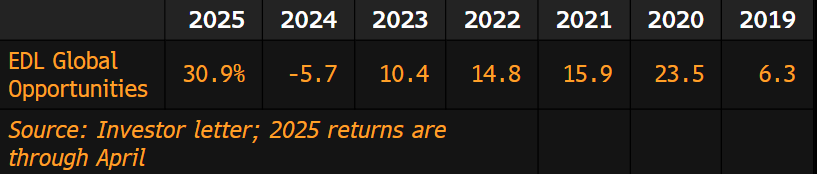
“I must be a masochist to be short the S&P 500”: trading veteran Edouard de Langlade. “Even when the Fed is on the sidelines, the index bounces back. I am starting to think only divine intervention can put it down for more than a month.” Fund up 31% YTD https://t.co/7yunjJBwEv
In 2010, George Soros gave a 40-minute masterclass on why humans misjudge market reality.
He explained why:
- Markets distort reality
- Bubbles are logical, not irrational
- Regulators must fight markets
12 lessons from Soros that change how you see financial markets forever:
In pre-production for Margin Call (2011), the film had a tiny $3.5 million budget. Irons and the rest of the A-list cast took massive pay cuts because they were so impressed by the precision and "Shakespearean" quality of the dialogue.
In trading, you’ll go through periods where you strikeout on everything. Drawdowns are part of the game. But you never, ever let any one position put your career as a trader at risk.
The move in metals right now is getting to the point where some traders are stomaching large losses and are now at the point of serious career risk.
It’s never worth it, and there’s always another trade around the block.
The beautiful thing about trading is that if you don’t have luck at one slot machine, you can always take your chips and go to another one at any point and time.