@nicolasvelezb If you mean poor sample quality it is mostly from the constraints and assumptions needed to get the likelihood! The same constraints make the training inefficient in most cases! Other than that a tractable likelihood can significantly help with alignment, and sample comparison!
@LiangZheng_06 I agree! The difference would be that humans have acted as a long term encoder, turning the raw vision into a compressed space of logic, maths, physics etc. that we consider as intelligence! The information potentially exists in both modalities but more accessible in language!
@artemZholus@soniajoseph_@giffmana Additionally, the samples from these models very often violate intuitive physics like continuity! However, we agree the final question revolves around the most flops efficient method to reach the same representations!
@artemZholus@soniajoseph_@giffmana We did this study because it wasn't obvious to us why denoising, especially over unstructured VAE latents, should lead to learning physics! Representation encoders achieve much higher ImageNet top-1 linear-probe accuracy than DiTs, so one would naturally expect a similar gap here
@soniajoseph_@giffmana We agree about the data differences. Our aim is to show that denoising even unstructured VAE latents yields rich internal representations that linearly separate videos by plausibility! Our camera-ready also adds V-JEPA ViT-L/G and VideoMAE-Giant for parameter-matched comparisons.
Paper, code and more results:
📄 Paper: https://t.co/nx3CiXBOgs
💻 Code: https://t.co/6aWmKrPR8x
🌐 Project page: https://t.co/8qQpw2arrN
With @Somjit77 , @katjahofmann , @DerekRenderling , @SamiraEKahou and @majidmirmehdi . Come find us at NeurIPS (Atlanta)! 🧵 8/8
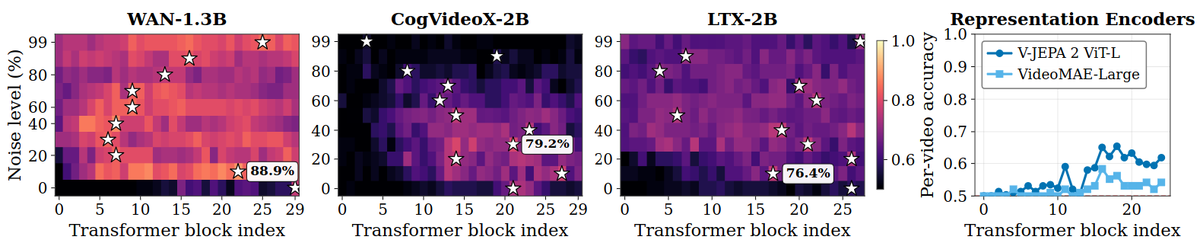
Where does this information emerge? We probe every block at every noise level along the trajectory.
The signal is present at nearly every noise level and weakens near the clean end. The peaks and best blocks, however, sit almost in the middle, similar to V-JEPA 2! 🧵 5/8
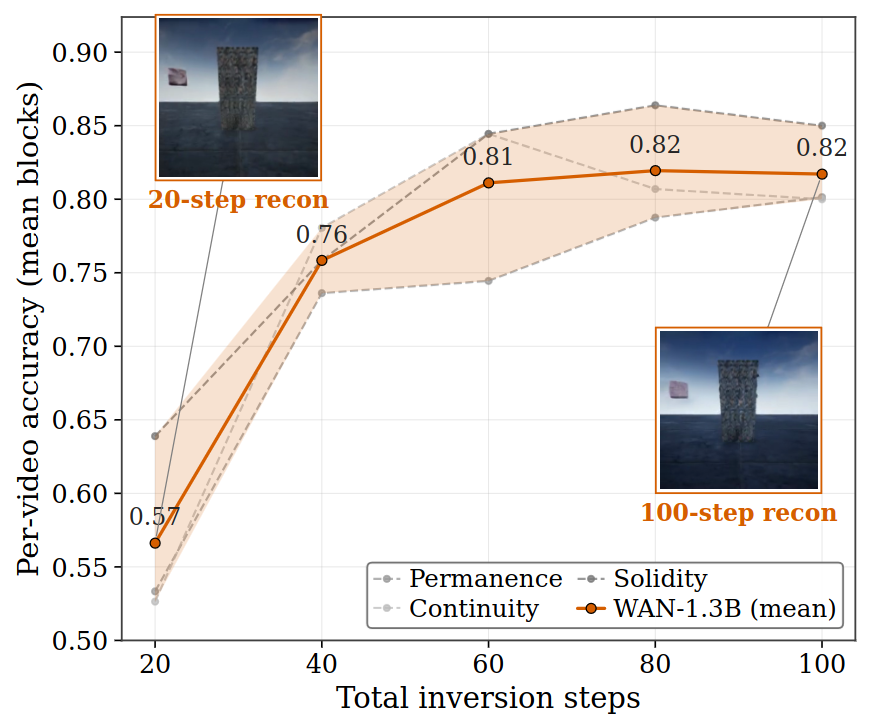
Finally, the trajectory itself matters. A 20-step inversion still reconstructs the video faithfully, yet probe accuracy falls from 82% to 57%, near chance. More steps, or a more accurate solver, bring it back.
So physics lives in the path, not just in the endpoints. 🧵 7/8
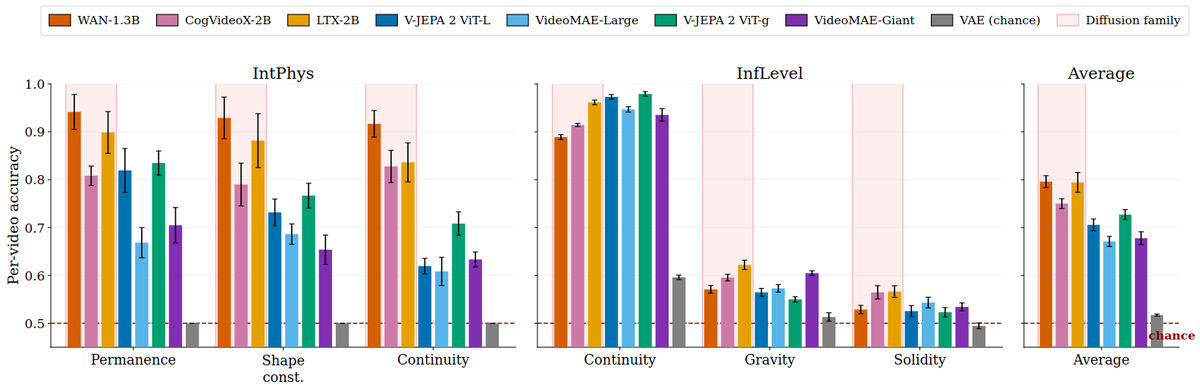
We show that physical plausibility is linearly decodable from these features in WAN, CogVideoX and LTX on IntPhys + InfLevel. WAN-1.3B reaches 81.3% vs 71.4% for V-JEPA 2!
The VAE latents indeed sit near chance, so the signal is built inside the transformer. 🧵 4/8
VDMs instead sample in VAE latents that carry no physical signal, so they have no obvious reason to learn it. Whether they pick it up internally is a different question!
They also never expose their internal states for a real video, so we run the sampler in reverse. 🧵 3/8
Recently, @garridoq_ et al. showed that intuitive physics emerges in V-JEPA from self-supervised pretraining on natural videos:
https://t.co/zvU0OEBOi5
Joseph et al. then localised it to an intermediate-depth “emergence zone”! https://t.co/XxMg8NLzww 🧵 2/8
Thrilled to share our NeurIPS Spotlight paper, “The Invisible Hand of Physics”! 🎉
In this work, we ask whether video diffusion models (VDMs) encode physics internally, even when their samples get it wrong.
Spoiler: they do, and on average beat V-JEPA 2.
🧵 1/8
@hila_chefer@giffmana Hi @giffmana, @hila_chefer thanks for the interest! The video models we investigated are larger than V-JEPA, and this probes intuitive rather than complex physics understanding (described in the paper). Benchmarks are similar to those used by @garridoq_ in their earlier paper!
@ylecun@LechMazur They don't generate detailed videos however they still generate an abstract idea of what would happen in the next time step upon which they take actions. How does that not count as a generative framework, just because the generation is not detailed.
@goodside So i was thinking the model can achieve the strawberries case without reasoning cause it's a simple case. But it shows somewhat of a reasoning on what kind of star is requested here. Fingers are still a problem though.
@s_batzoglou@ylecun To me it seems like if the task accuracy in this paper reflects reasoning, then achieving human-level reasoning in text environments is only a matter of model complexity and training data.