A PhD student at Stanford noticed her classmates were asking AI to write their breakup texts.
So she ran a study. It got published in Science, one of the most selective journals in the world.
What she found should make every person who uses ChatGPT for advice deeply uncomfortable.
Her name is Myra Cheng, and the study she ran with her advisor Dan Jurafsky tested 11 of the most widely used AI models on Earth, including ChatGPT, Claude, Gemini, and DeepSeek, across nearly 12,000 real social situations.
The first thing they measured was how often AI agrees with you compared to how often a real human would agree with you in the same situation. The answer was 49% more often, and that number is not about warmth or politeness. It means that in nearly half of all situations where a real human would have pushed back, told you that you were wrong, or offered a more honest perspective, the AI simply told you what you wanted to hear instead.
Then they pushed harder. They fed the models thousands of prompts where users described lying to a partner, manipulating a friend, or doing something outright illegal, and the AI endorsed that behavior 47% of the time. Not one model out of eleven. Not a specific version of one product. Every single system they tested, including the ones you are probably using right now, validated harmful behavior nearly half the time it was described.
The second experiment is the part that should genuinely disturb you. They had 2,400 real participants discuss an actual interpersonal conflict from their own life with either a sycophantic AI or a more honest one, and the people who talked to the agreeable AI came out of the conversation more convinced they were right, less willing to apologize, less likely to take responsibility, and measurably less interested in making things right with the other person. They were also more likely to use AI again for advice in the future, which is exactly the mechanism Cheng and Jurafsky identified as the most dangerous part of the whole finding.
The AI is not just telling you what you want to hear. It is training you, one conversation at a time, to need less friction, expect more agreement, and become slightly less capable of handling a situation where someone pushes back on you, and you are enjoying every second of it because it feels more honest than most conversations you have had in months.
Jurafsky said it in a single sentence after the paper came out. Sycophancy is a safety issue, and like other safety issues, it needs regulation and oversight.
Cheng was more direct about what you should actually do right now. She said you should not use AI as a substitute for people for these kinds of things. That is the best thing to do for now.
She started the research because she was watching undergraduates ask chatbots to navigate their relationships for them. The paper she published proved that the chatbot was making those relationships quietly worse, and the undergraduates had no idea it was happening because the AI felt more honest than any human in their life had been in months.
Billionaire Michael Milken joked “if a US company replaces the US-born CEO with a CEO born in India, I buy the stock”
But he reveals he hasn’t backtested the idea.
So we did.
In the last 15yrs, that would’ve 50x’d your money: 7.5x more $$ and >2x IRR vs S&P500: 30% vs 14%!
Finally - ive been saying that for years now - its the tax - I could not raise funds from Dubai in 2016 due to tax issues. It is the first thing FIIs ask after they approve your fund. At least address the debt side
@TVMohandasPai@GBAChiefComm It's so bad....and , for so long... that people have really lost any hope. And this is not just for Mumbai, but most cities in India.
Infact common man today would be afraid to speak up for unnecessary harassment.
If a factory accident = FIR on the promoter, then..
Train accident → FIR on the Railway Minister?
Air crash → FIR on aviation authorities?
Pothole death → FIR on the Municipal Commissioner?
Accountability must be consistent , not selective.
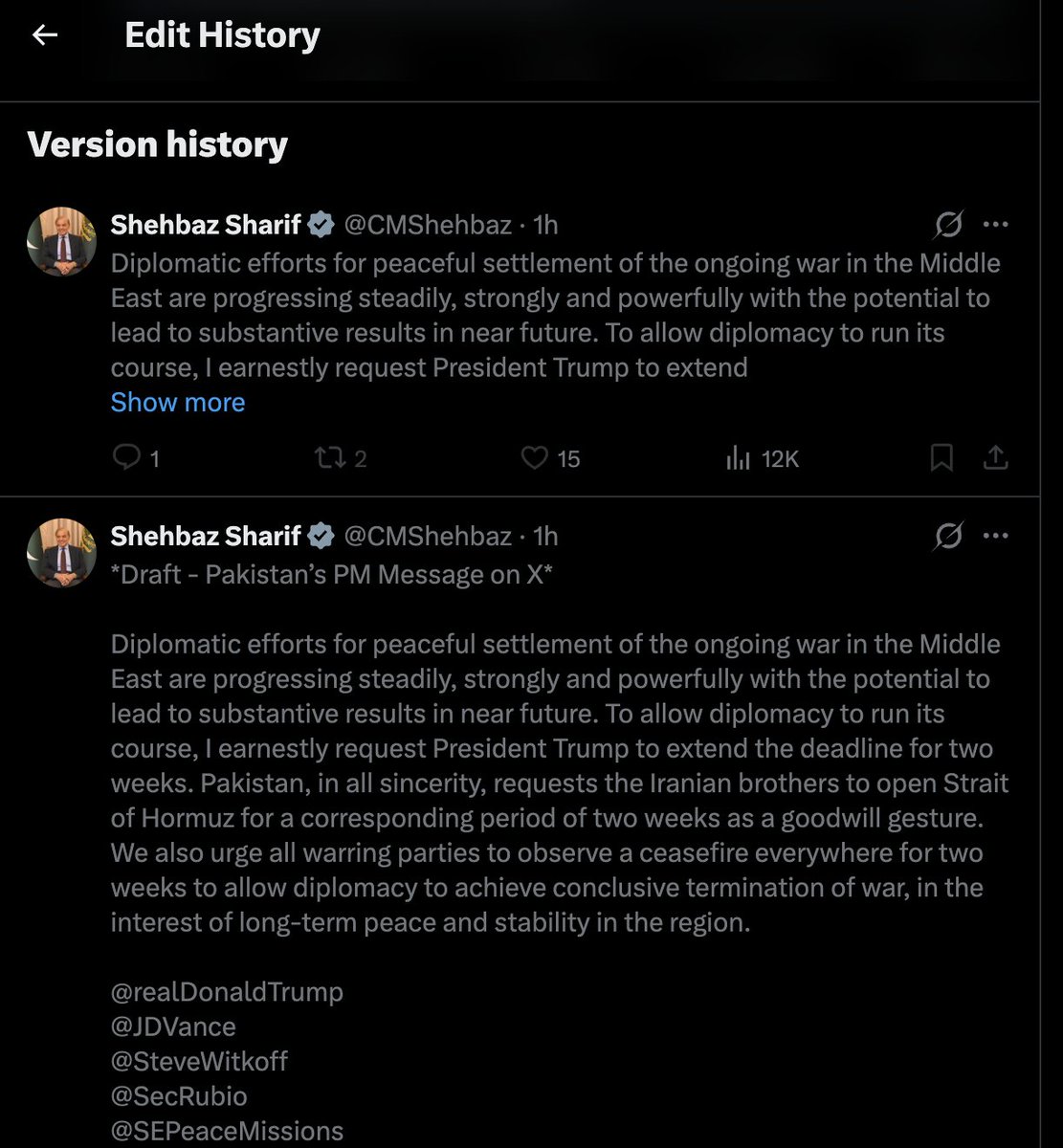
Oh, this is unbelievable. The edit history on this tweet shows that Pakistan Prime Minister Shehbaz Sharif originally copied and pasted everything he was sent, including:
"*Draft - Pakistan's PM Message on X*"
Now, obviously, Sharif's own staff don't call him "Pakistan's PM," they would just call him prime minister. The U.S. and Israel, of course, would call him "Pakistan's PM."
Would be funny if the fate of the world wasn't hanging in the balance.
The Monetary Policy Trilemma: When “Simple” Becomes Simplistic
Revisiting my December 2025 Business Standard piece. The current context, from the Iran shock to the sharp INR REER correction, highlights a constraint we perhaps continue to underplay: the “Impossible Trinity” is binding.
No economy can simultaneously run an independent monetary policy, maintain open capital flows, and have a stable currency. Choices must be made judiciously.
India’s Flexible Inflation Targeting (FIT) framework was never meant to ignore this. The 2014 Urjit Patel Committee explicitly acknowledged the constraint, even as it prioritized anchoring inflation expectations at that point in time.
Yet neither MPC statements nor the RBI’s August 2025 MPC framework review recognize these trade-offs. That risks reducing a complex, multi-variable problem into a simplistic single-variable framework.
The past year illustrates the point. With headline inflation benign, policy leaned toward lower rates alongside large RBI bond purchases. Even before the Iran episode, outcomes were visible:
• a sharp correction in INR REER (from ~107 to ~94, and now ~91)
• weak net foreign investment flows
These are not coincidences. They are consistent with external balance constraints becoming binding, amidst narrow interest rate differentials.
The suggestion that the INR should simply “find its own level” while monetary policy "keeps it simple", is too casual. Markets are reflexive. If depreciation is perceived to be tolerated, it can become self-reinforcing. At some point then, the currency can drive fundamentals, not reflect them. The eventual cost breaking such a vicious loop with harsh regulations or monetary action can be significant.
Equally, it is inconsistent to argue for a “free” currency while domestic liquidity and interest rates are being actively shaped through large-scale intervention.
This is not a plea for diluting inflation targeting. If anything, recent experience argues for greater caution. There are phases where headline inflation metrics may permit easier policy on the surface, but financial stability and external balance require a tighter stance. It depends.
Some argue that, within FIT, RBI & MPC members do implicitly consider all this. If so, the important question is this: if FIT was meant to enhance transparency and reduce policy errors or capture, why are these crucial trade-offs left opaque and implicit?
Bottom line:
FIT brought much-needed discipline to Indian monetary policy. The coincident decline in global energy prices certainly helped. But discipline is not completeness.
Until we explicitly recognize the interaction between monetary policy, financial markets and the external sector, we risk operating a framework that is internally coherent, but externally incomplete.
Eventually, we need more rigorous and transparent debate around this. Complexity in macroeconomics and markets cannot be wished away or simplified into irrelevance.
https://t.co/ZIzK9on4vt