He walked into a restaurant during a quiet Tuesday afternoon.
He didn't pitch software. He showed the owner his phone.
"Type an order like a customer would."
The chatbot took the order, confirmed the table, logged it in a Google Sheet, and sent it to the kitchen in under two seconds.
The owner asked how much.
"$500/month. First month free. If it doesn't save your staff real time, you owe nothing."
That conversation has played out 30 times. It closed 30 times.
30 clients. $500/month each. 4 hours of setup per restaurant. 93% margin.
Over 1 million restaurants in the US. Fewer than 3% have this.
He just keeps walking in during quiet Tuesday afternoons.
If I were in my 30s or 40s & wanted to retire in the next 10 years using AI, here’s exactly what I’d do:
1. Set up an LLC immediately. Not next month. Not after you "feel ready." This week.
Karpathy threw a grenade at every senior engineer who still treats LLMs as a toy.
his actual words: the worst thing an expert can do right now is reject them.
most experts read it as a threat, but it's advice.
his framing:
> the gap between "AI tools are bad" and "AI tools are useful when used right" is professional discipline, not capability
> agents have cognitive deficits. they fail in ways nothing in the training set anticipated
> the experts who reject LLMs lose to experts who learn to wrangle them
> "models have so many cognitive deficits. but you can route around them"
routing around the deficits is what CLAUDE.md was invented for.
Karpathy himself wrote 4 rules. across 30 codebases they took my Claude error rate from 41% down to 11%. solid drop.
but his rules pre-date the slop era going public. I bolted on 8 more, tuned to the failure modes that surfaced after January. got it down to 3%.
a CLAUDE.md does not raise Claude's IQ. it lowers his slop floor. that is the entire game.
open the article underneath.
the model is not the bottleneck. your config is.
@scorpiomanojFRM Can you tell me why you have taken only 4 external features- usdinr, usoil, msci and breadth? You also can take fii dii flow, sentiment ( I have seen your posts where you have done webscraping)
@Akshat_World Mf if you have access to US market and you haven't ride the wave of memory chip and semiconductor boom, you should only buy Nasdaq/S&P index 😆
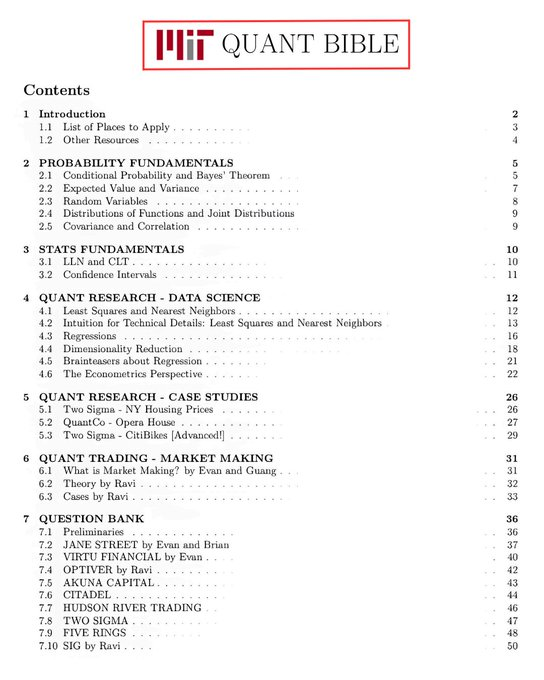
MIT JUST LEAKED THE EXACT DOCUMENT WALL STREET QUANT FIRMS USE TO HIRE PEOPLE.
It is called the MIT Quant Bible.
And it covers everything the $500,000 a year quants actually know that you do not.
Here is what is inside:
Probability fundamentals. Conditional probability, Bayes theorem, expected value, variance, joint distributions. The mathematical foundation every trading decision at Jane Street and Citadel is built on.
Stats fundamentals. The Law of Large Numbers. Central Limit Theorem. Confidence intervals. The tools quants use to know when a signal is real and when it is noise.
Quant research and data science. Least squares, regressions, dimensionality reduction. Real case studies from Two Sigma, QuantCo, and CitiBikes.
Quant trading and market making. What market making actually is and how the theory translates into real trading decisions.
And then the part that makes this document worth more than most finance degrees.
A question bank with real interview questions from Jane Street, Virtu Financial, Optiver, Akuna Capital, Citadel, Hudson River Trading, Two Sigma, Five Rings, and SIG.
Not prep questions.
The actual questions these firms ask.
With answers.
The firms charging $50,000 a year for access to this type of preparation are not going to be happy this exists.
Bookmark this before it disappears.
Follow @cyrilXBT for every elite resource that gives you access to what the top 1% actually know.
🚨 A junior at Jane Street reportedly landed a $220K–$600K role because he used AI to analyze trillions of data points faster than most teams ever could.
In this 1-hour lecture, he breaks down the exact system behind it:
• how he researches massive datasets
• how AI finds patterns humans miss
• how his machine turns raw data into decisions
• how you can apply the same thinking yourself
Skip Netflix tonight.
Watch this instead.
One hour could completely change how you think about research, AI, and opportunity.
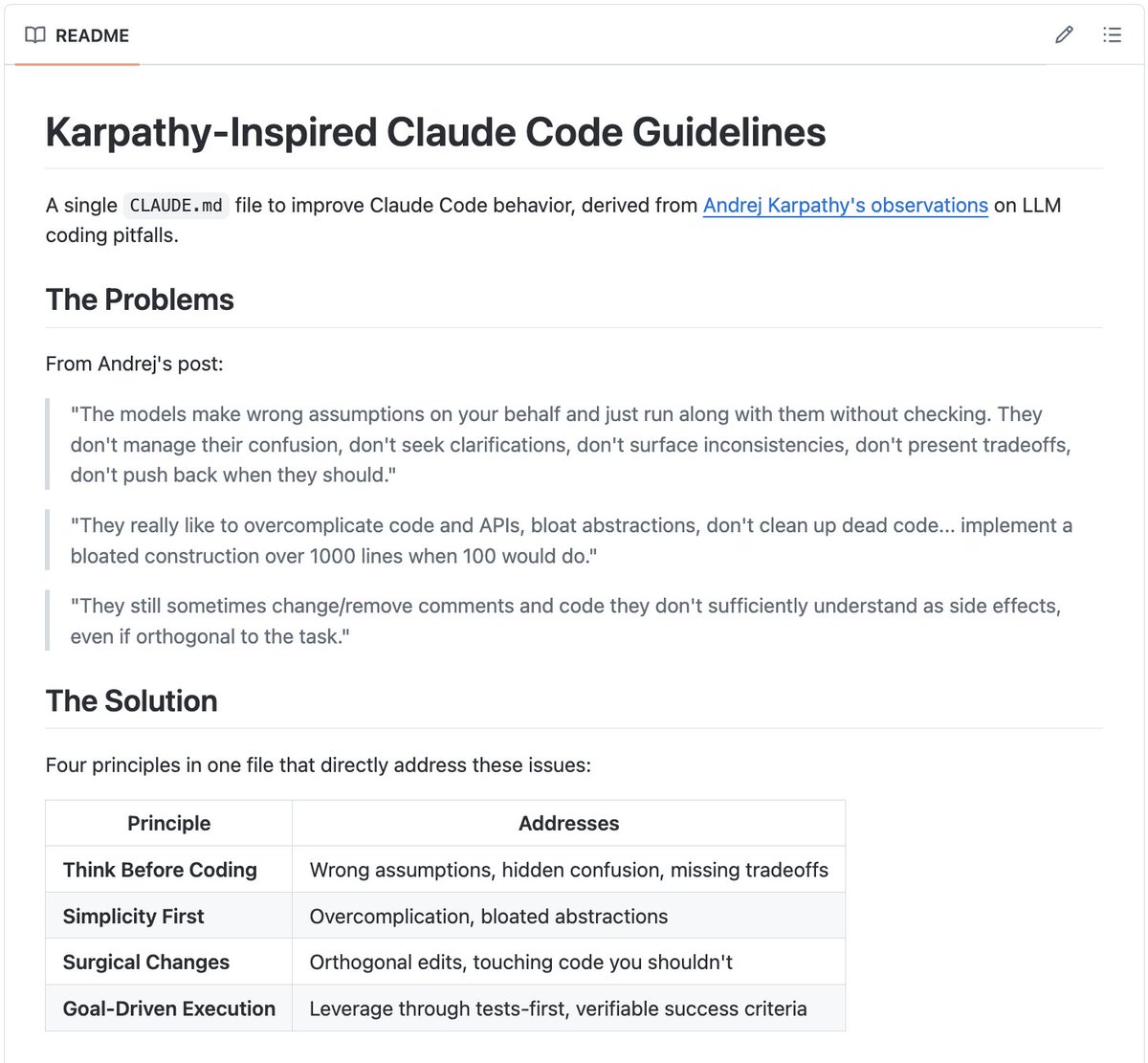
A single 𝗖𝗟𝗔𝗨𝗗𝗘.𝗺𝗱 file just hit 15K GitHub stars.
(derived from Karpathy's coding rules)
Andrej Karpathy observed that LLMs make the same predictable mistakes when writing code: over-engineering, ignoring existing patterns, and adding dependencies you never asked for.
If you've used AI coding assistants, you've hit all of these.
But here's the thing:
If the mistakes are predictable, you can prevent them with the right instructions.
That's exactly what this 𝗖𝗟𝗔𝗨𝗗𝗘.𝗺𝗱 does. You drop one markdown file into your repo, and it gives Claude Code a structured set of behavioral guidelines for your entire project.
This is a big deal.
- Built entirely around prompt engineering for AI coding assistants
- No framework, no complex tooling, just one .md file that shapes behavior
Developers are moving past "use AI to write code" and into "engineer the AI's behavior so the code is actually good."
The Claude Code ecosystem is growing fast, and the best tools in it aren't always software. Sometimes they're just well-crafted instructions.
100% open-source.
I've shared a link to the GitHub repo in the next tweet!
🤯 Don't hire an engineer to SET UP OPENCLAW
GREG ISENBERG & MORITZ KREMB just dropped a MASTERCLASS & taught you to do it yourself in 1 HOUR for $0.
Setup consultant: $3K
Greg's masterclass: FREE
26 billable hrs → 1 hour
🔖 Bookmark before it's gone.
🚨 JioBlackRock Flexi Cap Fund has been scanning small-cap stocks trading below their Industry P/E.
Here are 12 stocks fitting this valuation framework 👇
• Chambal Fertilisers & Chemicals - PE 9.3 vs Industry PE 22
• Elecon Engineering Company - PE 24 vs Industry PE 44
• Welspun Corp - PE 12 vs Industry PE 21
• Nava Limited - PE 17 vs Industry PE 26
• Jamna Auto Industries - PE 27 vs Industry PE 30
• Sammaan Capital - PE 20 vs Industry PE 18
• eClerx Services - PE 35 vs Industry PE 37
• CEAT - PE 29 vs Industry PE 31
• Aether Industries - PE 24 vs Industry PE 55
• Sharda Cropchem - PE 18 vs Industry PE 29
• Sagility India - PE 29 vs Industry PE 32
• Emami - PE 31 vs Industry PE 46
📊 Smart Money doesn’t chase hype.
They buy when valuation is comfortable.
From these 12 stocks, I find 5 extremely interesting.
Want to know which ones? 👀
❤️ Like
🔁 Repost
💬 Comment “Undervalued Stocks”
#SmartMoney #ValueInvesting #StockMarketIndia #SmallCaps #Multibagger
This is wild.
Someone just open-sourced a 1-person Wall Street AI agent that comes with:
- Research Desk
- Quant team
- Trading floor
- Risk Management
100% open source:
> be a chinese student
> work on small projects for your graduation on GitHub
> vibecoding data simulation systems using Cursor
> hits 60k stars on GitHub with 2 repo (BettaFish, MiroFish)
> get noticed by Chen Tianqiao, the former richest man in the Chinese internet industry
> secure $4M in funding from Chen
> go from student to CEO of a promising AI startup with backing from internet giants in <6months
> still believe that AI will one day learn to predict the future
I talked to Zihan Wang, one of the authors of the famous DeepSeek-V2 paper
In this podcast we talk about:
How the top AI labs compare.
The AI race between USA and China.
And what it's like to be an AI Researcher.
so we now have:
- OpenClaw
- perplexity OpenClaw (perplexity computer)
- anthropic openclaw (cowork)
- miniature openclaw (picoclaw)
- secure openclaw (ironclaw)
- chinese openclaw (kimi k2.5)
- enterprise openclaw (openai frontier)
the future is 100% agentic. get the fuck on board.
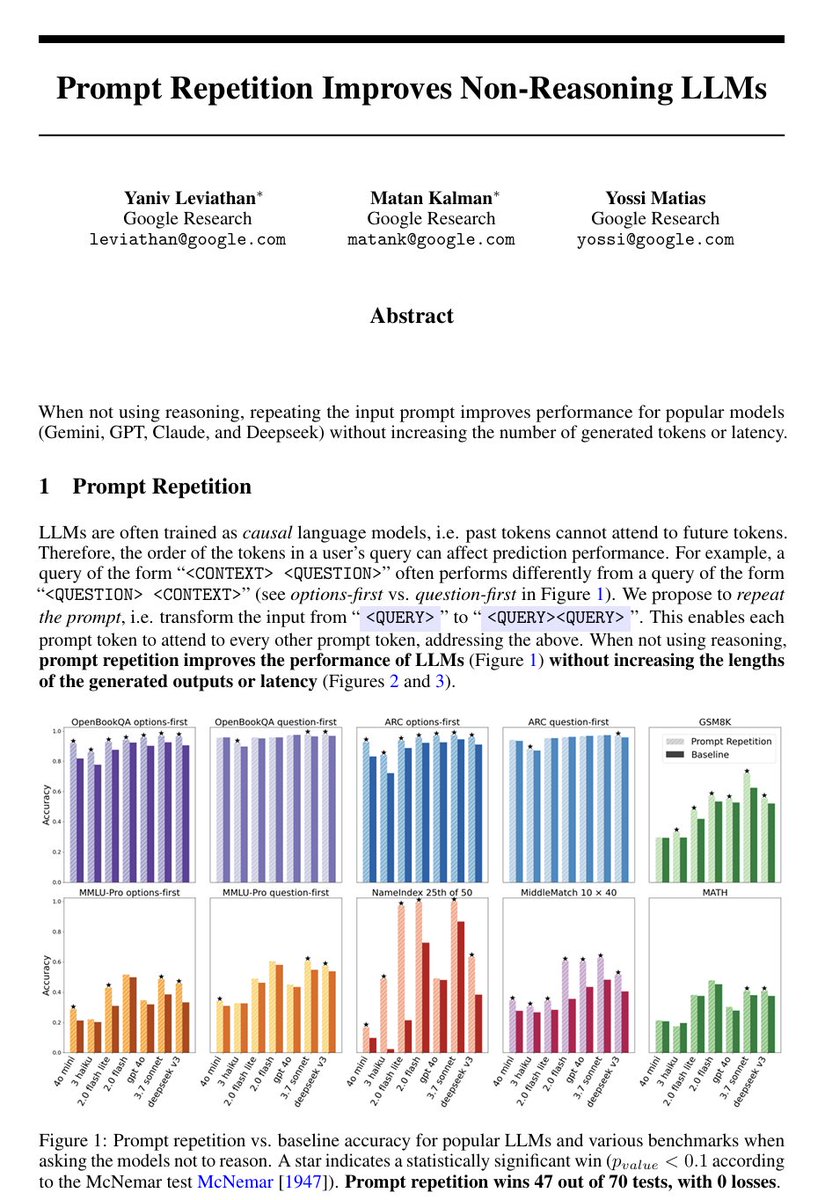
LLMs process text from left to right — each token can only look back at what came before it, never forward. This means that when you write a long prompt with context at the beginning and a question at the end, the model answers the question having "seen" the context, but the context tokens were generated without any awareness of what question was coming. This asymmetry is a basic structural property of how these models work.
The paper asks what happens if you just send the prompt twice in a row, so that every part of the input gets a second pass where it can attend to every other part. The answer is that accuracy goes up across seven different benchmarks and seven different models (from the Gemini, ChatGPT, Claude, and DeepSeek series of LLMs), with no increase in the length of the model's output and no meaningful increase in response time — because processing the input is done in parallel by the hardware anyway.
There are no new losses to compute, no finetuning, no clever prompt engineering beyond the repetition itself.
The gap between this technique and doing nothing is sometimes small, sometimes large (one model went from 21% to 97% on a task involving finding a name in a list). If you are thinking about how to get better results from these models without paying for longer outputs or slower responses, that's a fairly concrete and low-effort finding.
Read with AI tutor: https://t.co/MipHHO6rjX
Get the PDF: https://t.co/XQrqiaGwIO
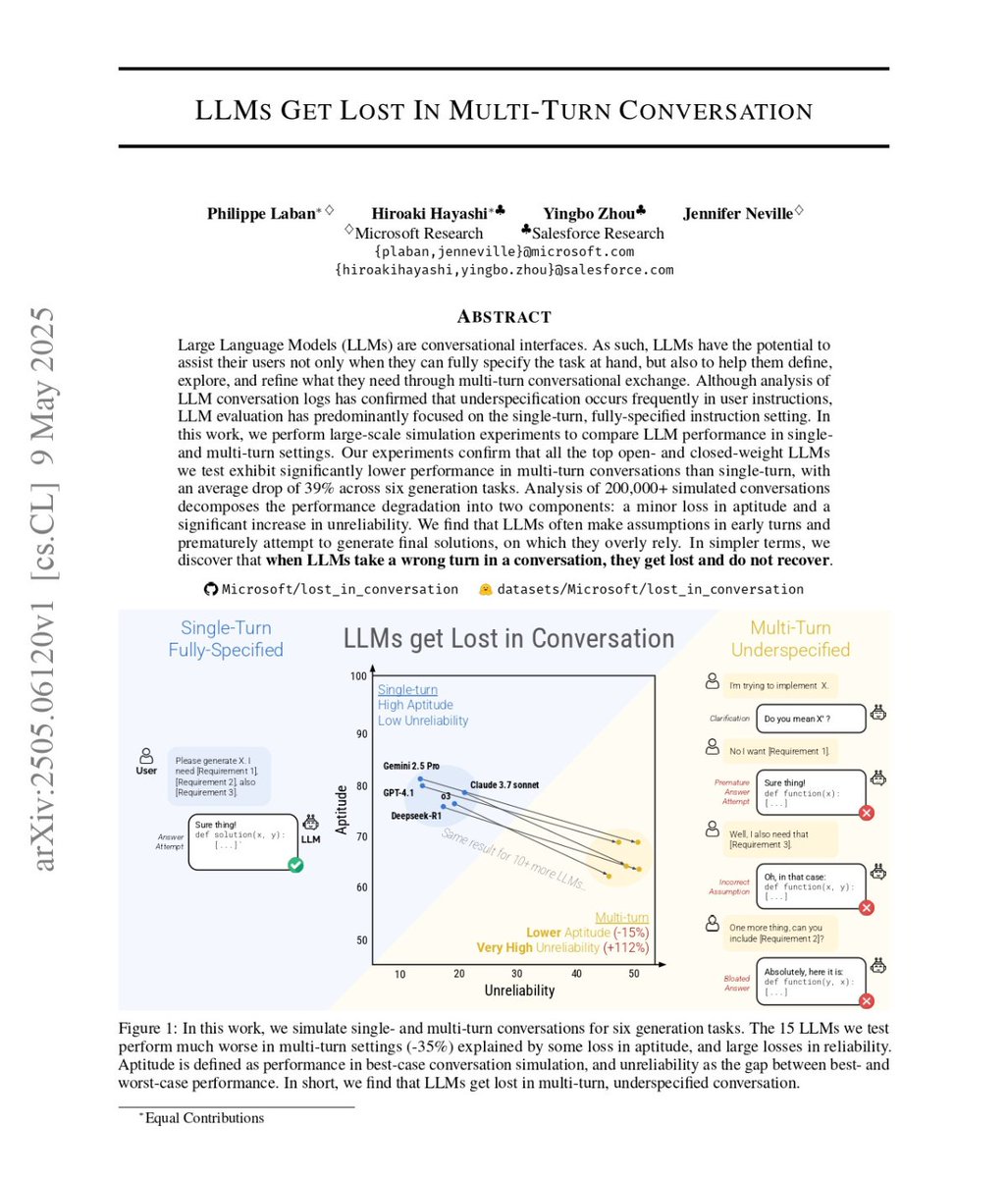
🚨BREAKING: Microsoft Research + Salesforce just dropped a paper that should scare every AI builder.
They tested 15 top LLMs GPT-4.1, Gemini 2.5 Pro, Claude 3.7 Sonnet, o3, DeepSeek R1, Llama 4 across 200,000+ simulated conversations.
Single-turn prompt: 90% performance.
Multi-turn conversation: 65% performance.
Same model. Same task. Just... talking normally.
The culprit isn't intelligence. Aptitude only dropped 15%.
Unreliability EXPLODED by 112%.
→ LLMs answer before you finish explaining (wrong assumptions get baked in permanently)
→ They fall in love with their first wrong answer and build on it
→ They forget the middle of your conversation entirely
→ Longer responses introduce more assumptions = more errors
Even reasoning models failed. o3 and DeepSeek R1 performed just as badly.
Extra thinking tokens did nothing.
Setting temperature to 0? Still broken.
The fix right now: give your AI everything upfront in one message instead of back-and-forth.
Every benchmark you've seen was tested on single-turn prompts in perfect lab conditions.
Real conversations break every model on the market and nobody's talking about it.
My favorite @perplexity_ai prompt I’ve made for traders.
Feel free to copy and use.
————————————————
Please analyze [TICKER] for me and provide the following, concise and clearly organized:
1. **Explain what the company does in like I'm 12 years old** - three short bullet points about what it does and any helpful relatable examples and analogies.
2. **Professional summary (max 10 sentences)** - industry, main products/services, primary competitors (list tickers), notable metrics or achievements, competitive advantage/moat, why they are unique and if they are a biotech provide if they have a commercial product or in clinical stages.
3. In a table, provide the follwoing:
* Any hot theme, narrative or story of the stock
* Any catalysts (earnings, news, macro)
* Any significant fundamentals (huge growth in earnings or revenues, moat, unique product or service, superior management, patents etc)
4. **Show all the main news/events for the last 3 months:** - Use a bullet-point table for: - Date (YYYY-MM-DD) - Event type (Earnings, Product Launch, Analyst Upgrade/Downgrade, etc.) - Short summary (max 1-2 sentences) - Direct source link - Mark any major price-moving events (surprise earnings, large guidance shift, top-tier analyst actions).
5. **Mention any recent insider buys/sells or institutional filings if visible.**
6. **Summarize how the stock is moving vs. main competitors and overall sector trend in past month (up/down).**
7. **Flag upcoming catalysts (earnings, product launches, regulatory events) in the next 30 days.**
8. **Note any changes in analyst price targets for this ticker during the period above.** - Format for easy review. If possible, use tables for events and peer moves. - Respond in clear, concise, easily readable style for use in trading decisions.
Overall, Focus on the reasons why the stock can make a big move in the future - earnings, sales, guidance, product launches, analyst upgrades/downgrades, insider buying especially from CEO/Founder and executive team, partnerships, and sector/news catalysts. I want to focus on stocks with catalysts and themes as catalysts are the cause of big moves in the stock market.
Finally, discuss and bring up any relevant previous perplexity queries and conversations.