What happens when the world is run on code no one understands?
By Patrick Shafto, Ken Ono, and
Scott Duke Kominers @patrickshafto@KenOno691@skominers
https://t.co/E7uSWbpTHl
@JTLonsdale I recollect the unusually harsh criticism by Karl Popper on the Frankfurt School and tenets. Non read in depth as I focus elsewhere but did read his Open Society e.g. re Hegel and Marx (w/Plato). If you X search on him and Adorno you'll see a lot w references. @MaxUnfried
@bengoertzel Great piece worth reading for having amateurishly mused on similar topics myself. As an old school I wondered about how it would have been written say 10 years ago before LLM's. Got feeling sometime of strange wording. No offence please, very much worth the reading effort 👌
Wonderful piece and useful resource. Cool the segmentation in 1st paragraph: I "entered" the field, as a learner, about 20 years ago with Aubrey's coauthored (w/ M. Rae) milestone book Ending Aging.
The full piece is here. I hope it can be as helpful to the community as it was to me in writing it.
https://t.co/ztYaB3VlfF
And, of course, full credit to the thinkers who came up with the ideas that I've (hopefully accurately and faithfully!) represented.
As to why Popper is neither understood nor well known - most of our institutions idealize and idolize perfection.
Error is frowned upon, a sign of weakness. Systems try to push it out, or cover it up when it (inevitably) happens. We airbrush imperfections and kill 99.9% of bacteria. We try to automate and proceduralize so the stupid, biased humans won’t screw it up.
Until we embrace our fallibility and realize that fragility and vulnerability aren’t genders, we will continue to live in closed societies.
Maybe reading Popper more closely can help take us a step closer to open.
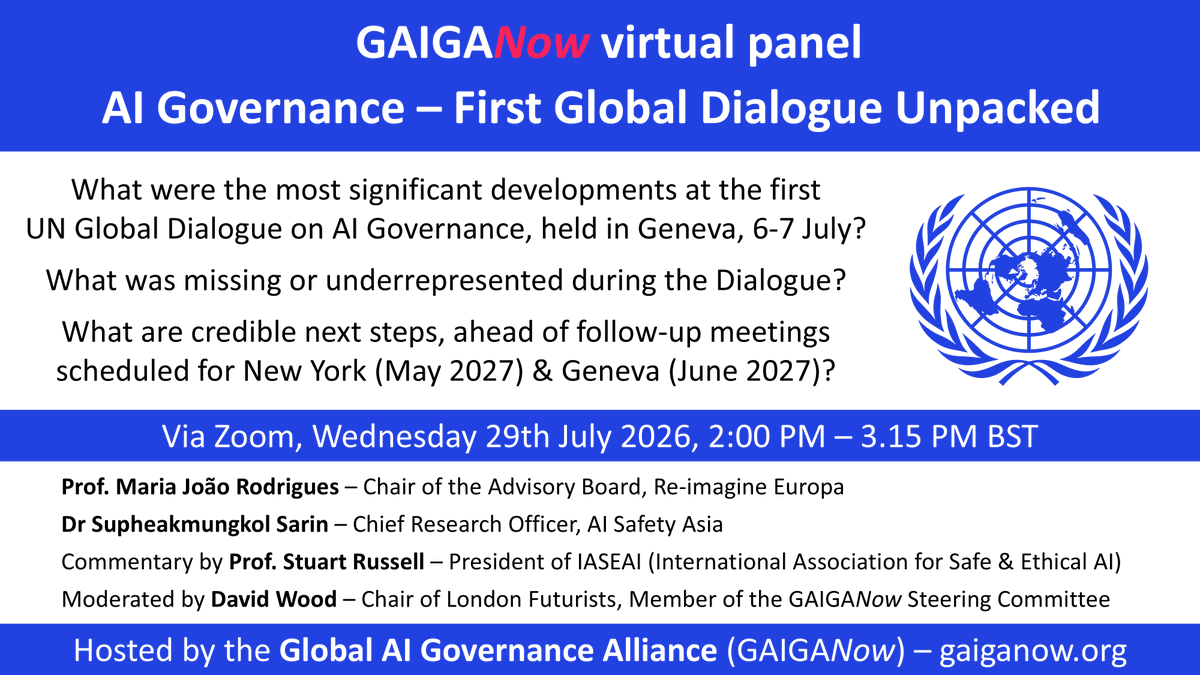
What were the most significant developments at the first UN Global Dialogue on AI Governance, held in Geneva, 6-7 July? What was missing or under-represented during the Dialogue? Hear these and other questions discussed by a panel of expert participants, in this @GAIGANow event
New #paper. Tons of important conversations among knowledge workers never make it into the scientific record - all we get are sanitized final "papers", cut down to match a journal's max allowed length. Recordings (like https://t.co/g4PXrOZ0bZ) help, but we can do better. Here's our attempt: @karina__kofman organized, many contributors in the discussion.
https://t.co/eQWZUe36mz
The journal Organisms (https://t.co/7vhwS95H0Y) was brave enough to agree to this idea: they published a transcript, very minimally edited (i.e., mostly unaltered) of a conversation among some great people. It's the discussion thread accompanying our recent paper (https://t.co/ITfC2yl9M6) on definitions of life. Check it out - all of this would normally have disappeared, buried in people's email databases and not available to the community. How many other amazing conversations could be mined by students, future AI's, etc.?
Wow - thanks! This was recorded more than 20 years ago. As usual, it's both heartening and disheartening that I was saying such similar things as I say today... Thanks to Soren Stirling for making it happen.
Curious about entropy & aging?
There are many open questions about entropy production in open-systems and what the consequences are for aging biology!
Come to Cologne to explore this intersection.
https://t.co/81C5Ceub1w
@LongevityTech@Meyer_DH@UniCologne
Which existing drugs could slow aging?
Our new @NatureAging paper finds that the #hallmarksofaging form distinct network modules, allowing us to identify drugs that can potentially slow specific aging hallmarks.
PDF at https://t.co/AHR1woNJCO
Wrt Argument 3/Thermodynamics of the substack, I think the more recent, I would say 20-30 years though, but well developed field of stochastic thermodynamics is what brings additional clarity and support to what Peter writes.