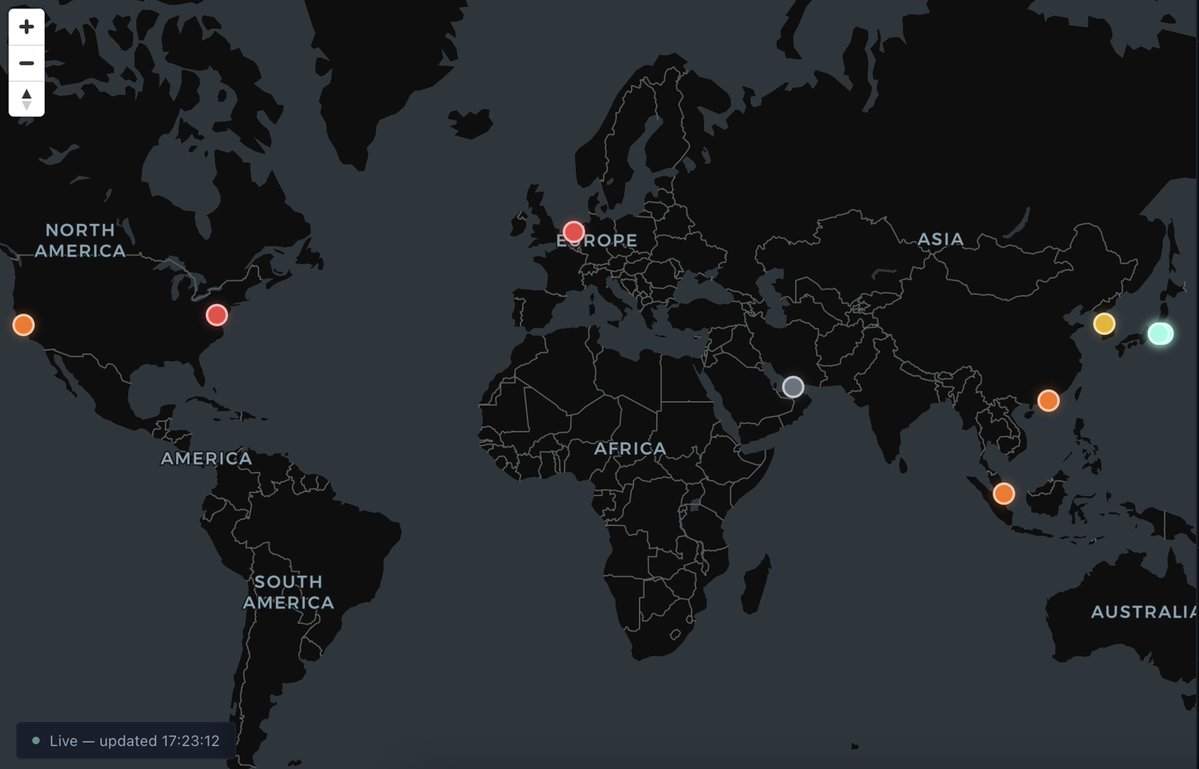
The market is global; the endpoints aren’t.
Where you trade from matters. We track real-time latency to both Polymarket and Ohio worldwide 👉 https://t.co/I7crikSMXu
Where do you deploy if you trade both @Polymarket and @Kalshi?
Latency becomes a geography problem. Polymarket pulls you towards London, Kalshi toward Ohio. You can optimize for one.
Use our live latency map for prediction markets: https://t.co/I7crikSMXu
Tokyo is pinging the Hyperliquid API in ~3ms. Amsterdam is sitting at ~221ms. Distance is a tax on your execution. We just deployed a live map of global probes tracking API and direct validator latency to Hyperliquid in real-time: https://t.co/9SwI8ErLeb
🇯🇵 Tokyo: ~15.9ms
🇰🇷 Seoul: ~50.2ms
🇭🇰 Hong Kong: ~66.9ms
🇸🇬 Singapore: ~136.1ms
🇺🇸 Virginia: ~163.5ms
🇳🇱 Amsterdam: ~245.2ms
Polkadot’s greatest failure isn’t technology — it’s perception.
Polkadot’s technology may be world-class, but the team’s market behavior has become a textbook example of how to kill a top-tier project with idealism and poor market awareness.
It’s like they spent four years forging the sharpest sword in the industry—only to discover the market is still fighting with sticks, stones, memes, and hype.
1. Treating technology as religion and the market as irrelevant — Polkadot’s core tragedy.
The team is obsessed with “changing the world” and building the “future internet,” while ignoring the most brutal truth of the crypto market:
This market isn’t a technology fair.
It’s a battlefield of capital.
And value = how much money your community can make.
Other ecosystems pump memes, push AI narratives, build hype, attract users, and expand liquidity.
Polkadot?
Publishing whitepapers, redesigning architectures, giving academic speeches, doing government seminars, and rewriting frameworks.
Result?
First-class technology.
Bottom-tier market performance.
The dream touches the sky, the market sits underground.
2. Zero market management, constant token selling
You can be idealistic.
You can NOT ignore market reality.
Polkadot’s approach belongs in a course titled:
“How to Turn a Potential $100B Ecosystem Into a Niche Side Project.”
Selling DOT aggressively during a bear market
No liquidity strategy
No price support
No narrative-building
No community activation
No rewards or incentives that create wealth effects
No demand-side engine for DOT
No mechanism to keep capital inside the ecosystem
Investors have done more for Polkadot than Polkadot has done for investors.
The community has honored Polkadot.
But Polkadot has not honored its community.
3. Choosing partnerships with collapsing economies — a strategic disaster
Polkadot has Silicon Valley-grade technology, yet chooses the most economically weak, low-impact partners imaginable:
Uruguay
Argentina (a country in chronic economic crisis)
These deals bring almost no capital inflow, no liquidity, no global influence, yet burn through DOT and time.
It’s not “visionary.”
It’s misplaced idealism.
This isn’t strategy.
It’s disconnection.
4. The market has evolved; Polkadot is still living four years in the past
Solana is embracing:
AI
Meme culture
Builder incentives
Speed, scale, and hype
Narrative dominance
Community engagement
Polkadot is embracing:
Architecture rewrites
Governance experiments
Academic-grade technical frameworks
Theoretical perfection
Occasional token sales
The market wants pumps.
Polkadot gives research papers.
The market wants participation.
Polkadot gives governance documents.
The market wants profit.
Polkadot wants purity.
This mismatch is fatal.
5. Final blow: A legendary sword, but no battlefield
Polkadot’s technology is strong enough for Fortune 500-level infrastructure.
Yet it’s locked out of the crypto battlefield where narratives, liquidity, and user psychology rule everything.
Users don’t care about runtime languages.
They don’t care about governance models.
They don’t care about TPS.
They care about one thing:
“Can I make money here?”
Polkadot keeps answering:
“We want to change the future of the internet.”
The market answers:
“Cool. I’ll go to Solana and make 10x first.”
Final Summary – The Most Brutal Line
Polkadot’s tragedy isn’t technical failure.
It’s a leadership failure.
A team with a world-changing weapon chose the wrong battlefield.
They don’t understand the market, don’t understand capital flows, and don’t understand what users actually need.
The technology hasn’t failed—
the team has failed the DOT holders.
#polkadot
@gavofyork@Polkadot@PolkadotDevs@PolkadotDecoded@AcademyPolkadot@PolkadotInsider@PolkadotAPAC@DotParachains@polkaworld_pro
As a thank you to our community, we're giving away 50X LEDGER FLEXES!
Yes, FIFTY! 5-0!
$250 value each. E-Ink touchscreen. Secure Element Chip. Only the best for you... Enter NOW 👇
1️⃣ Follow @Polkadot & @Ledger
2️⃣ Retweet this post
3️⃣ Bookmark this post
Good luck!