Traditional #SingleCell workflows were not built for multi-site studies or large cohorts. Our latest protocols fix that, starting at the blood draw itself. Explore now & enter to win a free kit >
https://t.co/sH1TnlcAP4
This Wednesday, our CEO Serge Saxonov joins @ay_zhou of @CancerResearch at the @Inside_PM Virtual Summit to discuss how AI and high-resolution biology are converging to enable predictive models for cancer discovery. Register here: https://t.co/M5AGVSYJzq
Proseg is a segmentation tool for single-cell spatial transcriptomics data that uses unsupervised probabilistic modeling of transcript spatial distribution, for accurate segmentation without multimodal staining.
https://t.co/qc1sgKsLKK
Inflammation drives nearly every major disease—cancer, heart disease, and autoimmune conditions. Yet we've never been able to watch and understand how it progresses in living tissue.
We're funding 15 projects to build real-time molecular tools to change that.
Learn more ➡️ https://t.co/o73euX9kIp
BREAKTHROUGH:
Scientists have partially reversed aging in blood-forming stem cells by repairing tiny cellular recycling systems called lysosomes.
Researchers at Mount Sinai discovered that aged blood stem cells become dysfunctional when their lysosomes turn hyperactive and damaged, triggering chronic inflammation and immune decline.
Using a v-ATPase inhibitor, the team restored more youthful function in old stem cells and achieved over 8-fold improvement in blood regeneration during transplantation experiments.
The rejuvenated cells showed healthier metabolism, reduced inflammatory signaling, improved self-renewal, and restoration of youthful gene activity patterns.
Because these stem cells generate the body’s blood and immune system, this discovery could eventually help treat immune aging, bone marrow failure, blood cancers, and age-related inflammatory diseases.
Congratulations to our friends at Bioptimus, 10x Genomics, Inc., and Broad Clinical Labs on the launch of their new Spatial Tissue Embedding Learning Atlas, named STELA!
https://t.co/ndcq5ZURW6
#Bioptimus#10xGenomics#STELA
Thanks to @BiotechTV for having our CEO Serge Saxonov on to discuss Atera, our newest platform that will transform how biology is measured and understood. Check out the full interview below.
10x Genomics Unveils Atera Spatial Platform at AACR Meeting
Serge Saxonov, PhD, CEO of @10xGenomics, walking onto the stage at #AACR26, noted that there is “a gap between what we need to see and what we have been able to measure.”
@AACR#spatialbiology
https://t.co/A1z0FVAM39
I've been watching spatial biology for years. What @10xGenomics just announced changes the game.
Serge Saxonov, CEO and Co-founder, 10x Genomics told Synbiobeta, "Biology is inherently complex, and as much progress as we have made, we still understand only a fraction of how it works. Progress in medicine depends on confronting that complexity directly, which requires measuring biology as it actually functions."
The work he and his team are doing will be front and center at #SynBioBeta2026 on May 4-7th regardless. Learn more and get your tickets here: https://t.co/96IRAmgJtQ
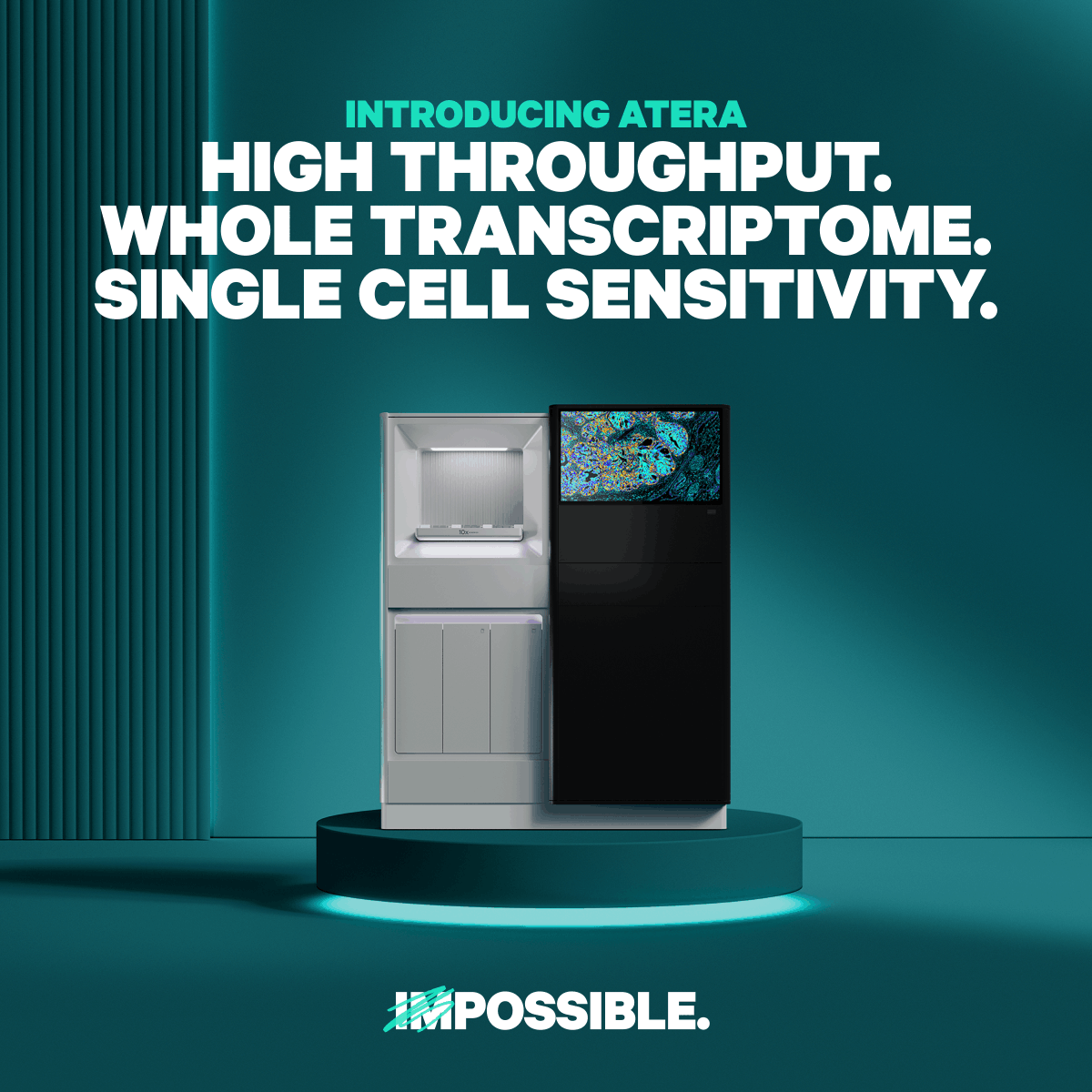
On April 18th at #AACR, 10x Genomics unveiled Atera. A spatial biology platform that runs up to 800 whole-transcriptome samples per year on a single instrument, detecting thousands of transcripts per cell in intact human tissue. That is not incremental progress. That is a new category.
The @AllenInstitute ran it before launch. So did @BrighamWomens and the @DKFZImmunology German Cancer Research Center. The DKFZ found active immune populations inside colorectal tumors that had been classified as immunologically cold. Biology is telling us things we weren't able to hear before.
What excites me most isn't just the hardware. It's what Atera makes possible for everyone building on top of it. The spatial atlases. The AI models trained on real tissue data. The clinical studies that finally reflect how cells actually behave in the body.
The founders, investors, and builders doing that work need to be in the same room. Deals get done in person. Partnerships form in person. The next breakthrough starts with a conversation at a table, not a notification in a feed.
Visit the @SynBioBeta website to read the full article: https://t.co/IY12IJuftR
With @10xGenomics and @thedohertyinst, we've mapped gene activity in human intestinal and skin tissue at unprecedented resolution.
To test the new Atera platform, we studied small pieces of each tissue. Data from each are now publicly available.
🔗 More: https://t.co/BLUod6YiQE
Studying biology has long meant working with fragmented tools. With Atera, for the first time ever, biology can be measured as a complete system in its native context, at scale, removing the constraints that have held spatial biology back: https://t.co/vu57JKktv1
Whole transcriptome discovery at single cell sensitivity! Tune in to our webinar tomorrow for more details on this unmatched spatial platform. #spatial#xenium#singlecell
𝐍𝐞𝐰: Tonight at #AACR26, @10xGenomics is announcing Atera, its new in situ spatial biology platform. Co-Founder & CEO Serge Saxonov walks us through it. $TXG
Full interview: https://t.co/nYRjfSAt3D
The impossible is here: introducing Atera, uncompromised #spatialbiology that lets you analyze up to 800 1 cm2 whole transcriptome samples/year with #singlecell sensitivity. Register now for an in-depth look at our 4/21 webinar: https://t.co/bLi5QkYgrS
The stage is set and we’re finally raising the curtain in just a few hours!
Watch for the full reveal at 7 PM PDT and make sure you register for our 4.21 webinar for a more in-depth look: https://t.co/bLi5QkYgrS
The wait is almost over.
Tomorrow, at 7 PM PDT, #10xGenomics invites you to witness the impossible. See what’s behind the curtain, then take a deeper dive in our 4.21 webinar. Register now: https://t.co/bLi5QkYgrS
We’re very excited about combining rationally designed probes with short polymerase activity to read out native genotypes, and it’s really gratifying to see our colleagues anticipating the same: https://t.co/xlcEkhG353 14/n
Science is filled with tales of researchers, asking the right questions with the right tools, doing the impossible.
You have the question: you just need the tool. So how will you do the impossible?
Join us at #AACR26 to find out > https://t.co/rJzdKnMocA
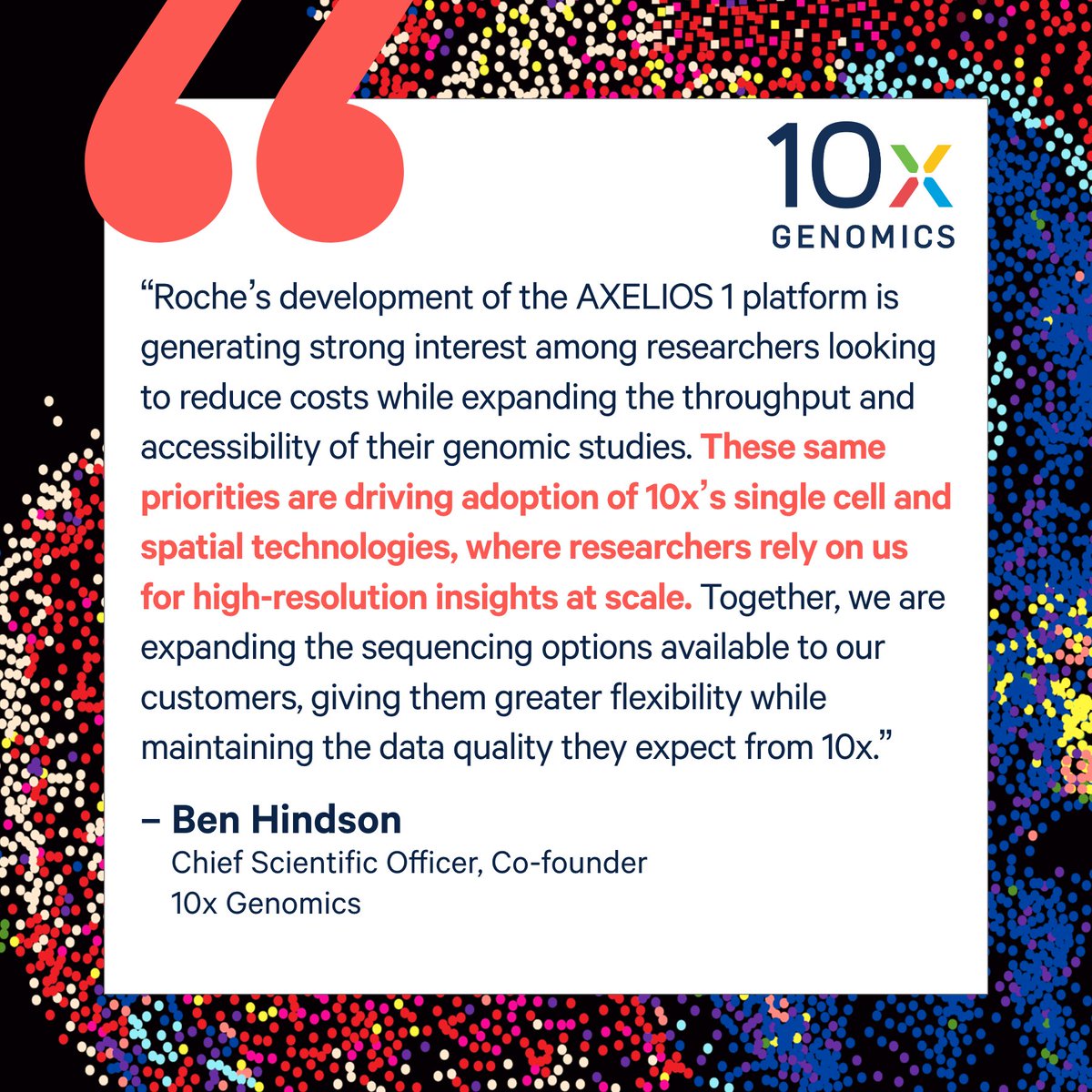
We’re proud to collaborate with @RocheDiaUSA in a shared commitment to supporting researchers with flexible, high-throughput, and trusted genomic data. This marks an important step forward in expanding sequencing options and scaling biological insights.