40% income tax on everything I earn
6.625% sales tax on everything I buy
4% inflation tax on everything I save
$10k/year tax on property I own
I’m tired boss 😔
Another water main burst right on cue.
You can set your watch to socialist failures, they’re so predictable. Don’t let communists run your city, folks.
It’s fascinating to study which historical figures schools teach were good and which were bad.
Andrew Jackson was a nationalist who took on the banks - “bad guy.”
Woodrow Wilson was a globalist who gave the banks power - “good guy.”
This is the heart of the mind control in America.
Tetanus shot (DTaP, TDaP)
Does NOT prevent Clostridium tetani from entering or multiplying in the body. Another worthless shot; Children get 5 doses of the DTaP starting @ 2mo of age
The 1930s “Dust Bowl” is entirely misunderstood by most of the general public, and this poster demonstrates his lack of understanding of the events quite spectacularly.
The decade-long drought and associated heatwaves that seared North America (not just the U.S.) during the 1930s had little to do with the actual “Dust Bowl,” which refers to a relatively small geographical area covering the Texas and Oklahoma panhandles, southwestern Kansas and southeastern Colorado that were affected by dust storms.
It is commonly claimed that the 1930s drought was a result of unsustainable farming practices in the Great Plains. Specifically, it has been argued that the replacement of deep-rooted and drought resistant perennial prairie grasses with shallow-rooted annual crops such as wheat loosened the soil, contributed to wind erosion, which then amplified the drought via positive feedback, turning abnormally dry conditions into the worst drought in modern American history. But these claims are not true. The drought was forced by a combination of a cool equatorial Pacific (persistent La Niña) sea surface temperatures (SSTs) and a warm North Atlantic (+AMO).
During La Niña, westward displacement of convection towards the Maritime Continent acts as a diabatic heating source that excites a stationary Rossby wave train. This, in turn, causes a Pacific jet extension and shifts storm tracks northward, which favors cyclonic activity over the Pacific Northwest and anticyclones (ridges) over the central and eastern CONUS. Sinking air beneath these high-pressure ridges warm the air and wring it dry. This suppresses rainfall for months at a time, causing drought to develop over the Plains (e.g., Ropelewski & Halpert, 1986; Ting & Wang, 1997; Shubert et al., 2004; Pu et al., 2016).
🔗https://t.co/ILzJdLU4W5
🔗https://t.co/kKmWUB2Pj7
🔗https://t.co/DRVc3rXCbV
🔗https://t.co/T85A1M5YKu
Drought conditions during the 1930s were amplified by positive land surface feedbacks from bare soil exposure, but that was primarily caused by vegetation loss from the lack of rainfall, not farming practices.
Contrary to popular belief, only ~30% of the Great Plains land area had been plowed by 1930 (Cunfer, 2005). Where there was agriculture, it had some localized amplifying effects, but it wasn't the cause, much less a significant contributor on a national or continental scale.
🔗https://t.co/Vp1UewkRF0
Tree-ring and sedimentary evidence reveal that there have been dozens of Great Plains droughts over the last 10,000 years that equaled or exceeded the 1930s drought, and all of those droughts occurred under NATURAL grassland conditions long before there was mechanized agriculture (Cook et al., 2009; Herweijer et al., 2007). That fact alone disproves the claim that the 1930s drought was caused by farming practices of the day. Farmers often adapted to the landscape and climate, rather than altering it.
🔗https://t.co/CRmYqyOq3x
🔗https://t.co/dh1HYJXQVt
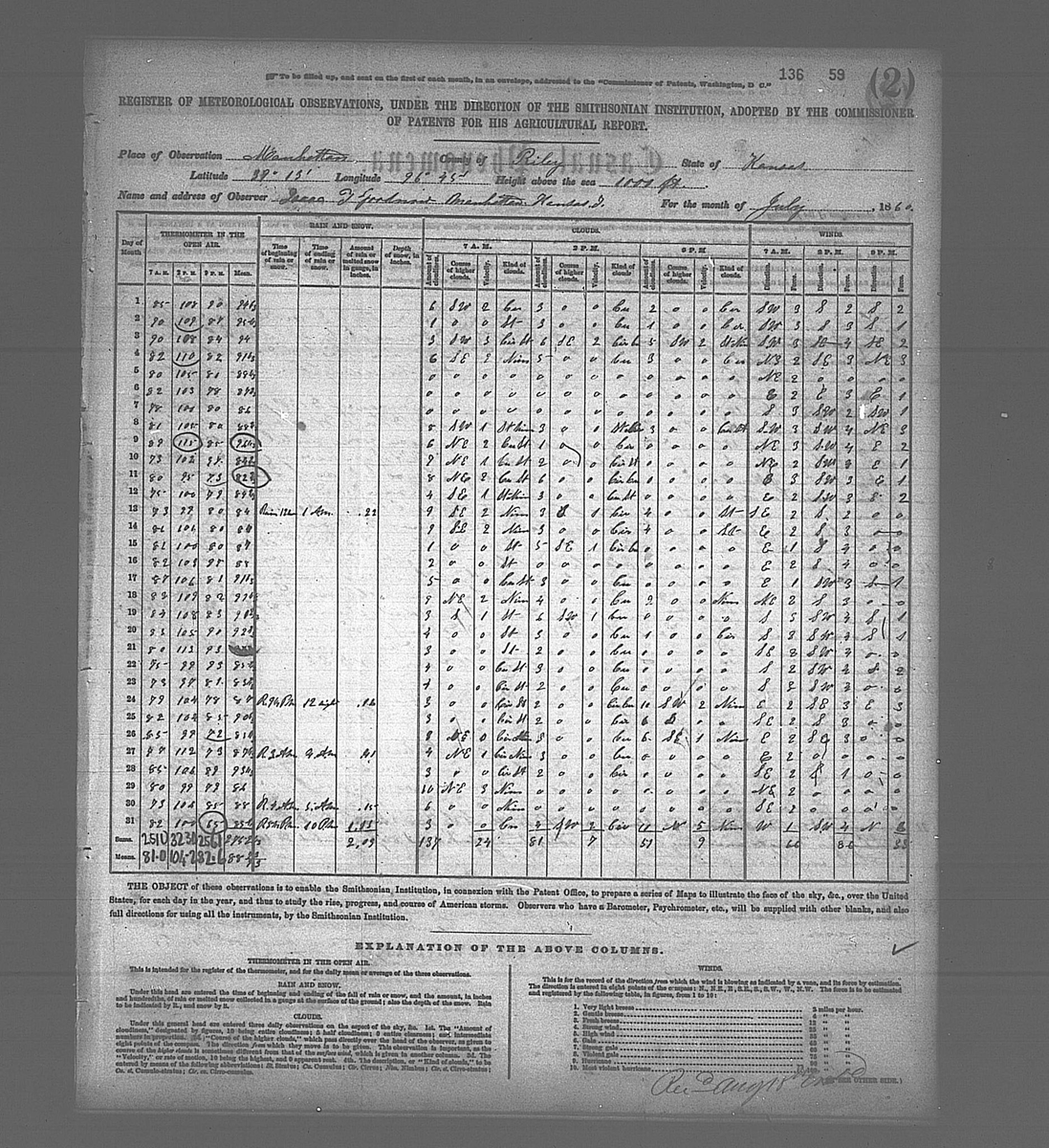
During the 19th century alone, there were two severe Great Plains droughts (circa 1818–25 and the 1854–65 “Civil War Drought”) that rivaled or exceeded the 1930s. Handwritten historical accounts from travelers note significant portions of the Great Plains stretching Kansas to Nebraska looked like a desert with blowing sand. Many of those accounts were documented in Muhs & Holliday (1995). There is also evidence that it was similarly very hot during that time. The summer of 1860, for example, rivaled that of 1934 and 1936 (I've attached a snippet of temperatures from Manhattan, Kansas from July 1860; the high of 115°F on July 9th is only eclipsed by August 13th, 1936's reading of 116°F).
🔗https://t.co/pwxS7sVsY0
The bottom line is that the Great Plains experiences a 1930s-like drought at least once or twice per century, on average.
If you cannot explain the 19th century droughts or the Medieval Megadrought with the “Muh, it was caused by farming practices” deflection, then you cannot with any degree of confidence blame the 1930s drought on it either.
The 1930s North American drought and heat extremes were not random outliers. They are likely a recurrent pattern as shown in the geological paleoclimate record. But they present climate alarmists with quite a challenge in attributing recent heat extremes to trace carbon dioxide (CO₂). What I also love about the plot in Jason's post is that the global graph below the U.S. chart starts in 1950. That's because there isn't enough data (spatially speaking) to have any idea of what temperature extremes were in most other areas of the globe prior to the 1950s. And if you were to extend it backwards, there's going to be a lot of interpolation of data by computer modeling that isn't a real measured value set.
The U.S. sends $2 billion to the Kingdom of Jordan each year. Their King spent $100 million on luxury properties in Malibu, DC, & London. I offered an amendment to end the welfare. Thank the 5 who voted w/me. @RepChipRoy@RepNancyMace@RepBrecheen@RepEricBurlison@Rep_Davidson
Wow. Communists in city hall have neutered law enforcement so badly that this car thief can stop for gas, mid-pursuit, fill up, and drive off, undisturbed. Dude could've dropped in the mini mart and gotten a Slurpee, too.
LA is full on GTA. Don't let communists run your city!
Hi Letitia,
I am a meteorologist. Maybe I can be of some help here.
The wildfire smoke we have seen recently blanketing the skies across the central / eastern U.S. came from Canada. I attached an animation below on the left for your viewing pleasure.
Suing the Trump EPA is not going to stop forest fires any more than President Trump threatening to levy tariffs on Canada will stop them. In your case, the fires aren't our nation's problem, and in Trump's case, over 50% of fires in Canada are caused by lightning and because the majority of Canada's boreal forests are in remote locations that are difficult to access, proper forest management isn't easily feasible.
As for exceedingly high temperatures, what you are describing there is, well, summer. This your first year on Earth, lady? Summers are hot. They always have been. They always will be. And, in the case of unusual heat, the average number of heatwave events per year—defined as three or more consecutive days with daily maximum temperatures ≥90th percentile relative to 1991−2020 climatology (TX90p)—have decreased by 20.2% since the beginning of the 20th century (1994−2025 average minus 1901−30).
I am interested in scientific facts, not fairytales, and your frivolous suit should be dismissed in court no sooner than it is brought forward.
cc: @NewYorkStateAG