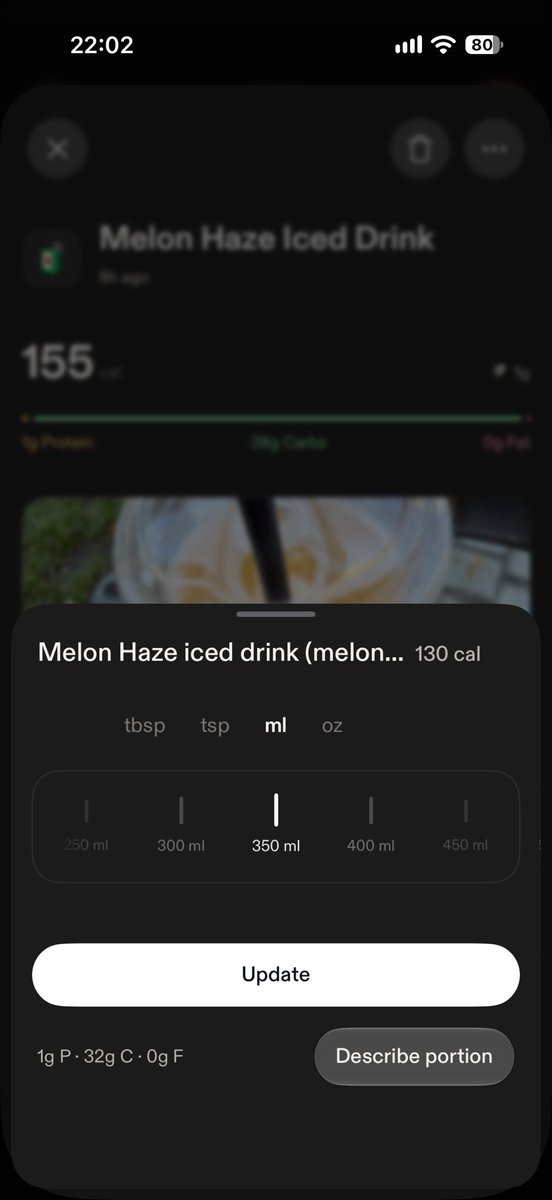
@0xDesigner Or this example it shows 1 cup of melon haze, then if you drill down one cup is actually 350 ml ? That’s not true so, maybe it refers to the container it sees not sure? A bit weird though.
@0xDesigner Mostly on volumetric units it’s annoying. Depending on the photo sometimes the main unit shown is cups or tub or container etc whatever the model sees, that’s fine.
Then I see tbs, tbsp, ml and oz these should be selectable imo. You pick the ones you want to see.
@ryskfinance isn't it wrong that all the $hype variants for covered calls have the same current price? some of them vary by more than 1% in reality, that's a bad deal if the call is ITM is it not?
This is the Baltic Way. On 23 August 1989, two million people joined their hands to form a human chain spanning 675.5 km across the three Baltic States of Lithuania, Estonia and Latvia. The protest was against Soviet oppression, and to support the independence movements of the three States and their desire to escape communism.
Residences use a lot less electricity than industries. Countries apart from the top 5 or so, use negligible amounts of energy compared to the top 5. That is why bitcoin power use is always compared to houses and countries down the list, and not to industries or top-5 countries.
The irony of the art is comical. If people actually want to understand why Bitcoiners are so amused, this is why (2 minute read):
Demand response programs are essential for balancing electricity supply and demand, increasing grid efficiency, and integrating renewable energy sources. Bitcoin mining can contribute significantly to these programs by absorbing excess energy during peak times, providing a sustainable financial system less reliant on traditional fiat infrastructure.
During high electricity demand, supply is often stretched thin, leading to increased costs and potential grid instability. Conversely, during low demand, excess energy, particularly from intermittent renewable sources like solar and wind, can go to waste. Bitcoin mining, with its immediate, on-demand energy consumption, can function as a flexible load that adjusts energy usage based on grid conditions. By participating in demand response programs, miners help absorb excess energy during periods of low demand, acting as a "battery" storing energy in digital currency form. This helps balance the grid and encourages the adoption of renewable and already existing natural energy sources.
In addition to environmental benefits, Bitcoin mining contributes to a more efficient financial system. The traditional fiat-based banking and financial infrastructure require millions of employees, thousands of branches, data centers, and other resources to function, consuming significant amounts of energy. By comparison, the Bitcoin network serves as a decentralized financial backbone, requiring far fewer physical resources and personnel to operate.
Bitcoin's decentralized nature eliminates many intermediaries in the financial system, streamlining processes and reducing overhead costs. Sure, the mining process requires computational power, consuming energy, but the overall energy usage is significantly less than the traditional fiat system.
Moreover, the Bitcoin network operates 24/7, providing near-instantaneous global settlements, contrasting with the slow traditional financial system (which requires trust and centralized powers that can debase the amount of currency supply in the system - which favors a few at the cost of the many), which can take days to clear and settle transactions across borders. The increased efficiency of the Bitcoin network translates to reduced energy consumption per transaction.
The transition to a Bitcoin-based financial backbone could result in significant energy savings, as the computational power needed for mining is less resource-intensive than maintaining the existing financial infrastructure. As the Bitcoin network continues to mature and gain acceptance as a global financial system, its potential to improve grid efficiency and reduce overall energy consumption will become increasingly apparent.
Dear God. Barney Frank openly admits that Signature was arbitrarily shuttered despite no insolvency because regulators wanted to kill off the last major pro-crypto bank. Colossal scandal
https://t.co/Sa25w6Au7b