@nntaleb@TheStalwart The philosopher king is the least enslaved, the lover of money is third, between the honor lovers and those whose souls are dominated by the unnecessary appetites.
Read more difficult books. If a text doesn't force you to pause, re-read a page three times, and uncomfortably inspect your own behavior, you aren't expanding your mind. You are just consuming easy narrative junk food to feel productive.
Make sure to own KPLC to pay your power and water bills.
Own Kenya Re and use it's dividends to pay your insurance policies. Let your data and Airtime come from Safaricom dividends. Let your food be bought by Kapchorua tea dividends. And those who party hard ....
How to Actually Analyze a Stock on the NSE (Step-by-Step Beginner Guide)
Understanding terminology is step one.
Knowing how to use it is step two.
If you’re investing at the Nairobi Securities Exchange, here’s a simple framework to evaluate any listed company.
# Step 1️⃣: Understand the Business First (Not the Chart)
Before numbers, ask:
* What does the company sell?
* Who are its customers?
* Is demand growing?
* Is it regulated?
For example:
* Banks → sensitive to interest rates & CBK policy
* Telcos → sensitive to data usage & competition
* Manufacturers → sensitive to fuel prices & FX
If you don’t understand how it makes money, don’t buy it.
# Step 2️⃣: Check Revenue Trend (Growth Direction)
Look at 3–5 years of revenue.
Ask:
* Is revenue growing consistently?
* Is growth stable or volatile?
* Is it seasonal?
Stable revenue = predictable business.
Unstable revenue = higher risk.
# Step 3️⃣: Check Profitability (Not Just Revenue)
A company can grow revenue but still struggle.
Look at:
* Profit After Tax (PAT)
* Profit margins
* EPS (Earnings Per Share)
If revenue rises but profits fall → costs are rising.
# Step 4️⃣: Look at Cash Flow (Very Important on NSE)
Many beginners ignore this.
Focus on:
* Operating Cash Flow (OCF)
* Free Cash Flow (FCF)
Positive free cash flow means:
* Dividends are sustainable
* Debt can be repaid
* Expansion is possible
Profits can be manipulated.
Cash is harder to fake.
# Step 5️⃣: Check Debt Levels
Use these questions:
* Is debt rising?
* Can operating profit comfortably cover interest payments?
* Is the company over-leveraged?
In rising interest rate environments, high debt = higher risk.
# Step 6️⃣: Compare Valuation
Now check:
* P/E ratio
* Dividend yield
* Price-to-Book (especially for banks)
Then compare:
* Against historical average
* Against competitors in the same sector
Cheap doesn’t always mean undervalued.
Sometimes it means the market sees risk.
# Step 7️⃣: Understand Market Liquidity
On the NSE, liquidity varies significantly.
Ask:
* Is there daily trading volume?
* Is the bid-ask spread wide?
* Can I exit easily?
Low liquidity = harder to sell in panic.
# Step 8️⃣: Consider Macroeconomic Factors
Kenyan stocks are influenced by:
* Interest rates (via Central Bank of Kenya policy)
* Inflation trends
* Fuel prices
* Exchange rate movements
* Foreign investor participation
Remember:
The NSE is still heavily influenced by foreign flows.
# Step 9️⃣: Decide Your Strategy
Are you:
* Dividend-focused?
* Growth-focused?
* Value investor?
* Short-term trader?
Your strategy determines:
* Which stocks you choose
* How long you hold
* How you react to volatility
# Step 🔟: Risk Management (Non-Negotiable)
Never:
* Put all capital in one stock
* Trade emotionally
* Chase price spikes
Always:
* Diversify
* Allocate capital intentionally
* Have an exit plan
# Common Beginner Mistakes on the NSE
❌ Buying because “it’s trending”
❌ Ignoring financial statements
❌ Overconcentration in one sector (e.g., only banks)
❌ Confusing low price with cheap valuation
✓Your debt is someone else’s income.
✓Your time is building someone else’s business.
✓Your spending is funding someone else’s lifestyle.
Consider putting yourself on the receiving side of the cash register, with income streams like unit trust funds, stocks, businesses, etc.
As a Kenyan you have access to the greatest wealth generating machine i.e the US Stock market via IBKR
Why are you throwing away your future with an immature market like the NSE?
Don’t complicate things
Save your money in MMF
When it gets to Kshs 1 Million
Buy a 13% Infrustructure Bond
Every year you will get Kshs 130,00
Use that Kshs. 130,000 to buy stocks
The stock will pay you dividend
Reinvest the Dividend in the stocks
Rinse and repeat.
In 10 years you will be Financially Free!
Note whatever is being risked at the stock market is purely your profits and they will grow very fast.
Giste ako na idea poa eeh?
Kiharu M.P Ndindi Nyoro owns 27M shares of KPLC. He bought most of these shares three years ago when when they were retailing at less than ksh.2 bob per share.
Meaning he bought them at around ksh.54M.
Today, for share closed at ksh.15.40 at Nairobi Stock exchange.
Yesterday, the power utility company announced a ksh.10.4B in half year profit and announced an interim dividend of ksh.0.30..
Meaning that Nyoro is going to receive a cheque of ksh.8.1M from KPLC as dividend.
Investment in shares calls for patience and alot of research on the company's financial future.
Ndindi is reaping handsomely on these shares.
Before investing in any company, ask yourself these 7 critical questions:
1. Does the company have a sustainable advantage?
2. Is the company recession-proof?
3. Will people still be using this product or service in 20 years?
4. Has the company had consistent dividend growth?
5. Does management have a proven track record of delivering results?
6. Are margins and cash flows strong and improving? Are debt levels manageable?
7. Is there a clear plan for growth and innovation?
Bonus: Is the stock reasonably priced relative to earnings and growth prospects?
Okay so reading through @SafaricomPLC Zidii Trader FAQs I got some clarification on how the shares will be held.
Every individual shares is held to their names in an omnibus account. Safaricom holds the CDSC account.
You will not see this shares in your CDSC account meaning you forgo the little benefits of having that like using them as collateral for loans, I doubt if you will be able to vote or attend the AGMs.
This is a welcomed move but I still see the benefits of going straight to your brokerage firm.
That said I am impressed by this product and will be using it for sure 👍🏽
There is always time for everyone to do something.
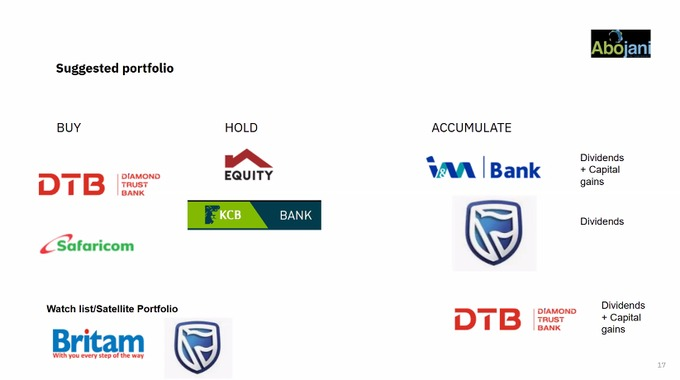
You wish you had invested in Safaricom at 17 a year ago,
You wish you had bought DTB at Sh 58 a year ago,
You wish you knew about money market funds years ago,
If you didn't, start now.
Buy Safaricom now,
Buy DTB now,
Open an MMF now.
There is no deadline for investing.
Best Youtube Channels To Learn in 2026
1. Cybersecurity - John Hammond
2. Artificial Intelligence - Krish Naik
3. Web Development - Traversy Media
4. Python Programming - Code With Harry
5. DevOps TechWorld With Nana
6. Cloud Computing - freeCodeCamp
7. Data Analytics - Alex The Analyst
8. Digital Marketing - Neil Patel
9. UI / UX Design - GFXMentor
10. Blockchain Development - Telusko
11. React Development - Codevolution
12. Java Programming - Kunal Kushwaha
13. Networking - David Bombal
14. Personal Branding - Ali Abdaal