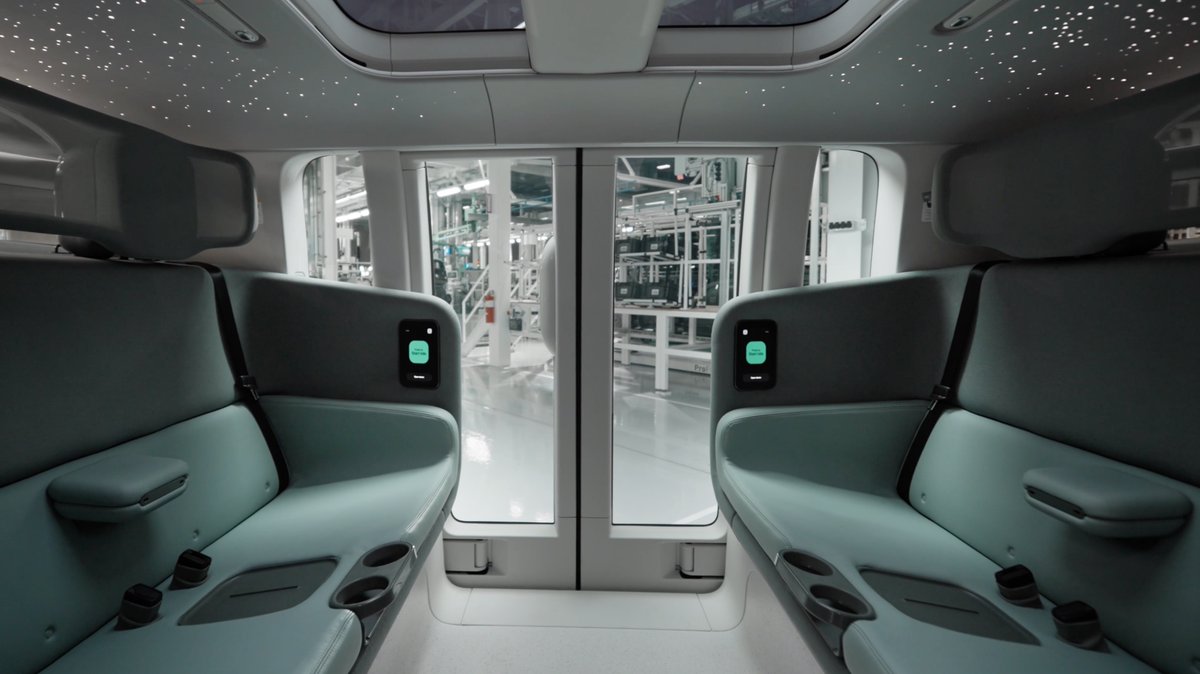
Zoox (owned by Amazon) has unveiled its updated Robotaxi, which they say will be the version that goes into mass production and that they can build up to 100 per week.
• Improved seat design with additional padding, more ergonomic contours and improved headrest.
• New interior color scheme featuring aloe green seating and stone-gray flooring/trim.
• Brighter cabin designed to make personal items like phones, wallets, and keys easier to spot.
• Updated touchscreen display with improved brightness and clarity.
• Redesigned wireless charging pad with a fluted surface to help keep phones in place while driving.
• Larger cupholders for improved usability.
• New rotating bidirectional reflectors on the exterior to improve visibility and communication with other road users.
• Enhanced sliding doors with upgraded speakers and microphones.
• Improved two-way audio system for clearer communication between passengers and remote support staff.
• Refresh is intended for Zoox's future mass-production robotaxi fleet built at its Hayward, California manufacturing facility.
Core Robotaxi Specs (unchanged):
• No steering wheel, pedals, or traditional driver controls.
• Bidirectional design allows the vehicle to drive equally well in either direction.
• Four-passenger cabin with face-to-face bench seating.
• Sensor suite includes cameras, lidar, radar, and long-wave infrared sensors.
Zoox says it has given rides to over 500,000 people and that they will soon move into large-scale production: "These robotaxis will join the fleet across our markets and become available to riders later this year as they come off the production line. We have the capability to ramp production up to a rate of 100 vehicles a week to support our expansions this year, subject to regulatory approval."
At the bottom of the world, in one of the most extreme and isolated environments on Earth, scientists just got a major upgrade.
Until recently, Antarctica’s research stations like McMurdo relied on slow satellite links (~17 Mbps shared). Large scientific datasets often had to be sent physically or uploaded over days.
Then Starlink arrived.
Now researchers have high-speed connectivity (50–200+ Mbps) even in brutal polar conditions — thanks to Starlink’s space laser network.
What changed?
• Real-time transfer of massive ice-core photos, sensor data, and high-resolution imagery
• Much faster scientific collaboration across continents
• Field teams can work more efficiently without waiting days for uploads
Starlink is now live on all seven continents — including the most remote place on the planet.
Science at the South Pole just got a serious boost.
Celebrating our 1,000th Supercharger post in Australia with the opening of Byron Bay
This marks 10,000 km of major AU corridors accessible by the Supercharger network
One day, a reusable rocket will feel less like an escape from Earth and more like the first page of a holiday.
We’ll rise into orbit, check in beneath starlight, and watch our blue home turn slowly below the windows of a space hotel.
Optimus has the potential to completely change what happens in the “last mile” of transportation and delivery, which is the part that has traditionally required a human to step in.
Today, a package can travel thousands of miles through automated warehouses, trucks, ships, and airplanes, but the final few feet often still depend on a person carrying it to your front door. That last step is one of the most expensive and difficult parts of the entire process.
That’s where Tesla Bots could make a huge difference.
Imagine a Robovan arriving at your neighborhood autonomously. Instead of a human driver getting out, a Tesla Bot grabs the package, groceries, or pizza and walks it right to your doorstep. The vehicle handles the transportation, and the bot handles the final delivery.
The same system could operate around the clock 24/7, reduce costs, improve consistency, and help solve labor shortages that many industries face today.
Most people think about Tesla Bots helping inside factories, but I think one of their biggest impacts will be outside of them. The combination of autonomous vehicles and humanoid robots could create a fully automated delivery network from warehouse to doorstep.
The “last mile” has been one of the hardest problems to solve for all of human history and I believe Tesla is building the first system capable of automating the entire journey with Optimus.