All-in investor $OPEN leaps ||| Betting all the hard-earned money on the future ||| Let's build a community where us (retail investor) can win the market
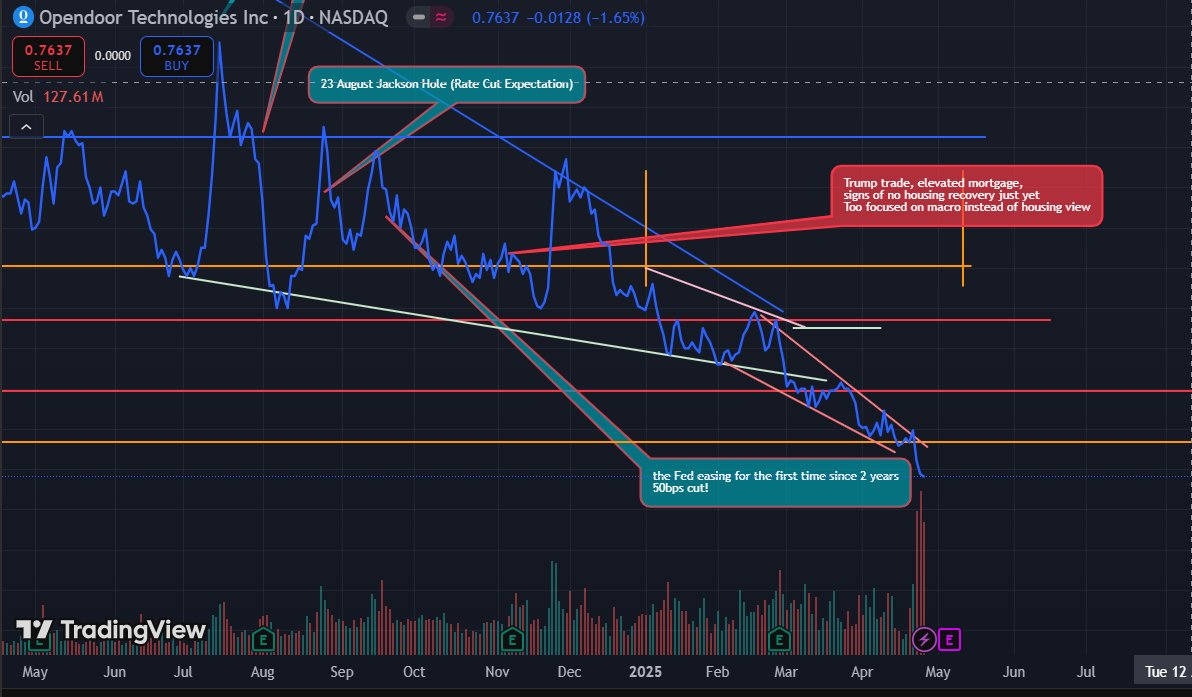
Is this mark the bottom for Opendoor $OPEN?
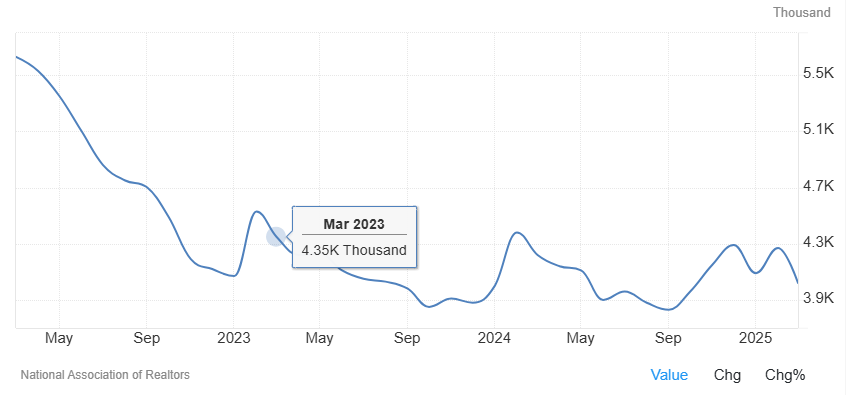
Let's do another quick assessment (Technical, housing macro & Opendoor Fundamentals) I promise to provide an objective overview (Not biased)
*Thread*🌟
(Disclaimer: I own $OPEN, 30% of my total portfolio)
Anthropic at 2tn and $meta at 1.9tn is absurd.
One of these has to re-rate bigly - I think both.
The market can't punish Zuck's capex and reward Darios - they're the same thing. They both have high quality models, they both have cash flows.
Only one of them is profitable and only one has a moat.
For the record.
A contentious thesis that will slowly become consensus
Hedge funds’ growing control of the bond market challenges an old conviction: that credit markets and the bond vigilantes, represent the smart money.
When short-term, leveraged players dominate, price signals can reflect crowded trades and groupthink rather than sober judgments about economic fundamentals.
This is not your grandfather’s bond market. It is time to stop treating it as the smartest money in the room.
Have a nice day
It's been a historically bad month and bad week for mortgage rates. Today's movement is in the top 5 one-day deteriorations since 2011. A mortgage rate with zero points yesterday now requires approximately 1.2 discount points to lock.
This is why we are building Opendoor Home Loans - to help Americans buy homes.
@KrisPatel99 Yes it feels simillar. With more capital competition resulting vaccum of liquidity to a certain sector that typically has more trasanction volumes
I've been inspired by @Aubermark's dash and have been building my own $OPEN tracker - trying to capture critical data points that I think are key to the business.
Here's an important one:
Opendoor Initial List Price / Opendoor Purchase Price
This basically represents how aggressively Opendoor is "marking up" its homes at list and signals their belief in the strength of buyer demand at the time of listing. Pairs cleanly with price drops.
This chart shows a dramatic drop from the spring till now with Opendoor listing homes for roughly 500bps markup LESS. Clearly they're pricing to move inventory which I 100% believe is the right play.
Call it market-making, call it fire-sale. Two sides of the same coin.
One offset / caveat to this is that the recorded Opendoor purchase price does NOT include Opendoor's service fee which has almost certainly gone up the last few months to account for holding / macro risk.
This is probably a partial (but not full) offset to lower resale prices.
For example, I could see Opendoor having moved their average fee from 5% -> 8% (or more) over the same period while at the same time pulling down their list price mark-up from 1.10 to 1.05. This basically offsets 300bps out of the 500bps loss in price gain.
Lots of other moving pieces (price drop path, mortgage buydowns and attach, CNML, seasonality) but I'm probably in the ballpark if I had to guess.
@nejatian@Mikewnwo@BenLPatton good to read. Please consider providing a 12 month road map. I think after a less than amazing year 1, it's fair to ask for your vision on where this is going to go for year 2, and what progress can be expected. Retail played a unique role in literally saving the company.
THE PACING IS A NINJA MOVE - But be careful what you campaign for.
In any competitive sport, I have seldom found people exercise restraint - they usually have a capture the flag mentality. Don't I want to be the best? The first? The only? - this is how we have been programmed. In the AI race, winning is existential. All AI labs have to race to generate revenue to be able to sustain the enormous amount of committed capital to "not be left behind" in the infrastructure build. There isn't enough room for many. So the desire to slow down is puzzling, but perhaps if the whole system slows down, the rules of winning can be the same for all.
Do we have a problem that AI could be a killer?
Model capability is a tale of two cities, at one end the models are showing their prowess in tasks like cyber or math as seen recently, so there is likely a probability that the models get extremely powerful and could precipitate a world event. At the same time, in many domains the lack of training data makes the models woefully inadequate. Even in areas like cyber - the LLMs aren't great at the edge cases and generally not economical for the defender case, but great for the attackers. Funnily - in all their "concern" it is still an uphill battle to get them to expose APIs for third party security companies like ours, for us to build robust security for AI adoption. It's slow progress.
So why do this?
I do believe deep down this is a commercial strategy. A ninja strategy. The liability associated with a model gone rogue has the potential of wiping out the economic opportunity of any frontier company. How do you best show the duty of care? You show that you care. How do you make sure you don't lose out to your competitors? You get them to do the same! If that becomes the industry standard for duty of care, you have a collective first line of defense. Who do you get to govern this? "Yourself" - that is what I think will become the achilles heel.
The risk? Open source! China! Countries other than the US! So you ask for a global agreement, because you don't want to be sued in other markets who might even be more punitive. But that was an afterthought - that afterthought will cost.
Thks pacing campaign rhetoric has become the talk of the town and it might work. Everyone has jumped into the debate. Both sides of the house, nation states. CEOs (present company included). It's more fun discussing the evil of AI than basics of economic affordability or international trade.
The result: We might end up with AI safety boards, regulation in micro jurisdictiona and a fragmented fabric of laws around the world which would make compliance and liability a challenge. Perhaps the intended consequence of pacing would have an unintended consequence of a labyrinth of regulation. Regulation destined to cause a slowdown.
Who wins? Simplicity. Open source? Open source is already on its way to gaining more adoption, this could drive it further, faster, each iteration of open source gets closer to frontier LLMs - making it viable to deploy them for more and more use cases.
In the end, how will the evaluators know as AI gets smarter, that AI hasn't figured their role out and outsmarts them at their task! That will be the next frontier :)
There has been a lot of speculation lately about where Opendoor is on the path to ANI break-even, and I worry some folks think we are further ahead than we actually are. Rather than have you guess, I want to do two things. First, give you a direct update on how Q3 is tracking, and second, start releasing numbers more frequently so you can track our progress for yourself and hold us accountable.
To say the thing up front: we are not at ANI break-even yet. What we are seeing in the actual numbers of the business this week, the speed of underwriting, the accuracy of our models, the response from our users and the forward revenue created are all going very well. We’re making lots of progress, but rebuilds are bumpy.
TL;DR: The worsening housing market at the end of August pushed us roughly six to eight weeks behind on our Adjusted EBITDA guideposts, meaning the twelve-month window in which we expect to be adjusted EBITDA profitable now starts this quarter rather than last quarter. For Q3, we expect revenue to increase 10-15% year over year, Contribution Profit dollars to increase 70-75% year over year, and Contribution Margin to land between 3.2% and 3.5%. We still expect to exit 2026 ANI-positive on a twelve-month go-forward basis.
On our first earnings call I told you we would make the right long-term decisions for the business, not manage it around a quarterly number. August tested whether we meant it.
For most of its life as a public company, Opendoor sold homes slower than the market. Between our IPO and my start date, we cleared at roughly 85% of market pace and lagged the market two days out of every three. We held on to homes under the belief that waiting protected margins. Holding homes was our own version of bloodletting, the "cure" for weak margins. It did not work, and it made this company fragile.
Over my first year, we changed that. We now clear significantly faster than the market, beating it nearly nine days out of ten. This is our job: clear faster.
When we reported earnings in early August, July contribution margin was tracking ahead of our plans and the housing market looked like it might be stabilizing. Instead, the last two weeks of August were among the worst we have seen for housing in years. Clearance slowed further and delistings stayed high. That is not an excuse - it’s just what happened.
We had a choice. Slow sales, protect the margin number, and let homes age. Or price to clear. Old Opendoor chose the first option for years. It made the quarter look better, but it made the company worse. We are not doing that again. Time has a cost, and selling homes fast is the discipline this business requires. We are going to clear homes, even when that hurts margins.
Our job is to sell homes, not park inventory or pull listings offline when things get tough. The market got worse, but it did not break our resale engine. We are still clearing faster than the market. That is part of the business we rebuilt, and it held. Don’t confuse any of this with the business moving backwards. The business is in materially better condition today. Revenue and contribution margin will both be higher year over year. And as the rest of the rebuild catches up, a market like this will hurt us less going forward.
Nothing longer-term is changing. We expect Opendoor will be ANI-positive on a twelve-month go-forward basis exiting 2026. That depends on buying fast and selling fast. If margins were resetting permanently, that would change things. That is not what is happening. We are repricing one book of inventory and clearing it instead of rolling it into next year.
To help you follow all that we are doing better, both on sales and acquisitions, we are going to give you more to track every week on https://t.co/u8GSnpFzzy. Just as you should not have to wait until earnings to see what is happening on acquisitions, you should not have to wait to see how many homes we sold or how fast we cleared.
Last week, we sold 223 homes, and cleared 19% faster than the market, adjusted for delistings. The weekly numbers will be noisy, just as the acquisition numbers were when we first started publishing them. What matters is the trend: as we buy more homes, are we selling them at the pace we planned and staying ahead of the market or not? And when we are behind, you will see it for yourself.
I told you how we would manage this company: for years, not quarters. Twelve months from now, judge us based on that. Either we fixed the company or not. The core metrics say we are on track. For Q3, year over year, we expect margin to be up. Revenue up. Velocity up. The end of August was absolutely brutal for housing and pushed us back by roughly six to eight weeks. We’re not going to take that sitting down.
Kaz
(fyi, regular disclosures on this type of thing where we release weekly numbers etc are on our IR page, https://t.co/ahitgfnIKI)
There has been a lot of speculation lately about where Opendoor is on the path to ANI break-even, and I worry some folks think we are further ahead than we actually are. Rather than have you guess, I want to do two things. First, give you a direct update on how Q3 is tracking, and second, start releasing numbers more frequently so you can track our progress for yourself and hold us accountable.
To say the thing up front: we are not at ANI break-even yet. What we are seeing in the actual numbers of the business this week, the speed of underwriting, the accuracy of our models, the response from our users and the forward revenue created are all going very well. We’re making lots of progress, but rebuilds are bumpy.
TL;DR: The worsening housing market at the end of August pushed us roughly six to eight weeks behind on our Adjusted EBITDA guideposts, meaning the twelve-month window in which we expect to be adjusted EBITDA profitable now starts this quarter rather than last quarter. For Q3, we expect revenue to increase 10-15% year over year, Contribution Profit dollars to increase 70-75% year over year, and Contribution Margin to land between 3.2% and 3.5%. We still expect to exit 2026 ANI-positive on a twelve-month go-forward basis.
On our first earnings call I told you we would make the right long-term decisions for the business, not manage it around a quarterly number. August tested whether we meant it.
For most of its life as a public company, Opendoor sold homes slower than the market. Between our IPO and my start date, we cleared at roughly 85% of market pace and lagged the market two days out of every three. We held on to homes under the belief that waiting protected margins. Holding homes was our own version of bloodletting, the "cure" for weak margins. It did not work, and it made this company fragile.
Over my first year, we changed that. We now clear significantly faster than the market, beating it nearly nine days out of ten. This is our job: clear faster.
When we reported earnings in early August, July contribution margin was tracking ahead of our plans and the housing market looked like it might be stabilizing. Instead, the last two weeks of August were among the worst we have seen for housing in years. Clearance slowed further and delistings stayed high. That is not an excuse - it’s just what happened.
We had a choice. Slow sales, protect the margin number, and let homes age. Or price to clear. Old Opendoor chose the first option for years. It made the quarter look better, but it made the company worse. We are not doing that again. Time has a cost, and selling homes fast is the discipline this business requires. We are going to clear homes, even when that hurts margins.
Our job is to sell homes, not park inventory or pull listings offline when things get tough. The market got worse, but it did not break our resale engine. We are still clearing faster than the market. That is part of the business we rebuilt, and it held. Don’t confuse any of this with the business moving backwards. The business is in materially better condition today. Revenue and contribution margin will both be higher year over year. And as the rest of the rebuild catches up, a market like this will hurt us less going forward.
Nothing longer-term is changing. We expect Opendoor will be ANI-positive on a twelve-month go-forward basis exiting 2026. That depends on buying fast and selling fast. If margins were resetting permanently, that would change things. That is not what is happening. We are repricing one book of inventory and clearing it instead of rolling it into next year.
To help you follow all that we are doing better, both on sales and acquisitions, we are going to give you more to track every week on https://t.co/u8GSnpFzzy. Just as you should not have to wait until earnings to see what is happening on acquisitions, you should not have to wait to see how many homes we sold or how fast we cleared.
Last week, we sold 223 homes, and cleared 19% faster than the market, adjusted for delistings. The weekly numbers will be noisy, just as the acquisition numbers were when we first started publishing them. What matters is the trend: as we buy more homes, are we selling them at the pace we planned and staying ahead of the market or not? And when we are behind, you will see it for yourself.
I told you how we would manage this company: for years, not quarters. Twelve months from now, judge us based on that. Either we fixed the company or not. The core metrics say we are on track. For Q3, year over year, we expect margin to be up. Revenue up. Velocity up. The end of August was absolutely brutal for housing and pushed us back by roughly six to eight weeks. We’re not going to take that sitting down.
Kaz
(fyi, regular disclosures on this type of thing where we release weekly numbers etc are on our IR page, https://t.co/ahitgfnIKI)
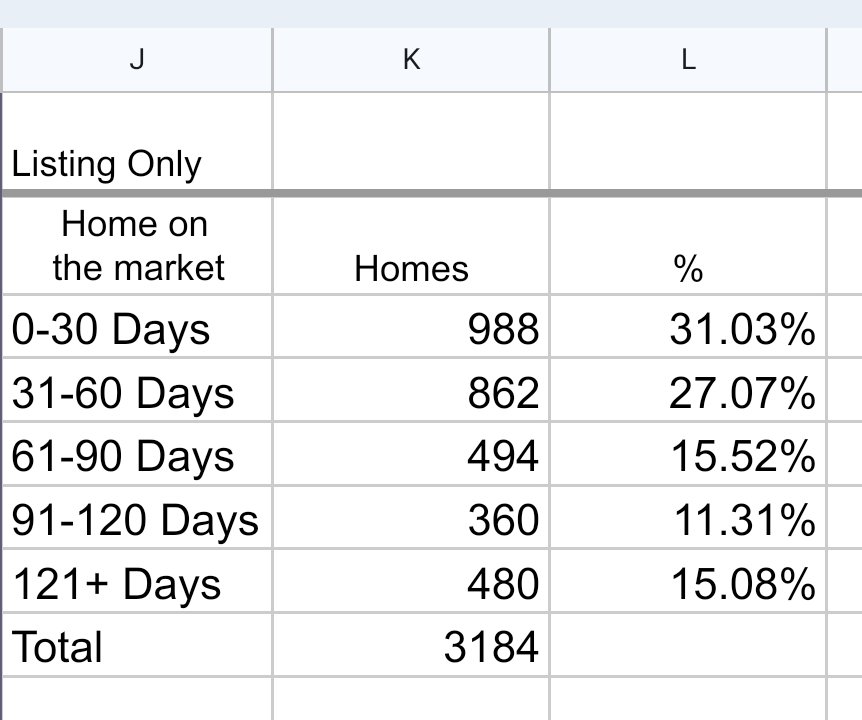
The percentage of homes listed on OpenDoor that have been for sale for more than 120 days has reached over 15%.
It seems we are repeating the same mistakes.
$OPEN
This is the only ‘sign’ that you need to see. We are in the second-derivatives world, its not about growth rate anymore, its the growth of the growth rate that matters
Anthropic Y/Y spend growth decelerated in July as user growth slows.
Total customer spend with Anthropic was up ~2,800% Y/Y but decelerated for the first time, while customer growth also decelerated for the 2nd consecutive month.
WALL STREET JOURNAL:
OPENAI'S HEAD OF DATA CENTERS CHRIS MALONE HAS LEFT THE COMPANY
this is like the 5th person who left in the past month
chief revenue officer left 2 weeks ago
you usually don’t leave one of the hottest startups a few months before IPO
just weird
If acquisition volume rises but profitability does not follow, the thesis weakens. If capital light products do not gain traction, the cash flow thesis weakens. If inventory ages again, the risk management thesis weakens. ~Scott
captures the only bear-thesis for $OPEN I'm BULL!
$OPEN The following is my condensed summary of Eric Jackson’s latest article on Opendoor, followed by my own investor perspective on what the data may mean for the next several quarters.
Jackson’s key point is that Opendoor’s short-term improvement in home sales is now being confirmed by the longer-term data.
Opendoor’s trailing 28-day homes sold are now +0.7% YoY, the first positive reading on this more durable window in over a year.
The progression over the last eight weeks is striking:
-43.7% → -37.4% → -32.6% → -32.9% → -21.7% → -20.6% → -16.5% → -3.5% → +0.7%
Eight weeks ago, Opendoor was selling roughly 44% fewer homes than a year earlier. Today, it is selling slightly more.
The important number is not simply +0.7%. It is the path from -43.7% to positive territory with almost no meaningful reversal.
That makes this look much more like a genuine level shift in the business than a temporary rebound.
Why the 28-Day Window Matters
The 7-day data had already turned positive, but short windows can be distorted by holidays, closing schedules, or one unusually strong week.
The 28-day window smooths out much of that noise.
The fast indicator turned first.
Now the slow indicator has followed.
That is exactly the pattern you would expect if the underlying transaction level were actually improving.
Revenue is telling a similar story.
Trailing 28-day revenue has improved from approximately -61% YoY at the end of April to just -0.3% today.
That is a remarkable normalization in only a few months.
But this is still primarily a volume signal.
The next question is margin.
Margin Is Now the Key Test
Average selling price is currently about 1% below last year, after being roughly 20% above last year in late June.
So volume is rising while selling prices are falling.
The critical question is whether Opendoor is simply finding the correct clearing price on a healthier inventory book, or whether it is sacrificing margin to generate volume.
Management expects Q3 Contribution Margin of approximately 4.0% to 4.5%, compared with 2.2% a year ago.
If Opendoor can maintain that margin while volume continues growing, the significance of the current recovery changes considerably.
It would mean:
Higher Volume + Better Margin
rather than growth purchased through weaker economics.
My Investor Take
For months, the market’s question was:
Can Opendoor grow transaction volume again?
The data is increasingly answering that question.
The short window turned first. Now the 28-day window has confirmed it.
The next question is:
Can Opendoor sustain that volume while improving unit economics?
I see the turnaround progressing through several stages:
Inventory cleanup
→ Acquisition growth
→ Sales volume recovery
→ 28-day volume turns positive YoY
→ Contribution Margin confirmation
→ Operating leverage
→ Sustainable profitability
We are now approaching the margin-confirmation stage.
That is why I continue to believe the next several quarters matter more than one isolated revenue print.
Housing transactions take time. Homes must be acquired, renovated, listed, contracted, and eventually closed. The volume that matters for future quarters enters the system before it appears on the income statement.
This is also why I remain focused on Q4.
Even if Q3 revenue does not exceed guidance, that would not automatically invalidate the operating recovery if transaction volume and the pipeline continue improving.
The bigger investment question is changing.
It is no longer simply:
“Can Opendoor survive and rebuild volume?”
It is becoming:
“What happens if volume is already returning and margins improve at the same time?”
That is a much more interesting setup.
The headline number may only be +0.7%.
But the real story is:
-43.7% → +0.7% in eight weeks.
Volume is beginning to confirm the turnaround.
Margin is the next confirmation.
And if both hold, operating leverage and profitability become the next chapters of the Opendoor story.
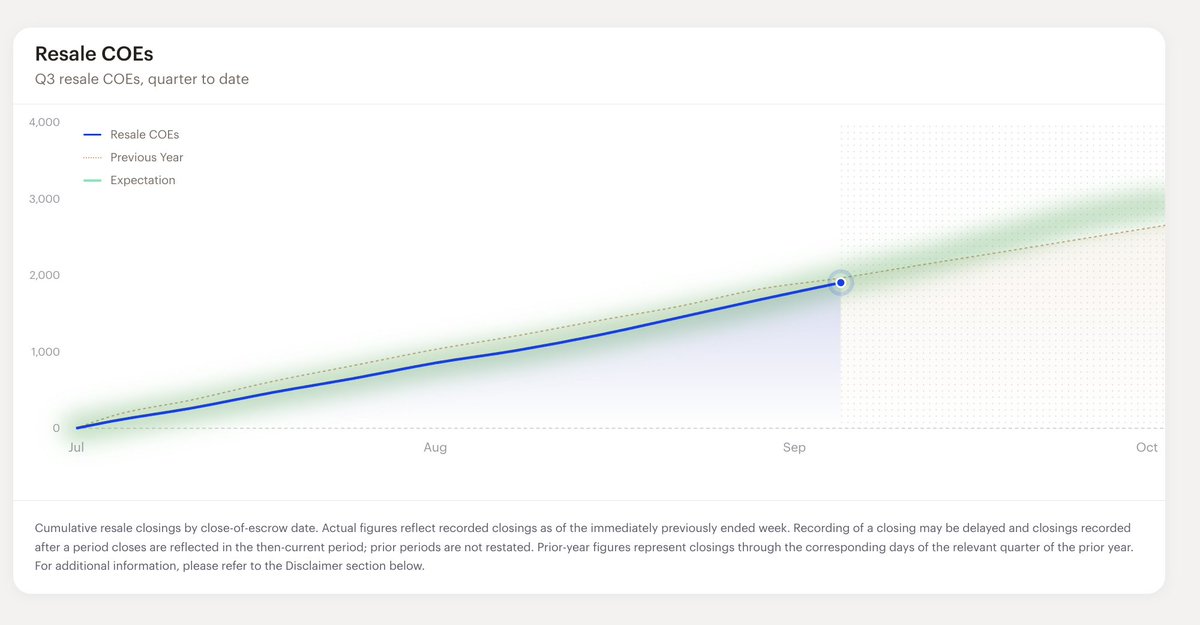
New table on the Data Explorer: cohort sell-through by listing week.
For the homes Opendoor listed in a given week, what % of THOSE homes sold within their own first 7 / 30 / 60 / 90 days. Every home runs its own clock from its own listing date.
Why it matters: Opendoor is accelerating new listings right now, and that quietly breaks the usual rotation metric. Sold ÷ active inventory falls automatically when listing volume rises, because the denominator fills up with homes that are simply too young to have sold yet. The ratio drops, nothing has gotten worse.
Measuring each cohort against itself removes that entirely. Cohort size, listing pace, inventory age mix, none of it enters the calculation.
And it's a clean test. A book that was actually deteriorating could not print similar percentages week after week across every window. Degradation would show up as later cohorts converting below earlier ones, at the same age.
Some news. Today, for the first time in Opendoor's history, we bought back our own stock.
Our share count is down 5%. We paid for this buyback with money borrowed at a 0% coupon and we still have hundreds of millions of dollars left to grow faster.
There are plenty of helpful details, along with a lot of legalese, in our press release and 8-K (linked below). But there are a few things I want to say directly and in plain English.
First, I *despise* dilution. On my first earnings call at Opendoor, I told you that if we issue a share, it has only one job: to make every other share worth more for our existing shareholders, not to extend runway for management. The flip side is just as simple: when our own stock is one of the best uses of capital, we should buy it back. Today, we did just that - by 5%.
Second, I run a publicly traded company. I don’t get to have feelings about the macro or the way Wall Street works. My job is to understand the rules of the game and use them to find an edge and build a better company.
One of those realities is that our stock price has lots of volatility.
People disagree - A LOT - about what Opendoor could be worth one day. Some think we're worth less. Some think we're worth dramatically more. I obviously have a view…
That disagreement isn’t just noise - it has economic value that Wall Street monetizes every single day.
Most companies would treat this as a headache, but we see it as an asset. If people are going to speculate about our future, I'd rather our shareholders get paid than anyone else. So instead of complaining about volatility, we used those dynamics to borrow $650M at a 0% coupon.
Then we turned around and used part of those proceeds to buy back our own stock. At today's prices, buying back our stock and call options was one of the best trades on the board. The rest stays on our balance sheet so we can buy more homes and grow faster.
As for dilution, we bought our stock where we thought it was cheap and pushed any future dilution far above today’s price. Not one net new Opendoor share will exist below $10.38. And if we buy back stock in the future, that floor goes higher.
But why raise now? Because the best time to raise capital is when you don’t need it. We’ve proven the business can reach ANI profitability, but profitability is just the starting point, not the finish line. And waiting could make the shares we are buying back today more expensive, and homes we could be buying don’t get bought. I’d rather move now.
Some people will call what we did today aggressive. They’re right. But being aggressive is how we fixed a company that spent years being careful. I’d make that trade again.
To our shareholders: You trusted us with your capital. Today, for the first time, Opendoor used its own capital to buy more of itself. The company is putting its money where its mouth is. Tomorrow, I will too.
After our lawyers allow, I’m personally buying $100K worth of shares. I'm all in, and I plan to keep buying.
the more people you consult for advice, the more likely you’ll make a bad/average decision.
(1) ppl are, on average, risk averse...and, in quantity, will blunt your boldness.
(2) ppl may hate/envy opportunities they lack.
(3) ppl tend to mix cynicism (bad) w/ criticism (good)