Anyone who has been pumping $AAOI has shown they simply do not understand or closely follow the optical communications industry.
AAOI was actually the first company I called out when I started posting on X. The pattern was obvious to me from the beginning: weak execution, repeated dilution, aggressive stock promotion, and shareholders paying the price afterward.
There are plenty of real leaders in optical communications. $AAOI is not one of them.
If you actually follow this industry—technology, products, customers, supply chain, earnings, and competitive positioning—you should have seen the red flags a long time ago.
$AAOI just announced ANOTHER $600M ATM offering. Stock -10% after hours. 😂
I’ve said it for months: this is a trash company wrapped in an AI optics story.
When the numbers can’t justify the hype, just sell more stock to Wall Street.
The shareholders are the product. 🤡
AAOI is issuing stock again.
My view on this company hasn’t changed: this kind of capital-markets playbook looks like a scam to me.
Over the past six months, AAOI has launched ATM offering after ATM offering. The first two rounds already raised more than $1 billion, and now it has opened yet another ATM for up to $600 million.
The pattern is simple:
Tell a new story → stock goes up → management sells more shares → existing shareholders get diluted → repeat.
Shares outstanding have already risen from roughly 75.2 million in February to about 84.9 million today, nearly 13% dilution in less than six months. And if the new $600 million ATM is fully used, dilution goes even higher.
What makes this worse is that AAOI is not some exceptional business generating huge profits and free cash flow.
The underlying business has been mediocre for years. Revenue quality, profitability, cash flow, and competitive position are nowhere close to the real leaders in optical networking.
Great companies create shareholder value through products, earnings, and cash flow.
AAOI increasingly looks like a company whose best product is not optical transceivers.
It’s its own stock. $AAOI
Since people are having fun speculating on $SKHY CPO roadmap supply chains.
I'm gonna do my own guess and say SK Hynix is evaluating Celestial/Ayar. Then doing heavy evaluation into microLEDs past first-gen deployments.
Both have been kinda working on it for awhile.
- Ayar shown up in SK hynix's own website in the context of optical <-> memory links.
- Marvell is actively working with SK Hynix in custom memory solutions (and guess who owns Celestial now).
Celestial/Ayar are both also cited in SK Hynix's linked Nature Paper, which helps a bit with technical relevance:
(121): Stojanovic, V. A UCIe optical I/O retimer chiplet for AI scale-up. In 2025 IEEE Hot Chips 37 Symposium (HCS) 1–22 (IEEE, 2025)
- This is Ayar reference (Ayar’s teraphy optical I/O chiplet), Stojanovic is Ayar Lab's co-founder btw.
(123): Winterbottom, P. Photonic interconnect for accelerated computing celestial AI photonic fabric module (cough cough Celestial)
There's more breadcrumbs out there, but wanted to keep this relatively short-form.
For more upstream beneficaries:
-> I still think $SIVE is the cleanest read through since they're likely supplying to both Celestial/Ayar.
The interposer/packaging IP layer... People were speculating $POET, but Marvell probably vertically integrated players them out this year after the announcement.
Given they've had their own SiPH interposer tech/integration IP before Celestials acquisition (eg. presented a silicon-photonics interposer back in 2023)
-> AMS Osram (which I don't own), seems like they're co-developing in this area given they randomly went out of their way this year to say HBM <-> optics was a TAM increase for them.
TLDR: I see Ayar/Celestial as candidates for SK Hynix's CPO roadmap, then microLEDs being commercialized past gen-1 maybe 2029. (this is all speculation)
Just to throw a bone to quantum dot bros, this got cited like 5 times.
It’s actually very simple.
From upstream components to downstream modules, optical networking depends far more on reliable, pragmatic, execution-driven Chinese suppliers than on companies that are better at selling stories to Wall Street than delivering results.
In this industry, capacity, yield, cost and shipments matter. Not conference-call hype.
That’s why I trust the companies actually shipping at scale far more than the loudest storytellers. $AAOI $LITE $COHR
Very positive. My opinion is that the optical sector underperformance recently from $AAOI to $SIVE has been absurd.
The demand visibility... is just way too stupidly high.
AOI: “Even combined AOI, Coherent program altogether, is still very tough to meet the customer demand in the next 3 years” (2029)
Elazr GM: "entire optical supply chain was facing major shortages." "The shortage will continue to the next few years"
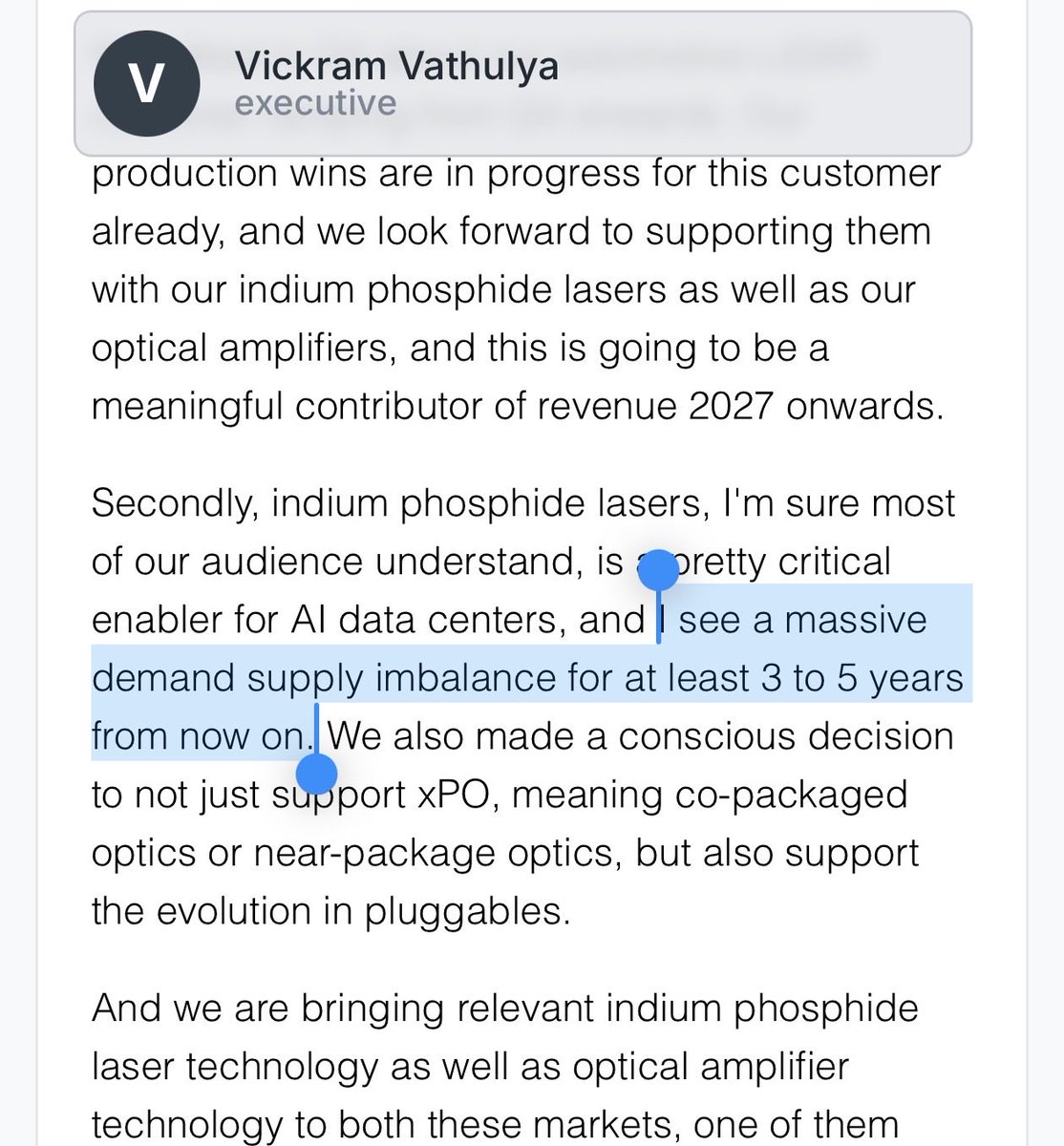
Sivers CEO said the same thing about InP laser demand imbalances expected for the next 3-5 years.
Can go on and on about $LITE, $MTSI and other comments.
We haven't even hit the inflection point with 1.6T, NPO, CPO scale out/up, and optics with memory (as seen with SK Hynix).
Yet the industry is already bottlenecked by EML/CW and all your other upstream components from PDs/TIA/DSPs, transceivers, and soon FAU + others when CPO scales…
I'm personally extremely comfortable watching this all play out, but just a little confused that markets don't know how to math a year or two ahead.
U.S. Treasury yields are dropping sharply, and equities are bouncing.
The catalyst is straightforward: the Treasury will at least double the size of its long-dated bond buybacks, raising the per-operation cap from $2B to $4B starting Sept. 9, with a focus on improving liquidity in 10–30Y Treasuries.
This is not QE, but it does provide stronger liquidity support for the long end.
Lower long-term yields are clearly a marginal positive for high-duration, high-valuation assets.
$SPY $QQQ
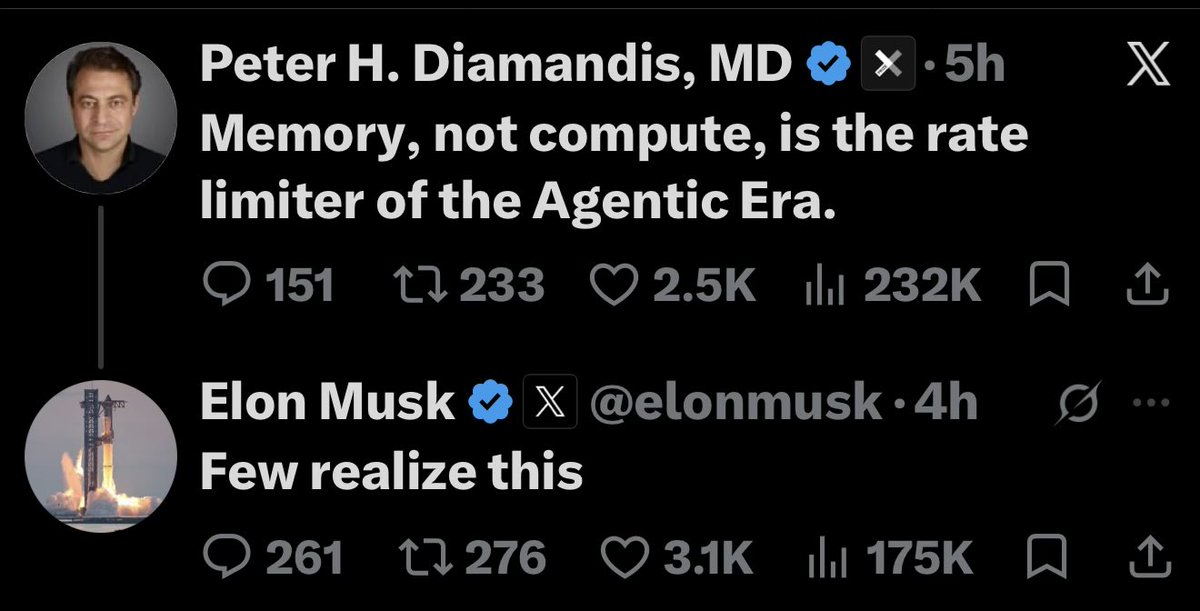
Exactly. NAND — and eventually HBF — is basically being built for the inference era.
Training is finite. Inference is not. More users, longer context, more agents, more tokens, more KV cache — all of it translates into more storage demand.
HBM makes inference fast. NAND/HBF makes inference scalable.
If AI keeps generating more tokens, the theoretical demand ceiling for storage is almost infinite.
$SNDK $MU $SKHY
$SNDK $MU $SKHY
TLC NAND prices jumped 11.6% in three weeks and 5% in one week because AI agents are running out of HBM & SOCAMM2 to store KV Cache (Context)
When a model holds a long conversation, it stores every prior token in something called the KV cache. The longer the context gets, the bigger that cache gets, and HBM (the fast memory sitting next to the GPU) is both limited in capacity and expensive to fill with it.
NVIDIA's fix, built into the Vera Rubin platform, is CMX (Context Memory eXtension). Running on BlueField-4, it inserts a flash layer between HBM and network storage. Excess KV cache spills out of HBM into high capacity TLC flash and gets pulled back fast when needed, connected to Rubin GPU clusters through BlueField-4 DPUs and Spectrum-X Ethernet.
HBM is how you make KV cache fast. NAND is how you make it affordable at scale. AI needs both.
The key difference is industry stage.
Memory is benefiting from a powerful pricing cycle: profits and FCF are exploding while leaders trade at just ~3–4x P/E. In that setup, buybacks are an obvious use of capital.
Optical modules are different. Growth is driven more by continuous product upgrades—800G → 1.6T → CPO/NPO—and capacity investment, so companies are still reinvesting heavily.
Once they accumulate enough cash and valuations compress, they’ll buy back stock too. In fact, Innolight (https://t.co/akHPCRoB39) already announced a RMB 6bn buyback.
Innolight and Eoptolink (https://t.co/hO9EmJRmcD) are now roughly ~10x 2027E earnings. Capital returns will come as the industry matures.
SK Hynix $000660 is doing exactly what $SNDK did: massive buybacks.
People can argue about charts, cycles and narratives all day.
But profits are real. Cash flow is real.
And when a great business is generating too much cash while the market refuses to value it properly, the ultimate buyer of the stock is the company itself.
That’s the beauty of owning a cash machine. 💰
Higher Treasury yields won’t kill AI capex.
$MSFT $GOOGL $META $AMZN $ORCL are issuing more debt, but debt is only part of the funding mix — their cash flows remain massive.
The real question is ROI vs. cost of capital.
Higher rates hurt expensive 30–50x PE stocks far more than profitable, low-multiple AI names.
AI capex ends when returns collapse, not when the 10Y hits 5%.
This comparison is fucking hilarious. 😂
$AAOI is the next $SNDK because its market cap is smaller?
That’s not how valuation works.
$SNDK is a global NAND heavyweight.
FY26:
• Revenue: $20.25B
• GAAP net income: $11.43B
• Market cap: ~$280B
That’s roughly 24.5x FY26 earnings.
Now look at $AAOI:
Q2 revenue: $191.9M
GAAP net loss: -$22.8M
Market cap: ~$12.6B
It’s STILL losing money on a GAAP basis. 😭
And here’s the funniest part:
Back in 2022, $AAOI literally announced a deal to sell its Chinese transceiver assets, saying it was in shareholders’ best interests to EXIT the transceiver market.
Then the AI optical boom became so insanely strong that it dragged AAOI back into the game. 😂
Meanwhile, there are plenty of optical vendors with far stronger scale, execution and industry positioning.
So comparing $AAOI to $SNDK simply because AAOI has a smaller market cap completely ignores:
industry position, earnings, competitive moat and valuation.
A small company can be insanely expensive.
A huge company can still be cheap.
Market cap ≠ valuation.
Investing 101. 😂
If optic demand continues
$AAOI is the next $SNDK
Here’s why:
AAOI is the small player in the optic sector (for now). They have the demand; what they are currently scaling is the infrastructure to capture it.
$AAOI current mc: $12.7B
$LITE current mc: $72B
LITE has already positioned itself to take on the demand, hence the current valuation.
AAOI is in the process of doing so. Q2 Revenue was ~$192M. Management expects $471M Monthly revenue by H2 2027.
Higher Risk, Higher Rewards. If you believe the AOI team can meet expectations, we are severely undervalued.
The market's reaction to the China optical ban seems illogical. Why did Lumentum and Coherent stock pop?
US firms make the high-end lasers (200-gig EMLs). Chinese module makers do the low-margin packaging. If you ban the packagers, who buys the lasers?
One of the funniest things about the US opticals trade right now 😂
$COHR and $LITE are aggressively locking up long-term InP substrate supply from $AXTI — with real prepayments and capacity reservations.
And where is a major part of AXT’s InP capacity?
Beijing, China. 🇨🇳
That’s the irony.
AI optics need more lasers → more lasers need more InP → US optical companies rush to secure InP → and a critical part of that upstream capacity is still sitting in China.
$AAOI, $LITE, $COHR all benefit from the AI optical boom, but the supply chain underneath them is far more intertwined with China than many investors seem to realize.
Everyone loves talking about “decoupling”…
until they actually trace the supply chain. 😂
Summary of CPO/NPO Market Update
🚀 NVIDIA CPO: Spectrum-X CPO switches for Scale-out are officially in mass production. Our forecasts: 15k units (2026E) & 100k units (2027E).
*Supply Chain: To support the CPO Scale-Out ramp, TSMC has expanded CPO inspection equipment capacity (notably adding Insertion 2/3 capacity), alongside strong progress from key suppliers in FAU, shuffle boxes, and system assembly.
* Scale-Up Architecture: Rubin Ultra is now expected to adopt a 9-18-9 tray design. While mechanical challenges from the 0.75U height could potentially lead to a reversion to a 10-9-8. This shift will have no impact on optical engine (OE).
📈 OE Shipments: NVIDIA platform optical engine (OE) shipments expected at 6m (2027E) & 19m (2028E). Total industry-wide OE hitting 11m & 40m.
☁️ Amazon Trainium 4: AWS projected to consume 5m (2H27E) & 12m (2028E) OE units, primarily 6.4T specs.
* Trainium 4 will likely have 3 configurations, with two expected to adopt NPO.
💡 Key Plays: LITE/COHR (CW laser upside), Browave (10k+ shuffle box per quarter in 4Q26E, followed by acceleration in 1H27E.), SMTC/MRVL (TIA/Driver), TSEM (NPO PIC exposure).
#NVDA #LITE #MRVL #SMTC #TSEM #Browave #CPO #NPO
The most undervalued optical communication names in the world, in my view:
Innolight https://t.co/akHPCRoB39
Eoptolink https://t.co/hO9EmJRmcD
AI clusters keep getting bigger. Bandwidth keeps going up. 800G → 1.6T → faster. Scale-out keeps expanding, and scale-up is increasingly moving toward optics too.
Yet these two sit at the center of the global optical module supply chain with massive volume, strong execution, and real earnings — while still trading at valuations that look almost absurd compared with many US optical names.
Sometimes the best AI infrastructure trade isn’t the loudest one.
It’s the one already shipping millions of modules and printing cash. 🐼🔥
$SNDK ripping higher again. 😂🔥
This is exactly what happens after a brutal deleveraging: the weak hands are forced out, leverage gets flushed, and once the selling pressure disappears, the market finally goes back to what actually matters — fundamentals, earnings and valuation.
The NAND cycle didn’t suddenly improve today. The fundamentals were already there.
What changed was the positioning.
When the chips are finally cleaned out, price can start reflecting value again.
Sometimes the biggest “catalyst” is simply: everyone who had to sell has already sold. 😌📈