Mathematician working in ML/AI, applying causal inference in practice & theory. Further interests in information theory, personalized medicine, and math.
Looking forward to sharing my thoughts on validating causal models at #CDSM22 on Monday!
#CausalTwitter#CausalInference
Check out the material in advance:
- Paper: https://t.co/CSlAZt62xJ
- Python package: https://t.co/wihcQuRDqN
#DataScienceSummit już 17 i 18 listopada, Mamy ogromną przyjemność Przedstawić Prelegentów ze ścieżki "PREDICTIVE & PRESCRIPTIVE ANALYTICS (ONSITE)".
🔹 Aneta Ptak-Chmielewska
🔹 Michael Grottke, GfK
🔹 Peter Gmeiner, GfK
Pełna Agenda na stronie wydarzenia (link w komentarzu).
@eliasbareinboim 2. What will happen if the discrimination bias in the data originates from a pure interaction of treatment and mediator variables? Can we still interpret the decomposition of TV as you have done it in a reasonable way and assign the decomposed terms to disparate treatment/impact?
@eliasbareinboim 1. Wouldn't it be more natural to have a decomposition of TV in the following form:
TV_{x0,x1} = NDE_{x0,x1} + NIE_{x0,x1} + IE_{x0,x1} + (Exp-SE_x0(y) − Exp-SE_x1(y)) with an interaction effect term given as IE_{x0,x1} := TE_{x0,x1} - NDE_{x0,x1} - NIE_{x0,x1}?
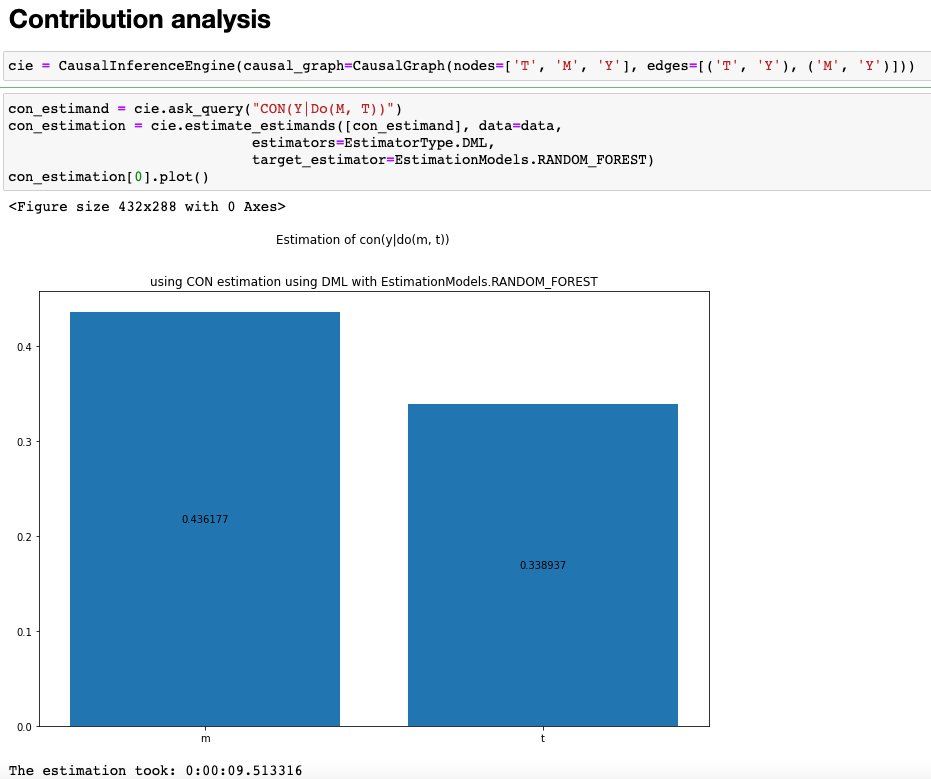
@eliasbareinboim@YonghanJung Great to see that our lines of thought coincide here and you set it on solid theoretical ground. We implemented the same as do-Shapley as a contribution-estimand to our package this spring.
Suppose we are interested in counterfactual questions and have access to multiple datasets. When/how can we merge SCMs over distinct but overlapping subsets of variables?
Check out our #icml poster (Tue 18:30) "Causal Inference Through the Structural Causal Marginal Problem"
1/n
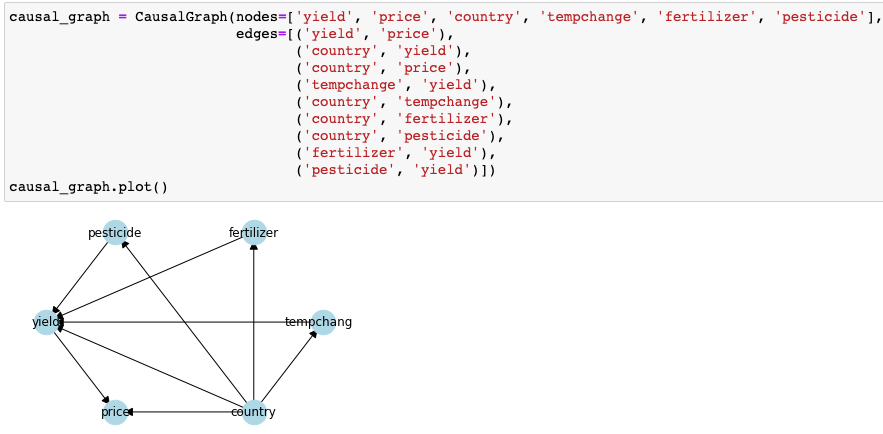
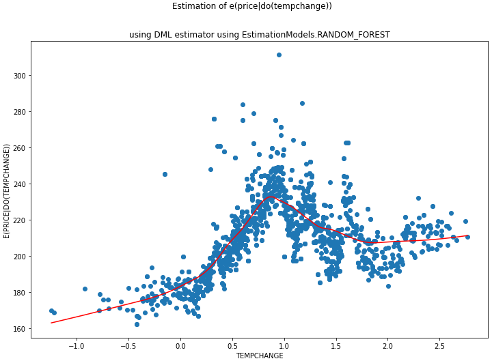
@soboleffspaces The causal graph is not very sophisticated. Data are drawn from "Food and Agriculture Organization of the United Nations" https://t.co/AbiIPANN1b
Happy to see how @yudapearl's Causal Inference Engine as described in his #Bookofwhy works together with recent research from @eliasbareinboim and @VC31415 in one Python implementation.
Happy to announce my talk about (un)observed confounders in causal models today at 3pm CET at the causal inference Meeting https://t.co/JLyDlpS6GY
#causality#causalinference
@Propofolium Klingt nach einer Anwendung von kausaler Inferenz um die Ursachen für Pollensymptome zu finden. Unsere App Nutrimizer https://t.co/Xx23aWI39H macht so etwas schon für Nahrungsmittelunverträglichkeiten. Wir überlegen unsere Modelle für eine Pollenallergieanalyse zu erweitern.