There is a new special issue in infant and child development on Registered Reports with secondary data analysis. https://t.co/hnQeibd16J I think it is time for a discussion if we call this preregistration. We recently argued we should not. If authors have access to data >
.@stephaniemlee interviews Carolyn M. Rouse @AmericanAnthro, Is Anthropology Hopelessly Politicized? https://t.co/QlXto8OGHr
"I just don’t trust opinion polling. That’s from just being an anthropologist & spending a lot of time w/people in the field. People don’t know a lot."
Hmm
It's depressing that 28 years after Judith Rich Harris's The Nurture Assumption, psychologists are conducting, and journalists credulously reporting, useless correlational studies of people's decades-old memories of childhood abuse & their adult relationships, presented as evidence for causality. No controls for (among other things) more neurotic adults spinning childhood memories as traumatic; abusive parents passing on genes for cantankerousness to their kids; more obstreperous children growing into more obstreperous adults. | "Childhood Trauma Echoes Through Romantic Relationships" https://t.co/9f5X99EJUx
Wat hebben Taranto en de IJmond met elkaar gemeen? Tinkebell reisde naar de Italiaanse staalstad om dat uit te zoeken. Haar video laat zien welke overeenkomsten er zijn en waarom de vergelijking juist nu relevant is, nu het Openbaar Ministerie Tata Steel gaat vervolgen.
Lees hier verder: https://t.co/pGDkYDpDOJ
Gepreregistreerde meta-analyse laat vooral zien hoe pover de stand van het onderzoek is. Onder de aankondiging barst direct de discussie los: ís montessorionderwijs überhaupt een ‘methode’ of vergelijken we appels met peren omdat leerkrachten de methode maken of kraken?
¿Qué dice la evidencia científica sobre el método Montessori?
Tras varios años de trabajo acaba de publicarse nuestra revisión sistemática y metaanálisis en Review of Educational Research.
Analizamos 198 estudios con una perspectiva meta-científica:
🧵👇
@michiellieuwma Voor een 'return of the father' met 1) een ondergeschikte rol van de moeder en 2) een Pyrrusoverwinning op het patriarchaat en 3) een blik op de angst na het verlies (met de twee zonen die "Papa!" uitschreeuwen naar een inmiddels zinkende boot). https://t.co/L8qnaw6PLN
Teaser 1 for a note on the new arXiv rule / desk rejecting LLM artifacts:
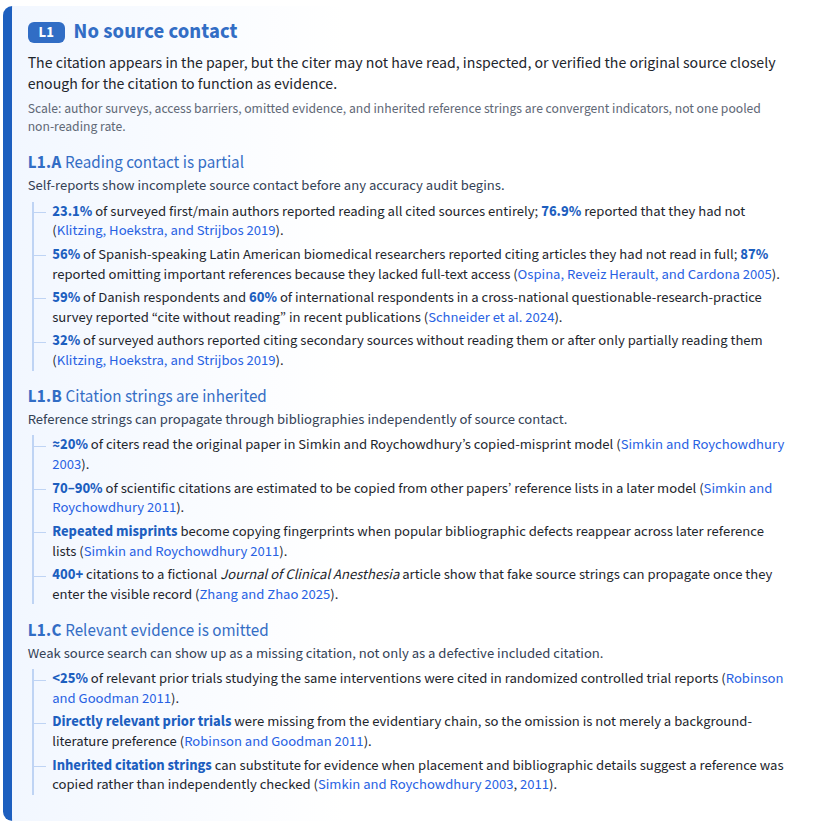
Nothing in all of meta-science suggests people actually read everything they cite. People who think otherwise have not studied citation practices even a little bit.
My surprise here seems warranted, this paper was retracted
(There are other peer-reviewed meta-analyses of the impact of AI on education finding positive effects, like: https://t.co/bLHHelTLCs though the best evidence of AI helping is from RCTs of interventions with AI tutors)
I've known @jayvanbavel and Dominic Packer for 20 years. Partly responsible for me ending up at UofT. They write one of the best psychology Substacks around. This week I'm republishing their piece on the bystander effect and why the Kitty Genovese story isn't what we thought.
https://t.co/nRUVu7KI9M
@mkeulemans@dr_kkjetelina@ZEMBLA@TonvanderHam@VJHarmsen Allesbehalve neutraal en eerder handige framing: “chemical tool” i.p.v. pesticide, de volgorde (“benefits”, dan “trade-offs”) centreert de voordelen, en “genuine open scientific questions” normaliseert de onzekerheid en dus ook de mogelijke risico's.
@mkeulemans@dr_kkjetelina@ZEMBLA@TonvanderHam@VJHarmsen “Glyphosate is a chemical tool with benefits, trade-offs, and genuine open scientific questions.” Wat valt hier op? “tool”, iets nuttigs dat je verstandig kunt gebruiken
Voordelen zijn hier het startpunt; de nadelen bestaan bij gratie van die voordelen. Onzekerheid is oké. Jaja.
Ask a colleague why they refuse to use AI. They say it uses up all that water. You point out the water use is far smaller than some would have them believe. Then it's the hallucinations. You mention accuracy has improved dramatically. Then, finally: the process is the point. The struggle. The craft. The deeply human act of sitting with uncertainty.
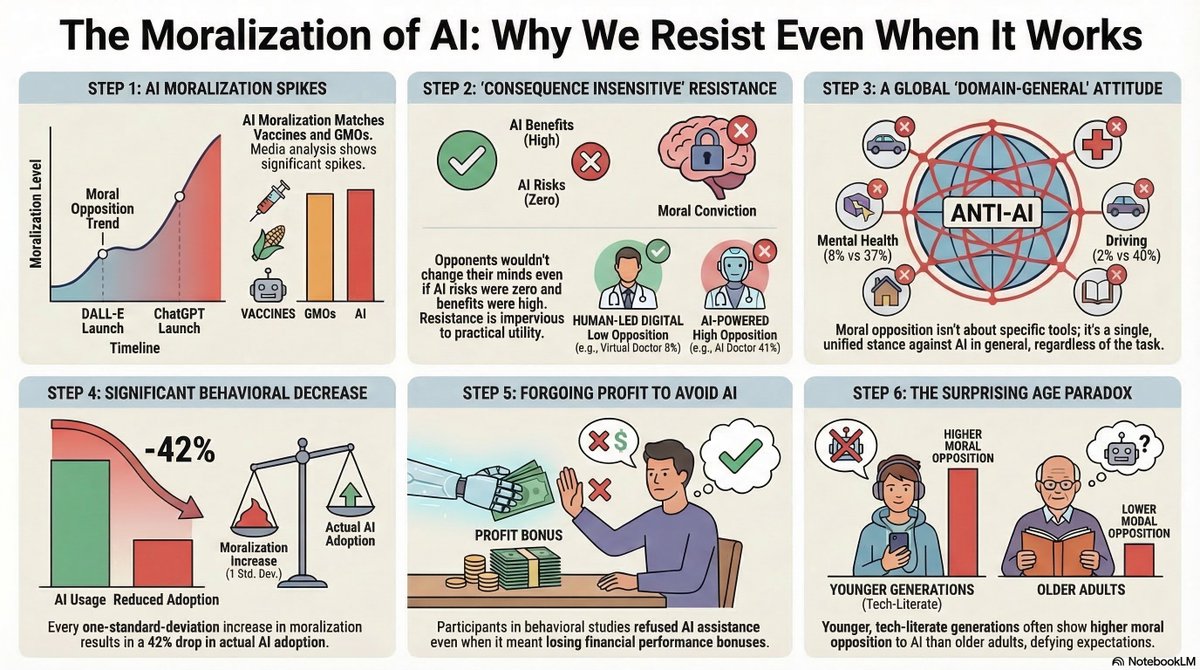
They're not reasoning. They're rationalizing their gut intuitions. My amazing student @vicoldemburgo, with Éloïse Côté, Reem Ayad, @yorl, Jason Plaks and I have a new preprint that explores this more thoroughly, called "The Moralization of Artificial Intelligence".
We started by asking how moralized AI has become in public discourse. Analyzing 69,890 news headlines from 2018 to 2024, we found that AI was moralized at levels comparable to GMOs and vaccines, technologies whose moral opposition has been studied for decades. It ranked above both. The sharpest spike came within weeks of ChatGPT's launch in late 2022.
When we surveyed representative samples of Americans, a majority of AI opponents said their views wouldn't change even if AI proved safe and beneficial. That's consequence insensitivity, the hallmark of moral conviction, not practical calculation. Across art, chatbots, legal tools, and romantic companions, AI moralization loaded onto a single latent factor. A global moral stance, dressed up in whatever practical language is available.
The behavioral data make this concrete: a one standard deviation increase in moralization scores predicted a 42% drop in actual AI usage, even when it would have benefited that person personally. The conviction preceded the behavior by up to 573 days.
The next time someone gives you three different reasons to oppose AI, each one dissolving under mild scrutiny, you're probably not watching someone think. You're watching someone feel.
Preprint avaulable here: https://t.co/dElNrW4OxL
Look at how physicians diagnose more children with ADHD on Halloween (the red line in the middle of the figure).
The authors hypothesize that docs are more likely to diagnose kids on this day simply because kids are excited for Halloween.
Fascinating!
Nederlandse neurowetenschapper dr. Martijn van den Heuvel zet nieuw vakgebied op zijn kop: Fundamentele denkfout in methode 'lesion network mapping' en publicaties Harvard-wetenschappers
https://t.co/32blXRijAl