Your ability to burn fat is not determined by willpower.
The limiting factor is your mitochondria. The study found that individuals with greater mitochondrial abundance achieved significantly higher peak fat oxidation, independent of aerobic fitness. Fat metabolism is not a motivation problem. It is a cellular infrastructure problem.
The biology of performance begins long before the workout starts.
Vertebrate animals cannot convert Ω-6 polyunsaturated fatty acids (PUFAs) to Ω-3 or vice versa, so dietary PUFA intake determines tissue Ω-6:Ω-3 levels.
Some creatures have enzymes that can interconvert Ω-6s and Ω-3s, allowing them to maintain an even balance even when dietary intake ratios are skewed.
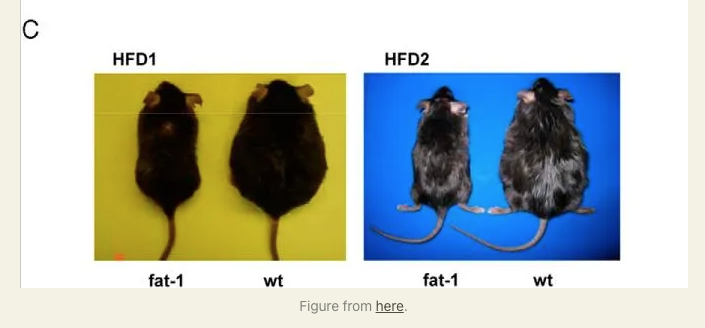
What happens when genetically engineer mice so they have that gene, called "fat-1"?
With the fat-1 gene, mice can now convert excess dietary Ω-6 PUFAs into Ω-3s, maintaining a more even balance.
Engineered mice have these features:
- Resistant to obesity, diabetes & liver disease
- Increased energy expenditure
- Lower inflammation
Look at the pictures below. Normal mice ("wt") gain much more weight on a high-fat diet than "fat-1" mice, which convert excess Ω-6 PUFAs into Ω-3s.
Source in reply.
Cancer was, in the 1920s, named the disease of the modern industrial age.
Otto Warburg, working in Berlin, demonstrated that cancer cells run on glucose. They prefer it. They run on it inefficiently, even in the presence of oxygen, in a way healthy cells do not. He won the Nobel Prize in 1931 for the work. The mechanism is now called the Warburg effect and sits in every oncology textbook published since.
In the 1970s, an American radiologist used Warburg's principle to build the PET scan. He injected radioactive glucose into the patient, waited twenty minutes, and watched on the screen where the glucose concentrated. The tumour lit up. The healthy tissue did not.
The machine has been used millions of times. It is, mechanically, a sugar detector. The thing it is detecting is the thing the cancer is eating.
The patient, after the scan, walks down the corridor to the oncology consultation. The oncologist explains the diagnosis. The dietitian, often in the same building, recommends wholegrain pasta, oat porridge, and fruit at every meal as part of a balanced recovery diet.
The mechanism is in the textbook. The textbook is on the shelf. The shelf is in the same building as the dietitian.
The two have not been introduced.
@drmarkhyman When you understand the chemistry of organic life, you see the answer is simple. Eat whole natural foods.
As @zoeharcombe says: We are the only species of animal smart enough to make our own food, but dumb enough to eat it.