Excited to share our @eccvconf paper: Resolution-Agnostic Neural Operators for Multi-Rate Sparse-View CT.
We introduce Computed Tomography neural Operator (CTO), the first neural operator framework for sparse-view CT reconstruction.
Sparse-view CT cuts radiation dose and scan time by taking fewer X-ray projections, but reconstruction then becomes ill-posed and needs a learned prior. Existing deep learning models are tied to one subsampling rate. However, this is not scalable since clinical protocols vary across organs and diagnostic purposes, so in practice you need a separate model for each subsampling rate.
CTO instead learns a mapping between function spaces. Because a function has no fixed resolution, one model ingests sinograms at any subsampling rate and outputs high quality reconstructions, with no retraining required.
On an average, CTO beats traditional unrolled CNN variational network by 3.42 dB PSNR and is 500x faster than diffusion models while being 6.02 dB PSNR better. @Caltech
Paper: https://t.co/5nTFedDmtJ
Project page: https://t.co/jt313GBntL
Code: https://t.co/6y02Z6HdR3
Chat with me at ICML! Find how we discover a hidden confidence dynamic signal on confidence evolves along reasoning trajectories; and use that to boost performance!
Inference Time Optimization with Confidence Dynamics; https://t.co/ZH4MnCdxrk Wed Jul 8 2:30 PM - A #2113
#icml
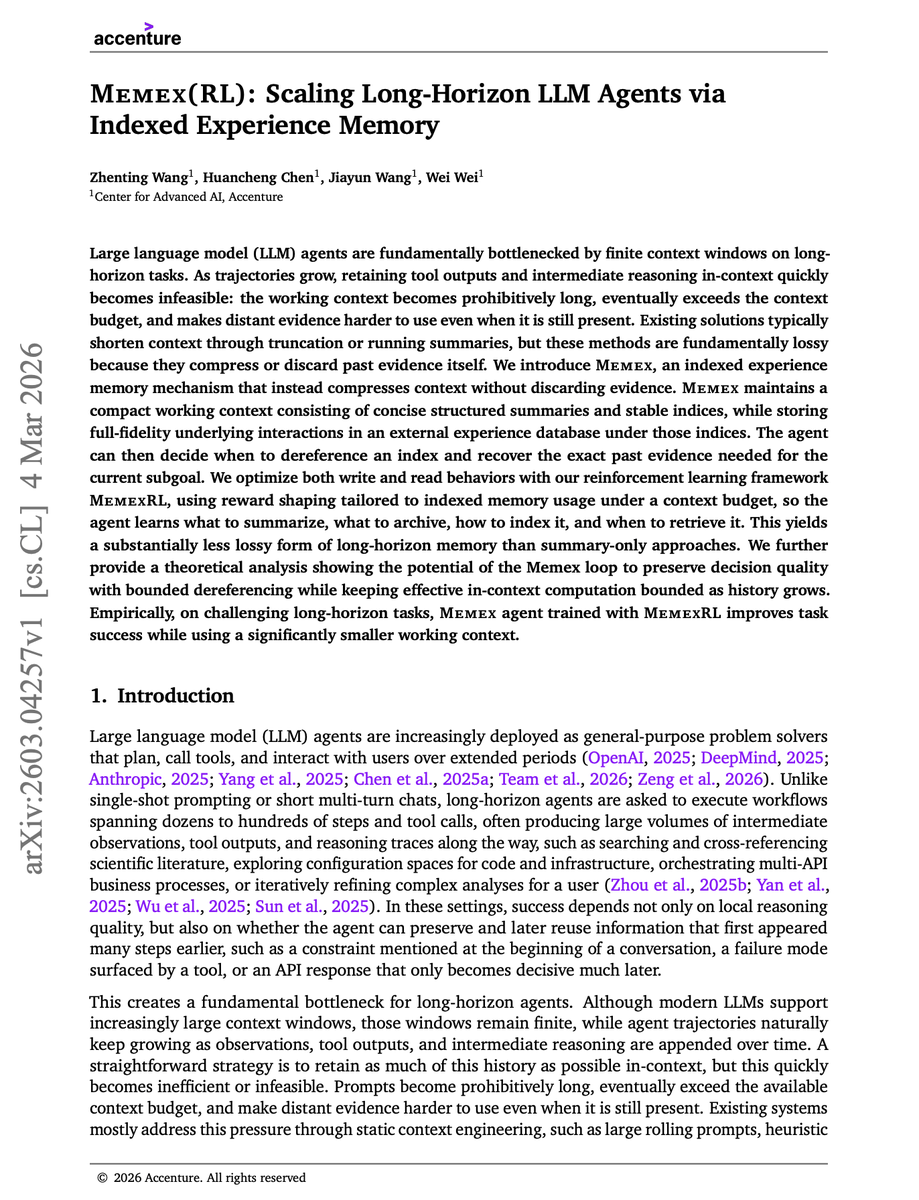
New research on scaling agent memory for long-horizon tasks.
One of the biggest challenges with AI agents is memory.
As tasks get longer and more complex, agents lose track of what they've learned, what they've tried, and what worked.
This paper, from Accenture, introduces Memex(RL), a system that gives agents indexed experience memory. Instead of relying on raw context windows, agents build a structured, searchable index of past experiences and retrieve relevant memories as needed.
Long-horizon agent tasks like deep research, multi-step coding, and complex planning all require persistent memory.
Memex(RL) shows how to scale this without blowing up context length.
Paper: https://t.co/TWMF5HC6Qe
Learn to build effective AI agents in our academy: https://t.co/1e8RZKs4uX
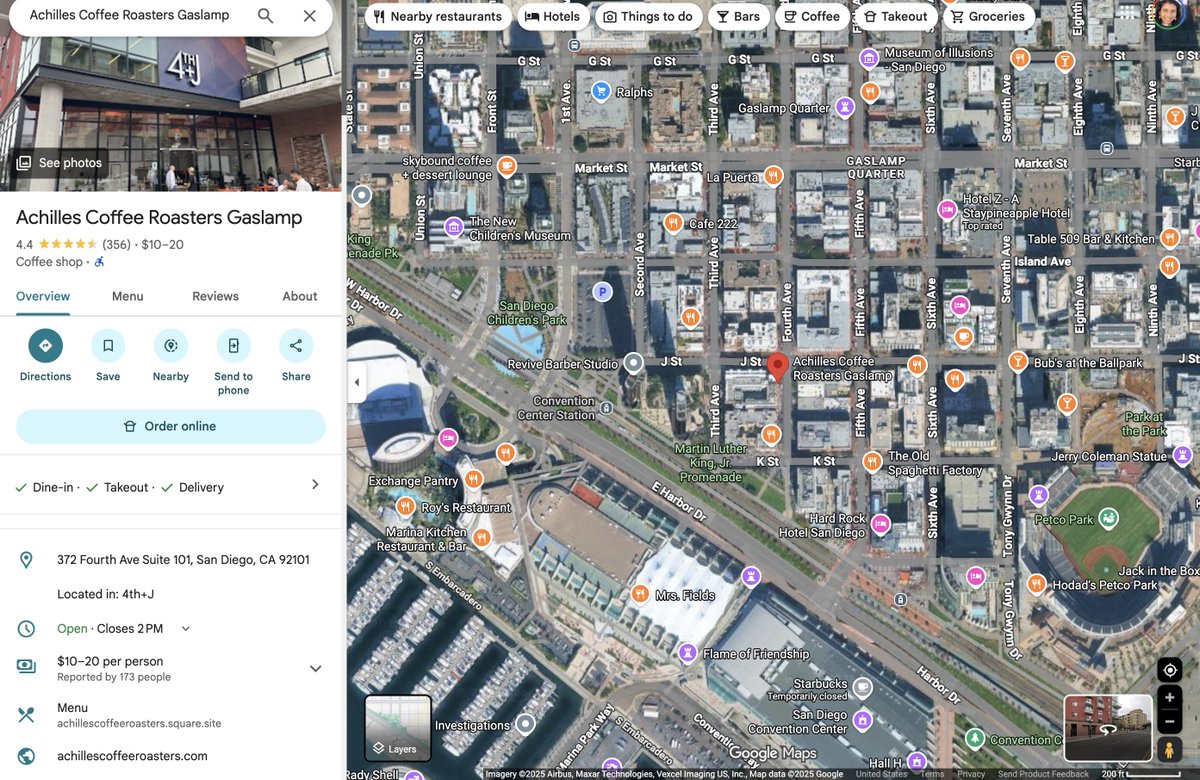
Join our happy hour meetup today at @NeurIPSConf to chat about AI+Science and AI+Math with me and my team from @Caltech at:
Achilles Coffee Roasters Gaslamp, San Diego.
4:45pm - 6:30pm
We have a number of papers at NeurIPS on Neural Operators, Inverse Problems, Scientific discovery, Design and experimentation, Lean + LLM, Physics-informed learning etc.
If you are interested in joining our team or collaborating with us, this will be a great opportunity to come talk to us, or if you are generally curious about the latest developments or want to learn about unsolved problems.
I will be announcing one more meetup later this week if you can't make it to this one. Stay tuned!
It has been exciting to see all the progress in AI+Science, but deep challenges still remain and the future is bright.
Amazing time at #CVPR with brilliant minds! Big congrats to @AnimaAnandkumar on receiving the IEEE Award! 🏆 Your mentorship light my way
Shout-out to @armeetjatyani for making any-resolution neural operators for imaging possible. Check out the demo: https://t.co/QHgSCKPAeT
NO-MRI
1 neural-operator handles any k-space pattern → +11 % SSIM, +4 dB PSNR vs E2E-VarNet, 600× faster than diffusion!
Zero-shot super-res & FOV (useful for clinics!)🩺
Try our demo on Hugging Face 🤗
https://t.co/GVX385XGca
Come to our poster #477 @ 10:30am at #CVPR 2025
I’m presenting our work at CVPR this week and happy to chat!
1) Thu 6/12 10am talk @room 107A Practical/Theoretical Gap workshop
2) Thu 6/12 11:30am talk @room 101D Embodied AI workshop
3) Sun 6/15 morning poster session: A Unified Model for Accelerated MRI
Please consider making a contribution to this special fund that will be used by Caltech and JPL to directly support affected individuals and their families greatly impacted by this week's devastating fires in Southern California.
https://t.co/2G0pT8XtRh
2024 was a pivotal year for AI+Science. Our team made exciting contributions. Here are some highlights: https://t.co/FeKVC5RKS7
1. Neural Operators as a unifying AI framework for modeling multi-scale processes. We got to write a perspective article in @NatRevPhys and released an open-source library that has been widely adopted.
2. FourCastNet, our Neural-Operator-based model, featured in the @WHOSTP PCAST report on AI+Science. Its speed enables large ensembles to obtain unprecedented predictions of extreme weather events.
3. Designed a novel medical catheter using Neural Operator-based inverse design.
4. Used Neural Operators with reinforcement learning for turbulence stabilization and wall friction reduction.
5. Many other applications where Neural Operators have shown a big impact: nuclear fusion, computational imaging, Carbon capture and storage etc.
6. Gave a @TEDTalks highlighting AI+Science.
7. Exascale training of genome-scale language models for protein design that was recognized as a finalist for the ACM Gordon-Bell prize.
8. State-of-the-art protein-ligand structure prediction that can handle changing protein conformations that Alphafold and other methods cannot.
9. AI+Math innovations with LLM + Lean for theorem proving.
10. Hardware-efficient large-scale training such as gradient projections and mini-sequence transformers.
11. Many honors such as @iitmadras Distinguished Alumnus award, and @BlavatnikAwards
Excited to share our work that detects 3D bounding boxes from 2D images. Plus, you can freely query detection boxes with any unbounded (open) vocabulary! Try our code: https://t.co/s0mALjh0jT
🚀 Thrilled to share our latest work: Open Vocabulary Monocular 3D Object Detection
💡 Our method OVMono3D-LIFT can detect and localize objects in 3D from a single RGB image for any object category!
🌟 Results on In-the-Wild COCO images:
A 🧵:
#ComputerVision#3DDetection
Happy to share our first @SymposiumML4H work on predicting the safety of IMRT plans. IMRT is an important cancer treatment, which needs to undergo measurement for quality assurance. However, it is very time consuming. Applying ML to help radiation physicists is safety-critical.
Happening now. I am giving a talk at @NeurIPSConf AIM-FM workshop at 3:30 today. If you want to learn about foundation models other than LLMs come to East ballroom A/B.
I’m at NeurIPS and happy to chat!
1) Sun 10/15 11am @W meeting room 116: Learning Chaotic-Systems via PINNs
2) Sun 10/15 2pm @W meeting room 211: A Unified Model for Accelerated MRI
3) Mon 10/16 1pm ML4H Best Paper: Multi-Modal Self-Supervised Learning for Surgery
Excited to share that our paper, "Multi-Modal Self-Supervised Learning for Surgical Feedback Effectiveness Assessment," won a Best Paper Award 🏆 at #ML4H2024!
Join us on Monday (12/16) at ML4H for our spotlight talk at 1:50pm and poster session at 2:15pm.
We propose a multi-modal approach for the novel task of assessing surgical feedback effectiveness, achieving an AUROC of 0.70. Our work provides a meaningful starting point for advancing and automating surgical training in the operating room. 🏥💉
Check out the paper at: https://t.co/PX1XGWzEmt Authors: @arushixgupta, @RKocielnik, @Peter_j_Wang, Firdavs Nasriddinov, Cherine Yang, Elyssa Wong, @AjhungMD #ML4H #AI #MachineLearning #AIforHealth #MedicalAI #SurgicalEducation
Excited to present at NeurIPS 2024! 🎉 We propose a unified neural operator for Compressed Sensing MRI, adapting to multiple undersampling patterns/rates, with 11% SSIM & 4dB PSNR gains. Full paper & code: https://t.co/TXr5edCBgj #NeurIPS2024#ML#MRI#NeuralOperators