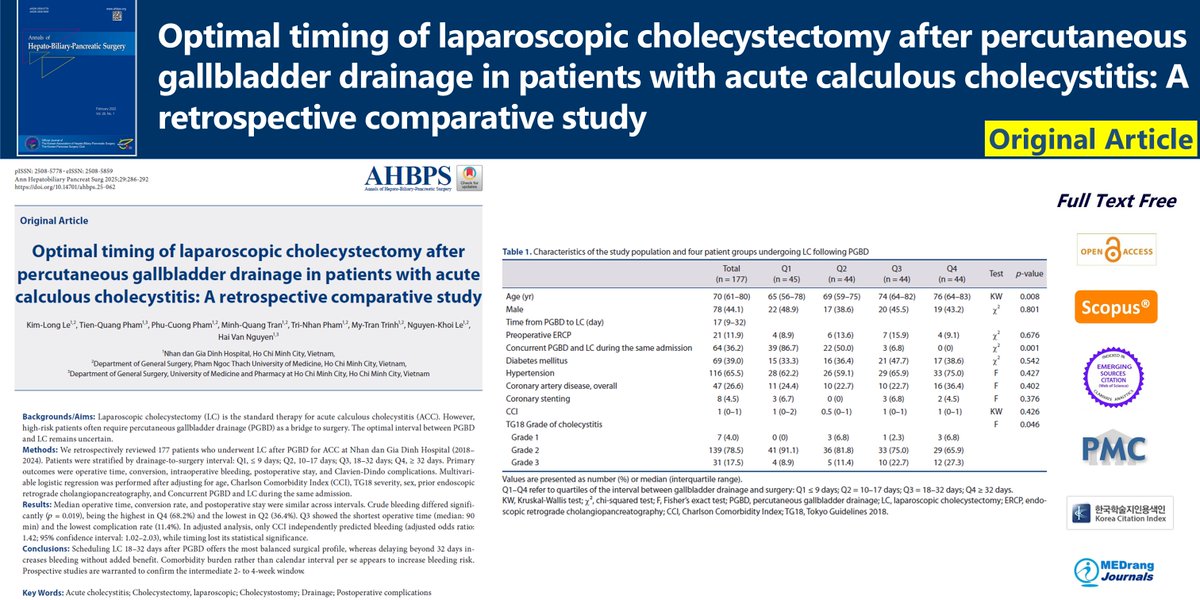
Optimal timing of laparoscopic cholecystectomy after percutaneous gallbladder drainage in patients with acute calculous cholecystitis: A retrospective comparative study
🌷https://t.co/pljI6Dcr7S
Ann Hepatobiliary Pancreat Surg 2025;29(3). Kim-Long Le
#AcuteCholecystitis
Is minimally invasive (robot) #Whipple surgery just as safe as open surgery?
Today: #DIPLOMA2 RCT in @NEJMEvidence
➡️ https://t.co/hxoIzVHpfB
288 patients, 14 expert centers, 6 countries 🇳🇱🇮🇹🇩🇪🇧🇪🇪🇸🇸🇪): MIS equally safe as open in experienced centers. With faster recovery, fewer wound complications, less pancreatic fistula, and a shorter hospital stay.
@nine_degraaf@AnoukEmmen@Abuhilal9Abu@e_mips@EAHPBA
The 2025 BCLC update on liver cancer management is here! Key highlights:
- Updated HCC diagnosis & staging
- New treatment decision algorithms
- Insights on using novel checkpoint inhibitors
https://t.co/jFeKnai4IM
Optimal timing of laparoscopic cholecystectomy after percutaneous gallbladder drainage in patients with acute calculous cholecystitis: A retrospective comparative study
🌷https://t.co/pljI6DbTik
29(3)Kim-Long Le
#Acute_cholecystitis#Cholecystectomy#laparoscopic#Cholecystostomy
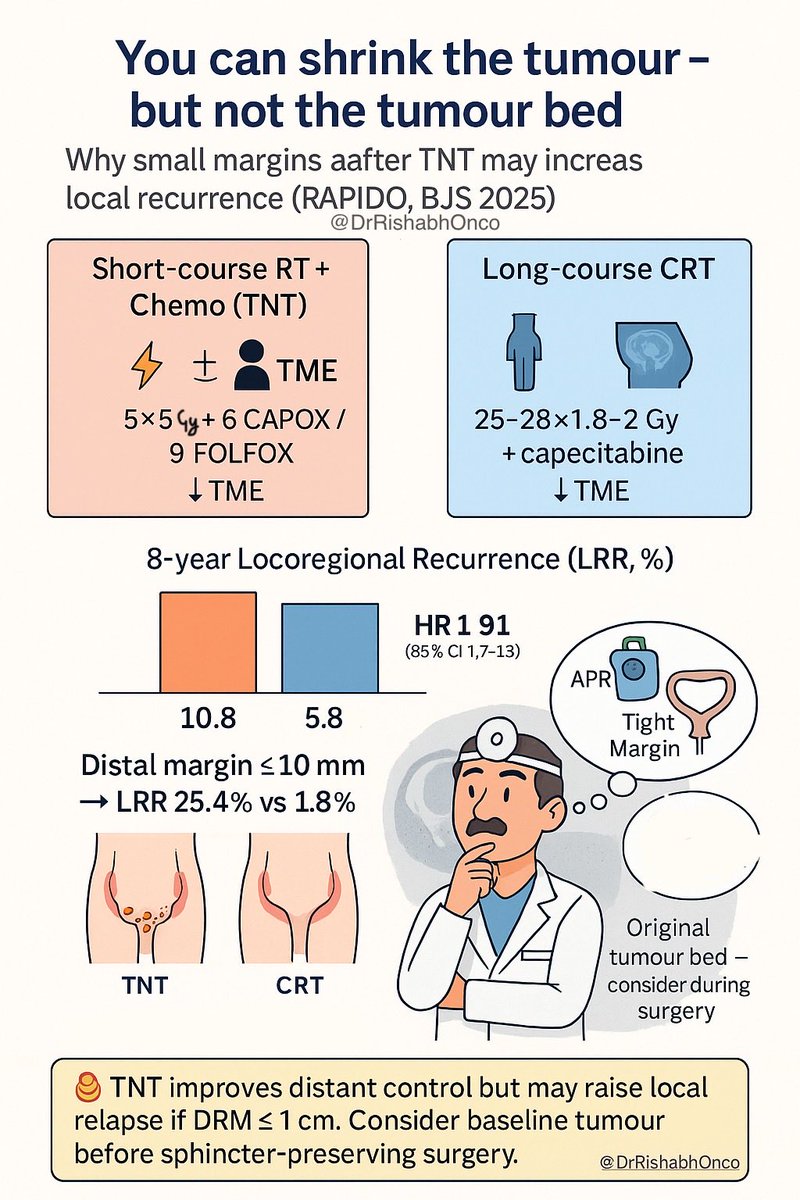
🧠 You can shrink the tumour—but not the tumour bed.
New RAPIDO analysis in BJS 2025 shows why small margins after TNT can turn dangerous 👇
💡 Trial: RAPIDO (n = 920, LARC)
🎯 TNT = 5×5 Gy + 6 CAPOX / 9 FOLFOX → TME
vs CRT = 25–28×1.8–2 Gy + capecitabine → TME
📊 8-year results:
• LRR 10.8% (TNT) vs 5.8% (CRT) → HR 1.91
• Spike seen only after sphincter-preserving surgery (SPS)
→ 12.1% (TNT) vs 4.8% (CRT) (HR 2.6)
• 🚨 If distal margin ≤ 10 mm → 25.4% (TNT) vs 1.8% (CRT) 💥 (HR 15.5)
🔍 Why?
TNT causes tumour shrinkage but leaves scattered viable cells in the original tumour bed.
✂️ Cutting “too close” (<1 cm) may slice through microscopic disease → higher local recurrence.
🇸🇪🇳🇱 Geography tells the story:
Sweden = more APR → no difference
Netherlands = more SPS & tight margins → higher TNT LRR
🩻 Takeaway:
TNT reduces distant mets ✅ but may raise local relapse if DRM ≤ 1 cm ⚠️
➡️ Surgeons must factor in baseline tumour bed, not just post-TNT shrinkage.
📖 Prata I et al. Br J Surg 2025
🔗 https://t.co/MqeM0xqH8i
#OncoTwitter #ColorectalCancer #RectalCancer #RadOnc #Surgery
@OncoAlert@esmo_open@BJSurgery@myESMO
Best in Surgery this month:
Impact of the robotic platform & surgeon variation on cholecystectomy disposable costs-More is not better
https://t.co/CS5D9TKWUp
The robot in the room: It’s time for an honest conversation about value
https://t.co/AYzotoJLJF
#SoMe4Surgery
D3 dissection with or without left colic artery preservation showed similar anastomotic leak rates (7.9% vs. 7.1%) and comparable 5-year OS (90.1% vs. 89.3%) and RFS (77.6% and 77.3%) in rectal cancer surgery, indicating LCA preservation neither increases leaks nor worsens oncologic outcomes.🇯🇵
https://t.co/f7HsSyqnPT
#colorectalresearch #colorectalsurgery #AGSurg @BJSAcademy@DCRjournal@ColorectalDis@SWexner@juliomayol@me4_so
#SoMe4Surgery
📚 Statistical errors in meta-analyses can impact the reliability of systematic reviews. This new article highlights the most frequent mistakes and how to avoid them.
📖 Read it here: https://t.co/2YSWWGwa6M
#SystematicReviews#MetaAnalysis#ResearchMethods#Statistics
PhD Students – Here are the top AI tools for researchers in 2025
Want to learn how to use these AI tools?
Join @AviStaiman in his AI tools bootcamp.
Registration Link: https://t.co/rv6M6NHzQe
The recording for the first session of bootcamp is available here.
Recording link: https://t.co/tir6R7k2Fj
Date: 24 February 2025
The list of tools to be covered.
𝐋𝐢𝐭𝐞𝐫𝐚𝐭𝐮𝐫𝐞 𝐑𝐞𝐯𝐢𝐞𝐰
1. @perplexity_ai
Assist researchers in quickly finding relevant information.
2. @keenious
Suggest relevant research papers for your literature review.
3. @scholarcy
Generates easy to understand summary of a research paper.
4. @R_Discovery
Send you alerts about newly published papers
𝐃𝐚𝐭𝐚 𝐂𝐨𝐥𝐥𝐞𝐜𝐭𝐢𝐨𝐧 𝐚𝐧𝐝 𝐃𝐚𝐭𝐚 𝐀𝐧𝐚𝐥𝐲𝐬𝐢𝐬
5. @Scinapse_
Helps you discover relevant research articles.
6. @juliusai
Helps you analyze quantitative data.
7. Atlas
Helps you to analyze qualitative data.
8. @SurveyMonkey
Helps you to create and distribute surveys.
𝐖𝐫𝐢𝐭𝐢𝐧𝐠 𝐚𝐧𝐝 𝐏𝐮𝐛𝐥𝐢𝐜𝐚𝐭𝐢𝐨𝐧
9. @whoisjenniai
Writing assistant that helps generate content.
10. @Writefullapp
Provides language feedback and editing suggestions.
11. STORM
Helps you to generate a comprehensive article from scratch.
12. @teampaperpal
Enhance your writing with real-time suggestions.
𝐌𝐢𝐧𝐝 𝐭𝐡𝐞 𝐆𝐫𝐚𝐩𝐡
13. @mindthegraph
Helps you make diagrams and infographics.
14. Runway
Helps you to edit videos of your research content.
15. @gammaapp
Helps you to create presentations slides.
16. Napkin AI
Convert text into a diagram.
Surgeons face a higher divorce rate (21.3%) compared to nonsurgeon physicians (17.9%) but lower than the general population (26.8%). Factors like long work hours and burnout highlight the importance of promoting work-life balance solutions.
https://t.co/14dJfs7oeL
2️⃣0️⃣2️⃣4️⃣ Pancreas Wrapped 🎄
7️⃣ July 🇯🇵 Mastering the dissection of the first jejunal branches during pancreatoduodenctomy
🏣 Japanese surgeons secret weapon: sketching the anatomy of each case before surgery! 🥷
🫵 How do you preop plan your surgery?!
The #RELARC trial was highly-anticipated, but scarcely-discussed online when it was published this Fall.
This was a massive effort from 17 hospitals in China that randomized >1000 patients with right-sided colon cancer to either CME or the more-traditional D2 dissection.
They found no benefit to CME in terms of 3-year DFS or OS.
I would love to hear the thoughts of both pro-CME and anti-CME surgeons.
Also, happy holidays to everyone!
https://t.co/NPhzh7LvFO
Does the impact of pancreatic fistula (POPF) differ between minimally invasive (MIPD) and open (OPD) Whipple?
Today in @JAMASurgery
In pts with POPF after MIPD vs OPD:
⬆️ more secondary clinically relevant complications ⚠️
⬆️ more hemorrhage 🩸
⬆️ longer hospital stay 🏥
⬆️ more reoperations 🔪
🔑 POPF prevention remains highly relevant, especially in MIPD
▶️ https://t.co/z9qm3doI4a
@carolouisebruna@Abuhilal9Abu@e_mips@AnoukEmmen and all the team thanks!
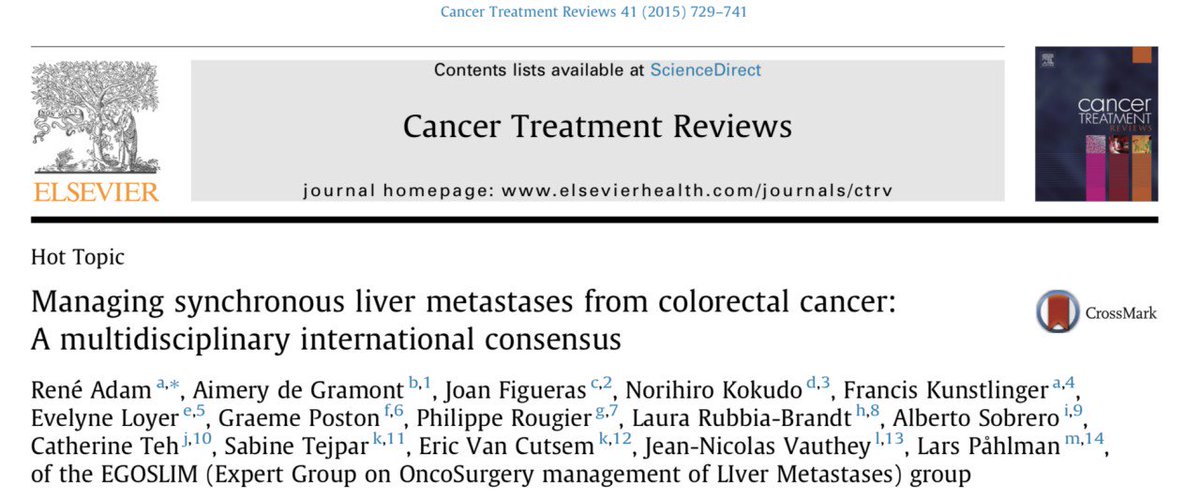
@ProfDemartines@_Ameera_2015@SWexner@juliomayol@dmcsurg Prevailing circumstances and expertise available. Here is a good outline of how to approach synchronous colorectal liver metastases though not too recent, principles remain. Hope it helps. 3/3