Leibniz attempted to create a universal language, the "characteristica universalis," that would be able to express mathematical, scientific, and philosophical concepts in a simple, logical form. His vision was to simplify complex thoughts into basic symbols.
In 1889, Henri Poincaré won a prestigious mathematics prize celebrating the birthday of King Oscar II after submitting what seemed to be a proof that the three-body problem was stable.
Just before publication, a flaw was discovered.
Rather than let an incorrect result stand, Poincaré recalled the journal, paid the printing costs himself, and rebuilt the proof from scratch.
What he found was far more important than what he had set out to prove.
He discovered that in some dynamical systems, infinitesimally small differences in starting conditions can grow into completely different futures, making long-term prediction fundamentally impossible.
That failed proof became the mathematical foundation of modern chaos theory. Decades later, Edward Lorenz would popularize the same idea as the "Butterfly Effect."
"The best people possess a feeling for beauty, the courage to take risks, the discipline to tell the truth, the capacity for sacrifice. Ironically, their virtues make them vulnerable; they are often wounded, sometimes destroyed."
- Ernest Hemingway
Astrophysicist Jocelyn Bell Burnell in 1968. ✍️
In 1967, Bell Burnell (aged 24) was working on her Ph.D. at Cambridge when she discovered Pulsars. The discovery was one of the greatest breakthroughs in the history of astrophysics.
@jk_rowling A grim side of “Rotto” involved tourists getting blotto [in Rotto], burying quokkas neck-deep in the sand, and kicking their heads. They dubbed it “Quokka soccer”.
"It is not knowledge, but the act of learning... which grants the greatest enjoyment."
— Carl Friedrich Gauss,
letter to Farkas Bolyai, 2 September (1808)
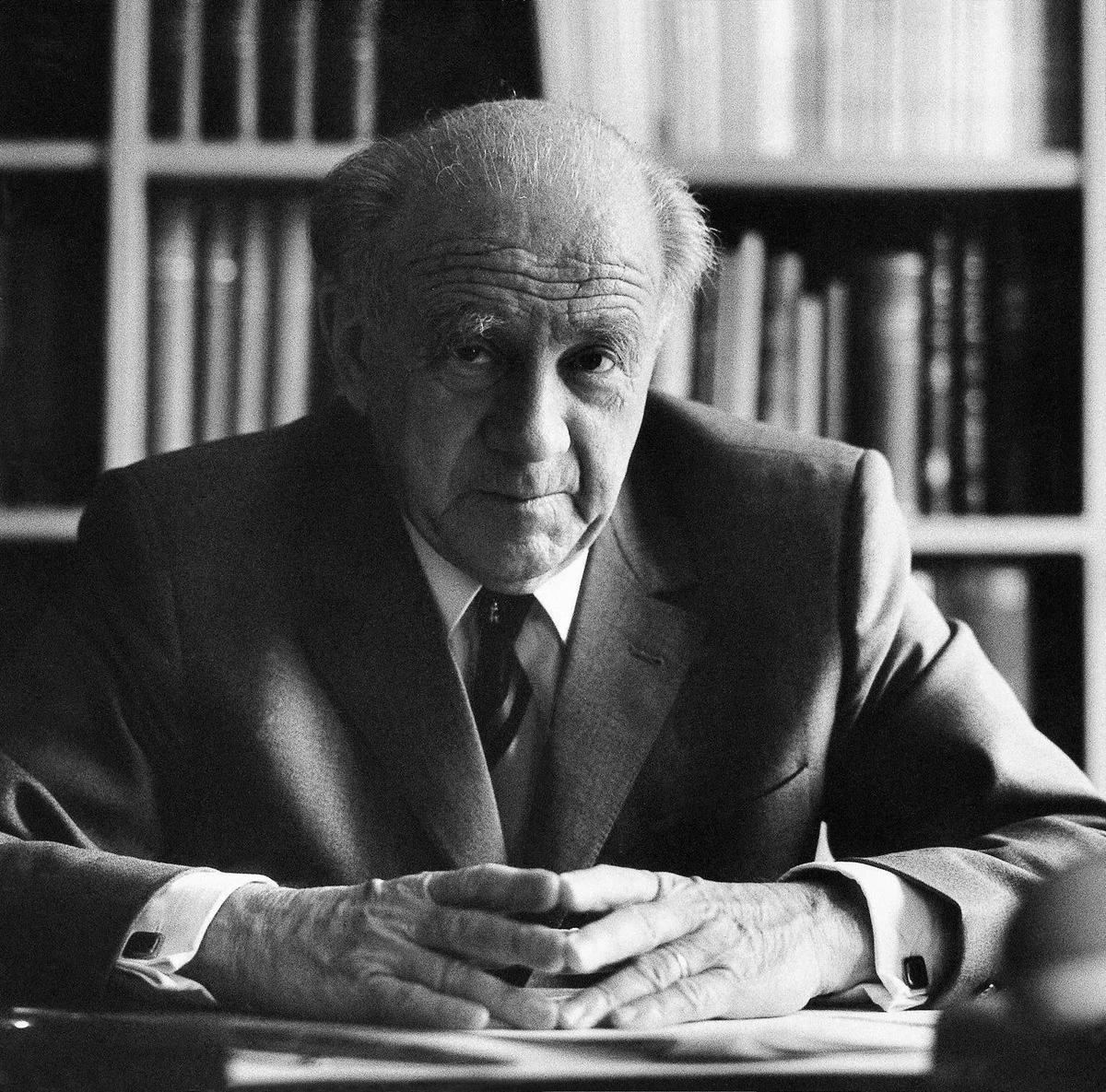
Norbert Wiener founded the field of cybernetics, pioneering the study of control, communication, and feedback in machines and living systems.
He made key contributions to stochastic processes, Brownian motion, and signal processing, influencing engineering, mathematics, and computer science.