If anybody wants to know why Gen X is always mad, it's because they had to replace their record collections with a tape collection that they had to replace with a CD collection that they had to replace with an MP3 collection, and now they need a subscription to listen to music
Our corporate policy dictates that we replace executive mobile devices every 24 months.
This means I have a closet containing 400 perfectly functional older generation smartphones.
HR asked me when I was going to contact an e-waste recycling vendor to dispose of them.
I told them we can't recycle these devices yet.
I explained that the lithium-ion matrices need to undergo a prolonged biometric quarantine.
I said we have proprietary company data baked into the deep silicon cache that takes years to evaporate.
None of that means anything.
Data doesn't evaporate.
But HR stopped asking questions immediately.
Instead of recycling them, I mounted all 400 phones to a massive piece of plywood in the basement.
I connected them to a dedicated power supply and wired them into a segregated VLAN.
I wrote a script that forces every single phone to continuously stream a YouTube channel.
The YouTube channel just plays 10-hour loops of rain sounds.
I own the YouTube channel.
I'm generating ad revenue from 400 concurrent U.S.-based viewers.
The phones run 24 hours a day, 7 days a week.
My localized click-farm is currently netting me about $3K a month in passive income.
Last week, the VP of Ops wandered into the basement and saw the glowing wall of screens.
He asked me what on earth he was looking at.
I didn't even blink.
I told him it was a distributed mobile redundancy matrix.
I explained that we were stress-testing our cloud infrastructure by simulating high-density mobile traffic.
He called it an absolute masterclass in proactive load balancing.
He actually took a picture of my click-farm to show the board how innovative we are.
The company is paying the electricity bill to power my personal monetization engine.
I'm going to use this month's ad revenue to buy a new Herman Miller Aeron chair.
I deserve it.
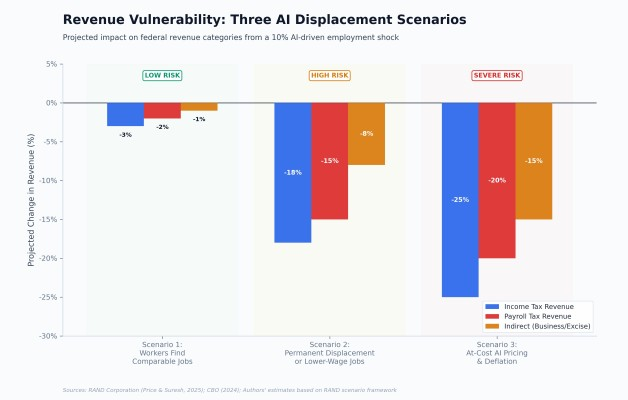
🦔The IMF quietly war-gamed how AI could destabilize the global economy last December. The biggest threat they identified was income tax erosion. 66% of US federal revenue comes from individual income and payroll taxes. Every job AI eliminates is a paycheck that stops funding the government.
My Take
Every AI earnings call celebrates headcount reduction. Dimon cut 30-40% of jobs in some departments. Oracle cut 21,000 to fund data centers. Meta used AI to rank employees for layoffs. The entire pitch to investors is fewer workers, higher margins. But who replaces the tax revenue those workers generated? Corporate tax is a fraction of what individuals pay in income tax, payroll tax, and Social Security. The companies eliminating the jobs aren't picking up the tab.
So you end up in a cycle where companies fire workers to boost margins, the government loses revenue, and then the same government is expected to fund the safety net for the people who got fired. At some point a politician is going to look at the numbers and realize that the AI companies celebrating record efficiency are also quietly draining the tax base that keeps everything else running. CEOs don't bring this up on earnings calls, and analysts haven't started asking yet.
Hedgie🤗
English sports talk radio has been an incredible listen tonight. Angry hosts, despondent callers, drunk guys forcing their wives to take the phone because “she knows more than the manager,” Irish and Scottish people calling in and trolling the entire audience.
Tremendous.
When the trade is as crowded as the bear case, the question stops being who’s right on fundamentals and starts being who can get out first.
South African retail now sits in that territory: positioning is beginning to matter almost as much as the underlying earnings story. Across the sector, short interest has moved beyond “cautious” and into clearly bearish territory, creating a backdrop in which even a modest shift in the narrative could trigger outsized moves.
At the sharp end of that trade, Truworths (TRU), Shoprite (SPP) and Dis-Chem (DCP) stand out as the most heavily shorted names, with double-digit percentages of free float on loan and, in several cases, shorts still drifting higher week on week.
The skepticism however is not evenly spread: mid-tier exposures in MR Price (MRP) and Pick n Pay (PIK) sit below that cluster, while names such as Clicks (CLS), Spar (SHP), Pepkor (PPH) and Woolworths (WHL) carry much lighter short interest, suggesting the market has picked specific losers rather than writing off the entire space.
What changes the character of the trade is the time it would take to unwind. Days-to-cover ratios are elevated, most notably in DCP, TRU and SPP, where covering existing positions would require weeks of average volume and therefore cannot happen discreetly.
In practice, that means the sector is now vulnerable to squeezes: a better-than-feared earnings print, a small improvement in the consumer backdrop or even a macro relief rally could force shorts to buy back stock into thin liquidity, driving price action that overshoots what the fundamentals alone might warrant.
The implication for investors is nuanced. Concentrated short interest in a handful of retailers still reflects a strong consensus that the operating environment is challenging and that balance-sheet or execution risks remain front of mind.
At the same time however, the degree of crowding means the near-term distribution of outcomes is no longer purely directional; it is increasingly conditional on how and when positions are reduced.
South African retail has therefore become as much a story about positioning and cover ratios as about earnings and valuations. The next decisive move may therefore be driven less by new information than by the mechanics of an over-crowded trade.
I’m so excited to share this update on @Conception –
We’ve generated the first early human eggs derived from stem cells.
This is a big deal -- the potential to redefine fertility is real.
Seit Jahren weise ich auf dieselben grundlegenden Probleme im deutschen Fußball hin. Selbst nach der begeisterten Förderung von Funino und kleinen Spielfeldern durch den DFB wurden die eigentlichen Ursachen kaum angegangen
Der deutsche Fußball ist in die Falle geraten, Extreme zu jagen. Wir sind von einer fast religiösen Besessenheit von filigranem, kurzpasslastigem Kombinationsfußball — oft mit endlosen Querpässen selbst gegen tiefstehende Verteidigungen — zu der plötzlichen Forderung nach mehr 1-gegen-1-Dribblern gewechselt. Doch keines der beiden Extreme allein bietet eine echte Lösung.
Die tiefste Krise liegt in der langjährigen Vernachlässigung von Physis, Athletik und Zweikampfmentalität. Kopfballduelle, aggressive Präsenz im Strafraum, zweite Bälle und gezieltes Vertikalspiel wurden in der Jugendausbildung seit über einem Jahrzehnt systematisch zurückgestellt.
Stattdessen haben wir technisch saubere, aber oft physisch weiche Spieler hervorgebracht, denen der Mut und die körperlichen Mittel fehlen, gut organisierte Verteidigungen zu knacken.
Stellt euch vor, wir hätten einen echten Zielspieler im Strafraum — einen Spieler vom Format eines Haaland oder Harry Kane oder unserer eigenen historischen Größen wie Oliver Bierhoff und Miroslav Klose. Wir könnten viel direkter und gefährlicher spielen und die Gegner zwingen, die Flanken und den Luftraum zu respektieren. Stattdessen haben wir den Mut verloren, Flanken zu schlagen oder physische Duelle zu suchen.
Wir bilden keine starken Flankenverteidiger und Flügelspieler mit herausragender Flankengenauigkeit mehr aus — und folglich auch keine richtigen Mittelstürmer, die den Strafraum besetzen, Gegner binden und Duelle gewinnen können. Das ist der zentrale philosophische Fehler der aktuellen Epoche.
Diese „Weichheit“ beschränkt sich nicht auf die Stürmer. Aufgrund der vorherrschenden Spielphilosophie, veralteter Scouting-Kriterien und fehlerhafter Spielerauswahl zieht sich dieselbe Schwäche durch den gesamten Kader. Talente wie Nicolai Remberg, Eric Martel und Anton Stach — die in Zweikämpfen aufblühen und echte Entschlossenheit und Kampfgeist zeigen — werden häufig aussortiert, weil sie nicht als „gefällige“ Passspieler gelten.
Anschließend wundern wir uns, warum unser Mittelfeld weich ist, Charakter, Durchsetzungsvermögen und Führungsqualitäten fehlen. Wieder einmal liegt die Ursache in der vorherrschenden Philosophie und dem darauf aufgebauten System.
Gegen kompakte, tiefstehende Blöcke, die keinen Raum für Kombinationsspiel zulassen, wirkt die Mannschaft immer wieder ratlos. Querpassspiel dominiert, während gefährliche Flanken und entschlossene physische Präsenz im Strafraum rar bleiben. Die Vorstellung, dass filigranes Kurzpassspiel oder gelegentliches Dribbling eine Abwehr mit zehn Mann hinter dem Ball konsequent knacken kann, ist schlicht unrealistisch. Die zweite Halbzeit gegen Paraguay hat gezeigt, was möglich ist, wenn wir direkter spielen und die Flanken nutzen — warum wurde das nicht von Anfang an versucht?
Dieses wiederkehrende Zögern ist die direkte Folge von Ausbildungsdefiziten. Wir schaffen es nicht, Angreifer zu entwickeln, die physisch dominant, zweikampfstark und kopfballstark sind. Selbst ein zwei Meter großer Stürmer wie Nick Woltemade sollte eine große Kopfballgefahr darstellen — doch Kopfballspiel und physische Duelle werden als Nebensache statt als Grundvoraussetzung für jeden Stürmer behandelt.
Die erfolgreichsten deutschen Teams haben immer vom Gleichgewicht gelebt. Die Weltmeister von 1990 und 2014 sowie die Europameister von 1996 verbanden hohe technische Qualität mit intensiver Physis und Spielern, die für jeden Ball kämpften. Sich hauptsächlich auf Kurzpassspieler und gelegentliche Dribbler zu verlassen, hat noch nie gereicht — und reicht auch heute nicht.
Ein Ausbildungssystem, das von Rondo und kleinen Spielfeldern dominiert wird und gleichzeitig massiv an positionsbezogenem Training sowie individueller technischer und physischer Arbeit mangelt, kann keine wirklich kompletten Spitzenspieler hervorbringen.
Darüber sind wir uns wohl alle einig. Durch die fast ausschließliche Betonung dieser Formate entfernen wir uns immer weiter davon, Fußballer zu entwickeln, die den Anforderungen des modernen Spitzensports auf allen Positionen gerecht werden — von kampfstarken Mittelfeldspielern über aggressive Außenbahnspieler bis hin zu dominanten Mittelstürmern.
Die Außenverteidiger trauen sich immer weniger, die Grundlinie anzugreifen, weil im Strafraum selten ein verlässlicher Anspielpunkt wartet — ein Teufelskreis, der die gesamte Angriffsstruktur schwächt. Scouts, Trainer und Sportdirektoren müssen dringend ihr Denken aktualisieren. Bequeme Passspieler zu produzieren ist wertvoll, aber moderner Erfolg verlangt ein deutlich breiteres Waffenarsenal: Vertikalität, physische Dominanz, aggressive Laufwege ohne Ball, klinische Abschlüsse und vor allem Spieler mit dem richtigen Charakter und der richtigen Mentalität, um einen ausgewogenen, konkurrenzfähigen Kader zu bilden.
Wenn sich die übergeordnete Spielphilosophie nicht dahingehend weiterentwickelt, dass sie physischen Mut, Direktspiel und Zweikampfmentalität neben technischer Exzellenz angemessen wertschätzt, dann werden sich die Trainingsmethoden vor Ort nie spürbar verbessern. Wir werden weiter unvollständige Spieler produzieren, die im kontrollierten Ballbesitz glänzen, aber verschwinden, sobald das Spiel hässlich und physisch wird — genau dann, wenn es am meisten zählt.
Der deutsche Fußball muss dringend seine traditionellen Stärken wiederentdecken: Entschlossenheit, physische Intensität, taktische Flexibilität und den Mut, komplette Kämpfer zu entwickeln, die die harten Duelle gewinnen können — und dabei trotzdem attraktiven Fußball spielen
Nicolai Tangen, CEO of Norges Bank Investment Management pressed IBM CEO Arvind Krishna directly on whether AI is a bubble (Save this).
And Krishna responded with what has become known inside financial circles as the $8 trillion math problem.
A single gigawatt of AI data center capacity filled with accelerators, liquid cooling, and power infrastructure costs roughly $60 to $80 billion to build and populate.
The industry has committed to more than 100 gigawatts of buildout globally.
That is $6 to $8 trillion in capital expenditure and because AI grade hardware depreciates on a five-year cycle, that entire sum must be effectively replaced and refreshed every five years.
To service the interest on $8 trillion in capital at a conservative 10% borrowing rate, the AI ecosystem would need to generate approximately $800 billion in annual profit, a number that currently exceeds the combined net income of every large technology company in the world.
Goldman Sachs estimates $7.6 trillion in aggregate AI CapEx between 2026 and 2031 alone, and Reuters Breakingviews has flagged that even if the capital is available, physical bottlenecks power permits, land, cooling infrastructure, and electrical grid connections mean that half of the planned data center projects are being cancelled or delayed before they ever go live.
Krishna also raised a second, structurally distinct concern that markets have largely ignored.
He argued that the largest foundation models, GPT, Gemini, Claude, Llama are converging toward commodity status.
When a product is a commodity, switching costs collapse.
When switching costs collapse, pricing power evaporates and margins compress regardless of how much capital was spent building the capability.
Morningstar's equity research team conducted a review of 132 technology companies in 2026 and found that AI had caused moat rating downgrades across roughly 40 major stocks concentrated in enterprise software, IT services, and SaaS with Adobe, Salesforce, Workday, and ADP among the companies whose competitive moats have materially weakened.
The implication is that the companies spending the most on AI model development may be building an asset that is simultaneously the most expensive to produce and the most difficult to monetize with durable margins.
This bear case is serious but it is also incomplete and that is what makes Krishna's framing so important to understand precisely.
When pressed further, Krishna explicitly said he does not believe there is an AI bubble in the technology itself only in a subset of the infrastructure capital that is being deployed against speculative assumptions rather than proven demand.
He draws the same analogy, the fiber optic overbuild of the late 1990s. Dozens of companies went bankrupt laying cable that nobody was using.
And yet that exact "wasted" infrastructure became the physical backbone of every cloud company, every streaming service, every mobile network, and every modern AI training cluster that followed.
The builders lost, the infrastructure won.
And the companies that were built on top of it, Amazon, Google, Netflix, Salesforce compounded for two decades.
The question, as Krishna framed it, is not whether AI is real.
It is which capital deployment earns a return versus which gets stranded and crucially, whether you own the stranded assets or the companies built on top of them.
On winners, Krishna was direct that distribution is the moat on the consumer side, and enterprise is wide open.
The data supports this, Meta with 3.3 billion daily active users across Facebook, Instagram, and WhatsApp is building AI into a distribution network that no startup can replicate at any cost.
Meanwhile, the productivity evidence arriving in real time is beginning to challenge the bear case's revenue projections.
Jensen Huang just showed on stage at Computex that GitHub commits, the universal measure of global software output nearly tripled in the first months of 2026, effectively converting $3 trillion in developer salaries into $9 trillion in productive output.
That is measurable, real time economic value already flowing through the system and it feeds directly back into token demand in a compounding loop that Krishna's static CapEx math does not fully capture.
"Go Your Own Way" was written by Lindsey Buckingham during his breakup with Stevie Nicks, amid the total chaos of recording the Rumours album. Stevie was so hurt that she asked Lindsey to change the lyrics, but he refused. Even so, Stevie recorded the backing vocals while the couple fought badly in the studio.
This is the greatest interview in the history of television.
This man, Ryan Cohen, is worth an estimated $5.1 billion dollars.
He’s the founder of Chewy, the e-commerce pet food brand, and current CEO of GameStop.
You can just do things, guys!
The Garden Route has officially been ranked the world’s best road trip
Scoring 90.6/100, it beat iconic routes like Route 66 and the Amalfi Coast. A big win for South African tourism!:
https://t.co/ajGAba99Yx
UK FINTECH CHOOSES SA
UK-based ClearScore Group has named Cape Town its second global tech hub, expanding beyond London.
The decision strengthens the Western Cape’s position as a growing technology destination.
The new office will support engineering, product, and data teams, with plans to grow staff.
ClearScore already serves 6.6 million South African users and is targeting further growth this year.
Full story - https://t.co/D3iOQYDiPM
Pictured - Justin Basini, Co-founder and CEO of ClearScore
The "Gateway" Effect 🇿🇦
South Africa didn't just get +27 by luck. It was the primary gateway for undersea cables and telegraph lines connecting the Southern Hemisphere.
We were the "Network Switch" for the region. That’s why Kenya (+254) and Nigeria (+234) have the extra digit—they joined a system SA had already helped build.
Very interesting sportsbiz read. In France, the Top14 rugby TV deal is now bigger than the equivalent football one, and the bottom club in the Top14 gets more money than many clubs in football's Ligue1.
https://t.co/CzQQw0tpMS