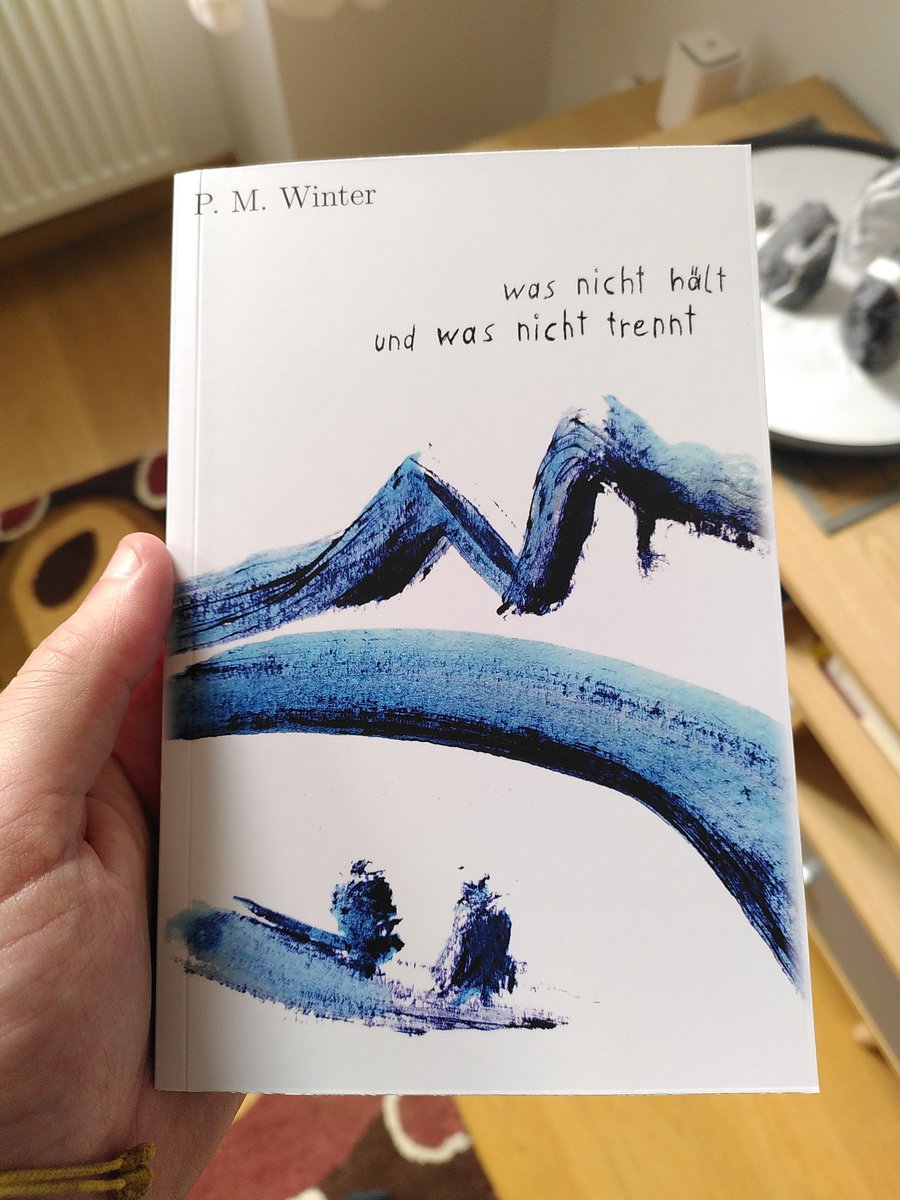
Wow, my book made it to the longlist of the Austrian Phantastik Price 🤩 That's s a massive achievement for me and I am deeply grateful 🌈🎉
link: https://t.co/com4c8OySw
🔥CARDANO’S MIDNIGHT TOKEN IS TRENDING
$NIGHT, the privacy token from Cardano’s Midnight network, is gaining traction across Crypto X.
Midnight is up 10% in the past week.
I'm extremely excited about the work of my friend and astrophysicist Nikolaus Sulzenauer from #MPIfR, challenging the long-standing hierarchical growth model of galaxy formation: https://t.co/jbjlNAgqnc
@akshay_pachaar When they now do the filtering parameter-free and hierarchical, they end up with what we already did years ago: https://t.co/qxPk7nBktn fast search + retrieval within a database of hundreds of millions of tokens (pixels in our case)
@MichaelElabd Thanks 😅 Making it fast+scalable was the biggest challenge. We managed to speedup the fwd pass from 10min (1st prototype) to about 0.5sec 💪 The key is doing hierarchical, local search for every query px in parallel. But like kNN it is still memory-heavy (fixed by sparsity)...
@MichaelElabd We solved the catastrophic forgetting problem for vision tasks already 2 years ago: stable knowledge retention / flexible plasticity trade-off, learning up to 10 000x faster, modular, etc. paper link: https://t.co/qxPk7nBktn
https://t.co/aXYj2IRsfP has been down for over 2 months now with no public updates. Many in the community (including our lab) are confused🤔MONAI is such a vital tool for medical AI. Could @ProjectMONAI or maintainers share any status on the site/outage? Thanks!
Due to the tremendous success of the free giveaway of my book, I'm making the e-book available completely free again throughout December 🎉 Merry Christmas and happy reading, everyone! You can download it, for example, from Amazon (link: https://t.co/YsbpuepGBA)
@akshay_pachaar in continual learning, different learning rates have been used for decades already xD describing a simple concept in a complicated way won't help to magically invent novelty
After 3 years of writing, my first book is finally out 🎉It’s a quite unique and deep story with a bunch of interesting characters and themes. Make sure to grab the FREE e-book version until next week and spread the word if you find it as inspiring as I do🌈
@_albertgu We use vision models for segmentation exactly the way you describe by separating computation and knowledge: https://t.co/qxPk7nBSiV. The neural network is the processing part while a memory database is used for transductive reasoning from specific examples. Works like a charm :)
@_sungmin_cha We solves this already last year. Transduction by memory retrieval is the answer: https://t.co/qxPk7nBSiV The plasticity-robustness tradeoff can be controlled via memory management (i.e., explicit learning/unlearning). Also see Nakata et al. 22 for image classification tasks
Schmidhubering 🧐: both groups from @MIT (https://t.co/e82PHKcURc, #ICML25) and @GoogleDeepMind (https://t.co/eCGpKqfwll, #ICML25) appear to overlook (i.e., not cite) our earlier work (https://t.co/yv7hOmFf7M, GCPR 2024, on arXiv since Mar 24)
coming from physics, this is something i do not particularly like about ML research, especially LLMs: most research ideas/approaches are just trial and error or a permutation and combination of architecures/training objectives etc. researchers don't know why something works or how, nobody does. it's not their fault. but it's just something i find irritating. like a new permutation of architectural designs can completely overthrow a previous SOTA model without any massive changes. there are too many degrees of freedom and the design space is HUGE.
adapting to a research field that operates on empiricism, while coming from one that operates on explanatory frameworks gives me massive unrest and leaves me in confusion. theories have longevity in physics/math. while in ML, paradigms change weekly.