Reminder Bayesian methods do not assign true or ontological probabilities to events such as the objective chance of a fair coin landing heads or a dice producing a six. Bayes treats probability as a measure of uncertainty or degree of belief that is through mathematical distributions like the beta, gamma, or normal curves, thus in the Bayesian framework, what is called “probability” is not the truth but a numerical representation derived from integrating areas under these curves being called "probability." Remember they depend on the chosen prior, thus changing the prior will alter the resulting “probabilities,” highlighting that they are not properties of the real world, but artifacts of the modeling assumptions. Theoretically they are just representations of your beliefs, which is why Bayes has been resisted as a foundation for stats.
@StrijbosMichiel@jryckman3@MaryBowdenMD Bro, I will tell you my secret. I am actually the one who fed Claude ivermectin and then it solved the Riemann hypothesis.
Agreed, more options is a win!
Different site, but classic slide. Patients with resectable disease may have better outcomes, and we can't fully account for that selection without randomizing.
Even with cool stats, there are factors not captured in databases or by tumor staging that influence treatment decisions.
🆒 use of inferential stats! Agree that residual confounding will be a limitation whomever is wielding the newest & coolest techniques.
Even with the upcoming RCTs, I suspect we will be left grappling with which local therapy is the best for operable/resectable #lungcancer. The victor is unlikely to be decided by numbers alone but by how our patients understand the trade-offs & apply their values & preferences. Given the state of excellent outcomes with #sbrt & surgery, the true victors will be our patients! #lungcancerawarenessmonth
What if STARS+ROSEL had fully accrued? Assume the 58 pts (1 vs 6 deaths) reflect truth → SABR sig. better in 100% of 2,000 sims. Add a skeptical prior: 55% SABR, 18% surgery. The answer depends on the assumption, just like JCO's emulation. Simulated demo. Did I just prove SABR > Surgery?!?! Sadly the answer is no. What’s even worse no JCO article! 🤣
@free_radical28 We need to come to grips with the reality of the administrative burden and hurdles it takes to enroll patients on a trial. We have to loosen up and NRG needs to recruit community hospitals to enroll and not just academic centers.
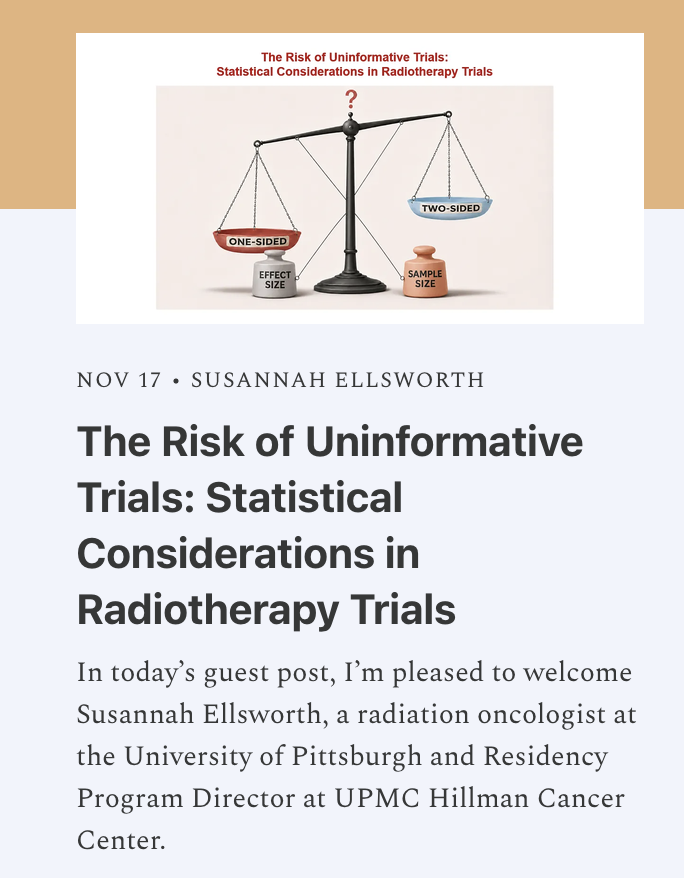
A new guest post "Oncology Shot" is out !
@free_radical28 expands on a recent manuscript we published together in EJC and its implications for past and ongoing radiotherapy trials.
Check it out!
https://t.co/hZT2fx5EBY
A new guest post "Oncology Shot" is out !
@free_radical28 expands on a recent manuscript we published together in EJC and its implications for past and ongoing radiotherapy trials.
Check it out!
https://t.co/hZT2fx5EBY
@gui_bignon_theo The contradictions esp post Vatican II that you can be saved without even being Christian ie invincible ignorance or that baptisms outside the Catholic church are efficacious via ex opere operato are wild
*Methods (simulated demonstration - using Grok Bot).* We used Monte Carlo simulation to model the full accrual of STARS (planned n=1,030) and ROSEL (planned n=960). The planned sizes come from Samson et al., citing the trial protocols. Each simulated trial randomized patients 1:1, with uniform accrual over 5 years and final analysis 3 years after the last patient enrolled. We assumed no dropout or crossover. Survival was exponential, with hazards derived from 3-year overall survival. We ran 2,000 trials under each of four assumptions about the true effect:
- **Naive:** the observed 3-year OS from the 58 patients (95% vs 79%) is the truth, which implies a hazard ratio (HR) of about 0.22.
- **Skeptical:** a Bayesian prior on the log HR, N(0, 0.35²), updated with the published HR of 0.14 (95% CI 0.017 to 1.19). The posterior median HR is 0.83.
- **STARS 2021:** the matched-comparison HR of 0.86, with 91% 3-year OS after surgery.
- **Null:** HR 1.0.
In each trial we estimated the HR by exponential maximum likelihood, stratified by trial, and called it significant if the 95% CI excluded 1. Under the naive assumption, SABR was significantly better in 100% of trials. With the skeptical prior, 55% favored SABR and 18% favored surgery. Under the STARS 2021 estimate, 23% favored SABR. Under the null, about 3% favored SABR and 2% favored surgery, as expected by chance. The conclusion is set by the assumption fed in, not by the data.
[Just FYI you may know that I’m not a huge fan of Bayes, but that is only for confirmatory ph3 trials in medicine not for analysis like this]
What if STARS+ROSEL had fully accrued? Assume the 58 pts (1 vs 6 deaths) reflect truth → SABR sig. better in 100% of 2,000 sims. Add a skeptical prior: 55% SABR, 18% surgery. The answer depends on the assumption, just like JCO's emulation. Simulated demo. Did I just prove SABR > Surgery?!?! Sadly the answer is no. What’s even worse no JCO article! 🤣
@SprakerMDPhD@jryckman3@BrendonStilesMD I believe the evidence for surgery against SBRT is very slim. The best reason surgery to say surgery is SOC is that it was there first. We can always play these same games and say the best data is ⭐️✨🌟 so SBRT is SOC and surgery needs to prove
Itself https://t.co/zU0bQtI1dK
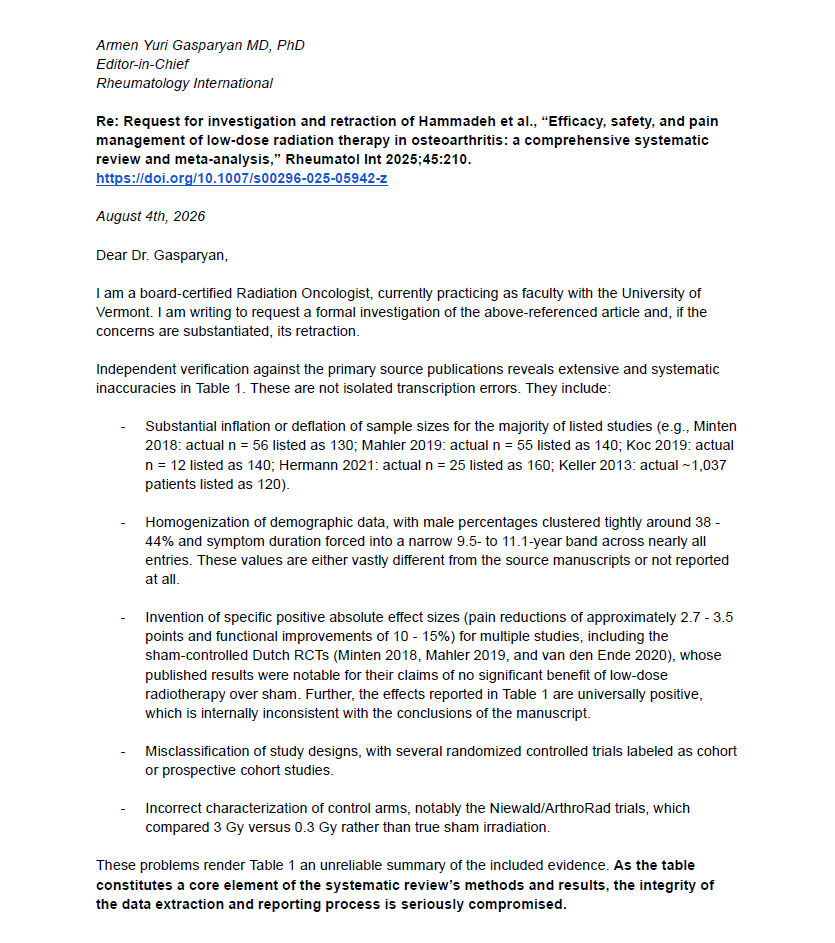
Dr Gasparyan, it's wonderful to see your feed filled with posts about the challenges AI brings to scientific publishing.
I imagine being Editor-in-Chief of Rheumatology International is a lot different today than a few years ago.
Last week, I contacted you, your Associate Editors, and Springer Nature about a 2025 manuscript published in your journal that is one of the most obvious examples of AI-hallucinated insanity I've ever seen.
It's especially brazen as the lead author has a website (https://t.co/GLfvhIUddf) where he sells an AI tool that produces these exact meta-analyses.
Unfortunately, this hallucinated fiction of a paper is being cited by the American insurance company EviCore as a reason to deny covering a commonly used treatment, which they have covered for many years - until now.
I'm attempting to get you/your journal's attention through multiple channels specifically because of the real-world, negative patient impact this AI paper has.
A copy of my August 4th letter is attached.
I am happy/willing/able to expand in great detail on literally any of this - just let me know!
@allisonoconn I also have no time for this and there is no appreciation of my time. I still do some but it’s so painful. They literally give us nothing. I missed being thanked by one journal by one peer review. It’s like, I’m not even worth a shoutout?
No its a great and important discussion to be had. I do think for early phase trials, secondary and post-hoc analysis, and rare cancers Bayes is great. Deborah Mayo provides a great foundation for stats and a good intro can be found here https://t.co/CE3qsrAtt8. This stuff gets complicated very fast as I am sure you are aware. With multiple looks it is tricky, but frankly both ways have challenges when it comes to multiplicity control. Bayes just theoretically does not need to control for multiplicity, so gets wonky real fast, do you really trust pure Bayes without any multiplicity controls? If no, why not - it's because you know intuitively that for looking at multiple variables from one trial the prior and data is not enough to make you confident. Great discussion!
Reminder Bayesian methods do not assign true or ontological probabilities to events such as the objective chance of a fair coin landing heads or a dice producing a six. Bayes treats probability as a measure of uncertainty or degree of belief that is through mathematical distributions like the beta, gamma, or normal curves, thus in the Bayesian framework, what is called “probability” is not the truth but a numerical representation derived from integrating areas under these curves being called "probability." Remember they depend on the chosen prior, thus changing the prior will alter the resulting “probabilities,” highlighting that they are not properties of the real world, but artifacts of the modeling assumptions. Theoretically they are just representations of your beliefs, which is why Bayes has been resisted as a foundation for stats.