Omission of ALND in #breastcancer with 1-2 sentinel nodes macrometastases - OS from SENOMAC trial - Jana de Boniface #ASCO26
Recommendation should be viewed in the context of postoperative locoregional #radiotherapy@OncoAlert#OncoAlert
Maybe cite our data - we have the largest series! https://t.co/XgrsCOrOUI. It’s a made up
criterion to help get urologists to buy into referral by making them do extra stuff. No proven benefit and possible harm eg perforation.
@CedricPetersRT@Prof_Nick_James There is this study that specifically examined this question. No difference between complete vs incomplete TURBT
https://t.co/XRC0e0vgqF
Great questions here!
Obviously Apalutamide is not providing more cure here, and we are losing the RT part that is potentially curative for large subset of patients. It's just sad!
And we're witnessing in real time people inventing nonsensical treatment algorithms around PROTEUS, based on personal opinion of influencial people 🤯.
I'm still not getting the benefit of adding ADT/Apa. Why the hype? I mean NED of 22% at 4 years, for a cohort with a lower risk than STAMPEDE! Why call it a victory?
OK so some of my thoughts about #PROTEUS, presented at Plenary session during #ASCO26
💠This was a tough trial to do, congratulations to the team for getting this done! 💪
🔷I think this is going to muddy the waters, esp for us rad oncs who get sent pts post-prostatectomy 1/n
To clarify a few things about this thread ⬇️
🔸Not only do we need think about this in the context of upfront tx considerations for men with HR PCa...
🔸Inevitably, there are going to be pts tx'd this way. What I am referring to is, what do we (rad oncs) do after? 1/n
Agree it does not concern PROTEUS.
This algorithm is a mess.
Perhaps it wasn't presented this way, but it clearly suggests that patients with a lower risk (EMPaCT) can skip PLND (first row), which is baseless, and the risk adapted adjuvant therapy based on RCB (second row) is baseless as well. Is it like a personal opinion or something?
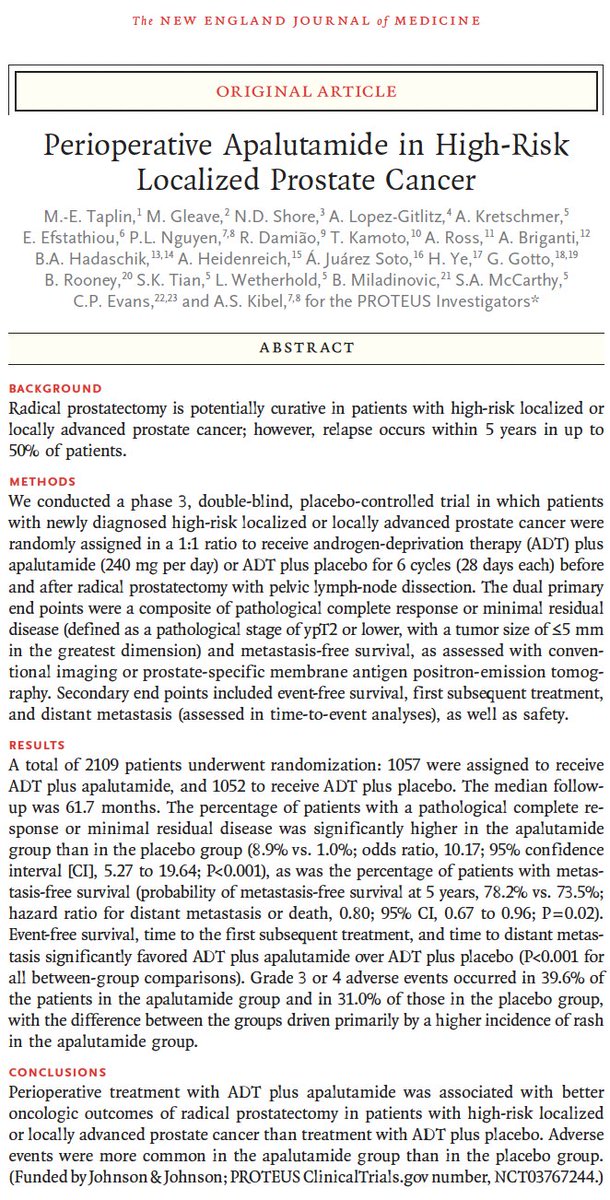
🚨 PROTEUS: perioperative apalutamide moves into high-risk localized #prostatecancer
Just out in @NEJM
🧬 2109 men w/ high-risk localized or locally advanced PCa randomized to ADT + apalutamide vs ADT + placebo around radical prostatectomy.
🎯 Both stated primary endpoints met.
⚠️ But the trial deserves nuance. Thread 🧵
#ASCO26 @ASCO@PCF_Science
Indeed ~62% had GS 9-10. It remains to be seen whether incuding PET would have an impact or not in ENZARAD; we can argue both ways. But also in the rad-onc community, adding ARPI is more and more questioned for N0. The benefit we've seen was in STAMPEDE that had higher risk patients than ENZARAD.
In any case, this isn't an RP vs RT discussion. RP is already a standard treatment even for high-risk localised disease (albeit end-to-end incorporating salvage RT with M0 failure, which is kinda frequent), and I would really love to see the needle moving, but I'm not sure the intensification here gives additional benefit. The MFS that matters, i.e. that might be a surrogate for OS, is conventional imaging-based MFS, and this wasn't improved. What is concerning I think is the very low rate of salvage RT, which is the only proven potentially curative treatment for failure post-RP. Would love to know why
@HimanshuNagarMD@dr_coops Also, eyeballing the curves, could have easily been "infinite" instead of 3 years😂. Classic example of skimming the median, and selling it as a huge benefit
Trials in localized prostate cancer are incredibly difficult to pull off, especially given the rapidly changing imaging and therapeutic landscape, so major congrats to the investigators.
For me, top line results: small MFS benefit when MFS is defined by either conventional imaging or PSMA PET. No MFS benefit by conventional imaging.
Critically, there were significant differences in PSMA PET utilization. Post hoc analysis showed that 686 patients (64.9%) in the apalutamide group and 755 patients (71.8%) in the placebo group underwent PSMA PET at least once.
That difference is greater than the absolute MFS benefit (when MFS is defined by either conventional or PSMA imaging) and may mean that the MFS benefit is confounded by the differential use of PSMA PET at biochemical recurrence. The extent of that confounding will depend on the comparative probability of detecting Mets at BCR using PET vs conventional imaging in the trial cohort. Would be interested in that data.
Does PROTEUS change practice? Given the above, I'm not sure the argument is there to go from RP alone (the current standard) to RP+ADT+ARPI. Will be interested in the substudy results.
#ASCO26 #radonc #medtwitter #pcsm
https://t.co/k8p6w2Lsh7
The real question is the Enzarad data, which is not a subgroup analysis like STAMPEDE.
STAMPEDE is hands down my favorite trial ever, but important to note that the M0 analysis was a subgroup analysis and not all patients even had local therapy. Some patients had PSAs in the 1000s.
Enzarad a bit more relevant where MFS and OS were not significantly improved in N0M0 patients. Just like PROTEUS MFS and OS were not improved by conventional imaging.
Given we now often get PSMA PET/CT upfront for staging, ARPIs in N0M0 patients have no proven role.
#ASCO26
Talk about real-time updates. NEJM paper now online and my predictions and inferences appear true.
Majority of MFS events were by PET not conventional imaging. "Most distant metastases were identified by PSMA PET (53.0% of those in the apalutamide group and 60.7% in the placebo group)"
VERY IMPORTANTLY: "No significant between-group difference was observed in metastasis-free survival assessed with conventional imaging alone (hazard ratio, 0.84; 95% CI, 0.67 to 1.07)"
Not only does MFS cross 1, but the HR also crosses the surrogate threshold effect (0.81).
@urotoday@PCF_select@US_FDA
🚨🚨 ASCO 2026 Final Results Randomized trial resected brain met Brachytherapy vs Post-Op SRS🚨
- Incredible Surg Bed Control with Brachy (↑↑OS as well)
- Surg bed recurrence 12% SRS vs 1% GammaTile