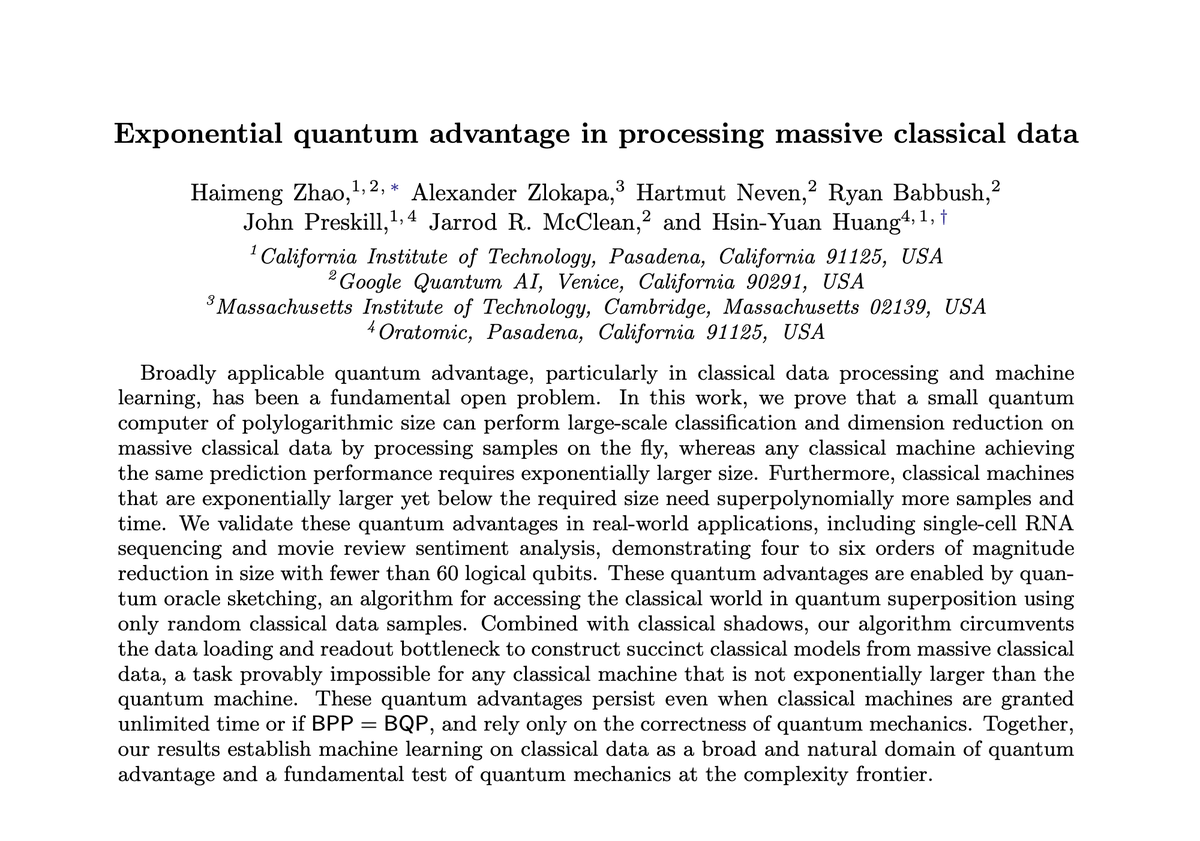
⚛ Can small quantum computers accelerate AI on massive classical data? Yes!
I am absolutely thrilled to share our new work proving *honest* exponential quantum advantages in broadly applicable classical tasks. 🧵👇
Paper: https://t.co/q1txrakSUJ
Blog: https://t.co/77svcuQ1Yl
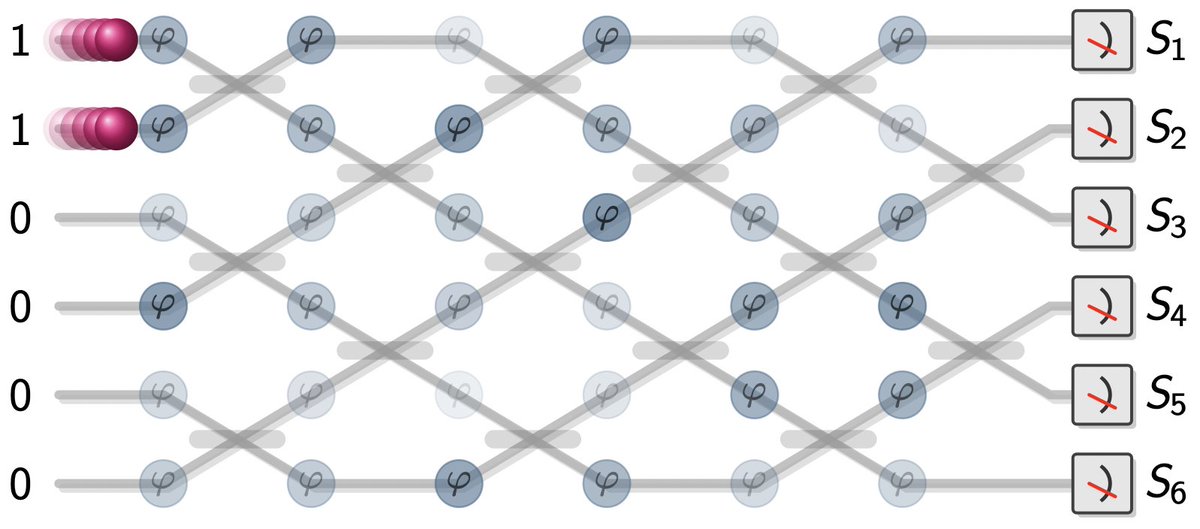
Measurement-induced non-commutativity in adaptive fermionic linear optics
We show that mid-circuit measurements of fermions with internal degrees of freedom can induce the equivalent of "magic" to free fermionic circuits and render them classically hard to sample.
https://t.co/r7rZBcyLHL
Fermionic linear optics (FLO) with Gaussian resources is efficiently classically simulable. We show that this is no longer the case for such quantum circuits for fermions with internal degrees of freedom, equipped with #midcircuit number monitoring and classical feedforward. In our architecture, the measurement record routes the selected blocks into a fixed-order Bell-fusion pairing geometry.
On the level of classical description, this implies realizing a situation in which the permutation sum no longer collapses to a single determinant or Pfaffian. Each post-selected branch expands as a signed sum of path-ordered products of typically non-commuting dressed blocks, and branch amplitudes are matrix elements of the resulting non-commutative trace polynomials. Numerically, we observe Porter-Thomas statistics as the output distribution and a rapid growth of the minimal order-respecting matrix product operator bond dimension. These results thus establish mid-circuit measurement-induced non-commutativity as a route to #samplinghardness for noninteracting #fermions under reasonable complexity assumptions, without introducing coherent two-body interactions into the FLO evolution.
Warm thanks to Chenfeng Cao and Yifan Tang for the wonderful collaboration.
Mid-circuit measurements are a powerful tool for state preparation, and they have generated considerable excitement in condensed matter physics due to their rich and surprising effects. In contrast, their usefulness for #quantumcomputation remains comparatively less well understood. In this work, we demonstrate that #midcircuitmeasurementscan enable genuine quantum advantages even in shallow quantum circuits.
https://t.co/zH1JbGjPfd
Concretely, quantum advantage schemes probe the boundary between classically simulatable and classically intractable quantum dynamics. We explore the impact of mid-circuit measurements on the computational power of quantum circuits.
To this effect, we focus on quantum sampling and introduce a constant-depth measurement-driven approach for efficiently sampling from a broad class of commuting diagonal quantum circuits and associated structured phase states, previously requiring polynomial-depth unitary circuits.
By interleaving mid-circuit measurements with feed-forward in randomized "fan-out staircases", our dynamical circuits bypass Lieb-Robinson light-cone constraints, enabling global entanglement with flexible auxiliary qubit usage on bounded-degree lattices (e.g., two-dimensional grids). The generated phase states exhibit random-matrix statistics and anti-concentration comparable to fully random architectures.
We further demonstrate measurement-driven feature maps that distinguish phases of an extended SSH model from random eigenstates in a quantum machine-learning benchmark (reservoir computing). Technologically, our results harness mid-circuit measurements to realize quantum advantages on bounded-degree hardware with a favorable topology. Conceptually, they provide complexity-theoretic support for quantum speedups by mid-circuit measurements.
Warm thanks to Chenfeng Cao for this wonderfully fruitful and inspiring collaboration.
What a year! I feel extremely grateful to work in one of the most creative teams in quantum information science and the study of complex quantum systems in the world, consisting of wonderful postdocs and students. Once again, this year has been enormously productive, and many interesting ideas have emerged, often first on the blackboard.
As a result of this, we had 11 papers in the Nature group this year, mostly in @NaturePhysics or @NatureComms,
https://t.co/BGRHkwOL36
https://t.co/u6D0OMtGRw
https://t.co/5SAfx5Nxmk
https://t.co/zveRmt1Um0
https://t.co/Dg1EMwHURL
https://t.co/nzPuK5PcqD
https://t.co/SxwsrCPNzM
https://t.co/GOZ3lTBLKc
https://t.co/hypexln2QY
https://t.co/aOzz58mhHx
https://t.co/wCsg5OdgKC
and 13 papers in the @PhysRevLett, @PRX_Quantum, or @PhysRevX of the @APSphysics.
https://t.co/QcGrFk7eGR
https://t.co/5YDUTBDN1Z
https://t.co/ibdFzOFBPA
https://t.co/eVmVum1WXt
https://t.co/shK0jFhDmN
https://t.co/1zeqxBSzn5
https://t.co/k45AAZkeuX
https://t.co/QgyiujuiPc
https://t.co/UuNZPEQbyr
https://t.co/hFkpGnchcy
among many others, https://t.co/RXyik0NWjP. I feel grateful and blessed. Thanks so much to all.
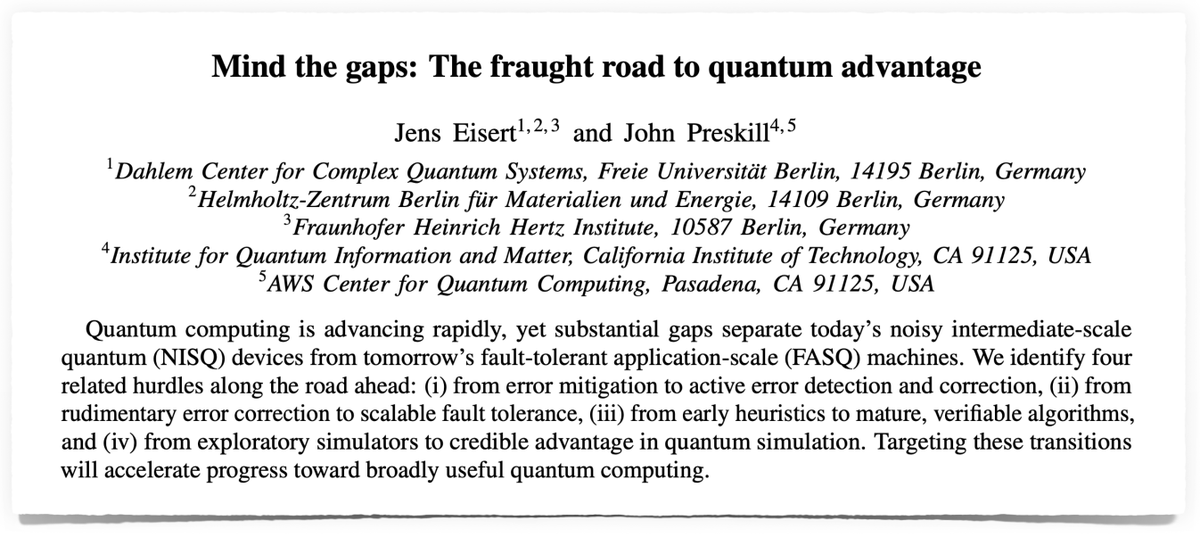
Over the recent weeks and months, @preskill and I sat down to think about where we are in quantum computing. While the noisy intermediate-scale quantum (#NISQ) era — a term coined by John in 2018 — is just unfolding as we speak, the time seems right to look ahead to the next steps to come.
https://t.co/aSWIa4Z6CA
In this perspectives article, we try to sketch the fraught road to quantum advantage — the path toward fault-tolerant, application-scale quantum (#FASQ) computers. There are several gaps ahead of us, and we try to faithfully and honestly hint at how one may be able to "mind those gaps", and suggest a few important intermediate steps along the way.
I have been impressed by the ease and efficiency with which we have been able to put this together. Warm thanks to John for the great collaboration and wonderful team work.
When and how will quantum computing broadly benefit humanity? Despite exhilarating recent progress, we still don’t know. Here my friend Jens Eisert and I assess the current status and the challenges ahead. We are optimistic about the quantum future, but there’s a lot of work to do.
https://t.co/cTbXNSd9c6
IQC and Waterloo mourn the loss of Ray Laflamme, IQC’s founding executive director from 2002 to 2017. Beyond his significant contributions to science, he was a leader, teacher, mentor and friend. We offer our deepest condolences to Laflamme’s family. https://t.co/9mT2p6OiTM
Hardware-tailored logical Clifford circuits for stabilizer codes
https://t.co/gYKuCAQiKe
This first first author paper of Eric Kuehnke appeared on the arXiv yesterday, but was not picked up by Scirate, but only today. It suggests novel strategies for implementing Clifford unitaries at the logical level of a given stabilizer code in #quantumerrorcorrection under hardware constraints.
🥳 7⃣ + 7⃣ 🥳
#ML4Q secures 7 more years as a #Cluster_of_Excellence under Germany’s #Exzellenzstrategie 🇩🇪
We continue to build on strong foundations and welcome new collaborators to explore the physics behind scalable, reliable #QuantumComputing ⚛️
🌐 https://t.co/wCmemkMFDV
In an exhibition entitled "We felt a star dying", the artist Laure Prouvost explores the connection between arts and quantum physics. Actually, @HartmutNeven of @GoogleQuantumAI has been involved in the making, with the help of @fzj_jsc.
I wonder whether this would be a good venue for #QIP one day. 😉
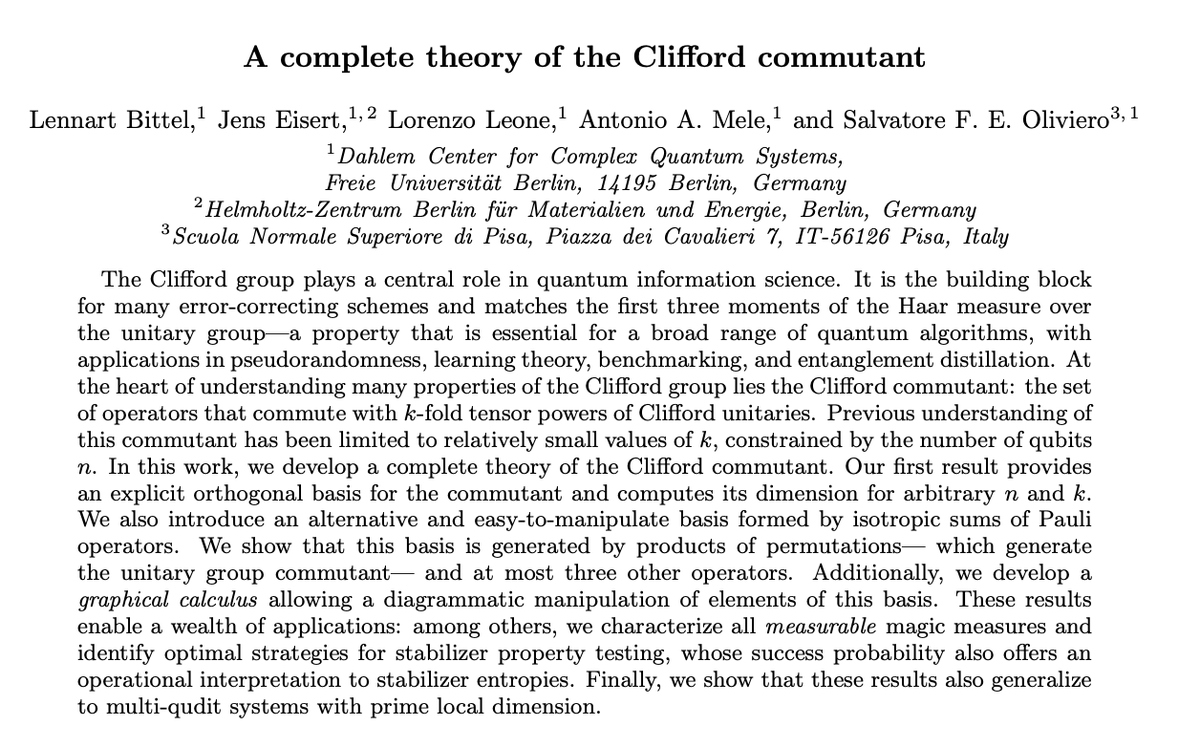
🧵 Super excited to finally share our new paper 🎉
Together with the dream team- Lennart Bittel, @jenseisert, @lorenzo_leone_, Salvatore F.E. Oliviero- we present a full theory of the Clifford commutant ⚡, a central object in quantum information. ⚛️
📄 https://t.co/qN4fgVpYyw
The paper “Local Hamiltonian problem with succinct ground state is MA complete” is published on PRX-Quantum. Thanks to the anonymous reviewers, this version contains a significantly simpler proof for the discrete-time case!
"XYZ ruby code: Making a case for a three-colored graphical calculus for quantum error correction in spacetime"
https://t.co/QgyiujuiPc
In brief: This work presents a new highly attractive Floquet code in #quantumerrorcorrection and introduces - yet another - useful graphical calculus.
In detail: Analyzing and developing new quantum error-correcting (#QEC) schemes is one of the most prominent tasks in quantum computing research. In such efforts, introducing time dynamics explicitly in both analysis and design of error-correcting protocols constitutes an important cornerstone. In this work, we present a #graphicalformalism based on #tensornetworks to capture the logical action and error-correcting capabilities of any #Cliffordcircuit with Pauli measurements.
We showcase the functioning of the formalism on new #Floquetcodes derived from #topological subsystem codes, which we call XYZ ruby codes. Based on the projective symmetries of the building blocks of the tensor network we develop a framework of Pauli flows. Pauli flows allow for a graphical understanding of all quantities entering an error-correction analysis of a circuit, including different types of QEC experiments, such as memory and stability experiments. We lay out how to derive a well-defined #decoding problem from the tensor-network representation of a protocol and its Pauli flows alone, independent of any stabilizer code or fixed circuit. Importantly, this framework applies to all Clifford protocols and encompasses both measurement-based and circuit-based approaches to #faulttolerance.
We apply our method to our new family of dynamical codes, which are in the same topological phase as the 2+1-dimensional #colorcode, making them a promising candidate for low-overhead logical gates. In contrast to its static counterpart, the dynamical protocol applies a ℤ₃ automorphism to the logical #Pauligroup every three time steps. We highlight some of its topological properties and comment on the anyon physics behind a planar layout. Lastly, we benchmark the performance of the XYZ ruby code on a torus by performing both memory and stability experiments and find competitive circuit-level noise thresholds of approximately equal to 0.18%, comparable with other Floquet codes and 2+1-dimensional color codes.
Warm thanks to Julio Carlos Magdalena de la Fuente, @old_josias, @the_grass_beige, Manuel Rispler and Markus Müller for this wonderful @FU_Berlin-@fz_juelich-@RWTH-collaboration.
Can (noisy) quantum entanglement provide advantages in learning physical processes of practical interest?
We give a positive answer to this question, in the task of learning the Pauli noise processes on a quantum device.
Preprint: https://t.co/H6Ae4uYEfu
Pauli noise learning is a well-studied task in the literature of quantum noise characterization. Recent works have proven rigorous efficiency enhancement in Pauli channel learning using entanglement with quantum memory, but it remains unclear whether such enhancement can survive noise and be practically useful.
Inspired by techniques from quantum benchmarking and error mitigation, we develop an entanglement-enhanced Pauli channel learning scheme that is both noise-resilient and provably efficient. Experimental results with IBM Quantum confirm our protocol yield consistent estimates with standard entanglement-free learning schemes, while possesses a significant improvement in sample efficiency, even on current noisy quantum hardware.
Our work showcases quantum entanglement as a resource are already giving us enhancement on current quantum devices. Our protocol also opens up new possibility for quantum noise characterization at scale.
Joint work with @Alireza_Seif, Swarnadeep Majumder, Haoran Liao, Derek S. Wang, Moein Malekakhlagh, Ali Javadi-Abhari, Liang Jiang, @zlatko_minev. Many thanks to my great collaborators!
A new paper on the arxiv shows that Pauli Lie algebras are either exponentially large or can be reduced to free fermion Lie algebras. For me, this is interesting because it rules out the fruitful application of g-sim techniques in this setting. 1/n
Given a random circuit (where each gate is chosen randomly and independently), is there a smaller circuit that implements the same operation? That is, are random circuits compressible? We show that the answer is no, for both random reversible and quantum circuits.
Shannon’s 1949 counting argument shows that a random Boolean function has exponential circuit complexity. The above question is more general: a random circuit is parameterized by L, the number of random gates; so how does circuit complexity depend on L?
Intuitively, one might expect the “linear growth of circuit complexity”, where the circuit complexity grows linearly with L until it reaches exponential. This has been a well-known conjecture due to connections with black holes and the AdS/CFT correspondence.
In this paper we prove this conjecture: we show that a random quantum (or reversible) circuit on n qubits (or bits) with L ≤ 2^Θ(n) gates cannot be implemented by any quantum (or reversible) circuit with L/poly(n) gates. This is joint work with Anthony, Jeongwan, Jonas @haferjonas, Tony, and Norah @NorahTan1.
The key is to show that random quantum circuits quickly converge to Haar random – more precisely, it forms a multiplicative unitary t-design with O(t·poly(n)) gates. Linear growth of circuit complexity follows from the linear dependence in t via a generalization of Shannon’s argument.
This quick convergence is proven by first constructing a structured random walk on the unitary group with a large spectral gap, and then approximating the structured walk with local random circuits without losing the gap. This argument crucially uses a modification of the “PFC ensemble” of Metger, Poremba, Sinha, and Yuen, as well as Kassabov’s expander on the alternating group.
Also see the amazing work of Gretta, He, and Pelecanos for related results on random reversible circuits: https://t.co/E5Z6ahnmi0
Paper link: https://t.co/RRZ7rorU2f
Extremely satisfied with our new paper: https://t.co/m5L3RUMpUG 🥳
The complexity 🧩 of quantum state tomography has been extensively analysed for qudit systems. However, this is not the case for quantum optical systems.💡
Our work fills this gap.
1/
New paper! 🥳
We show that any amount of non-unital noise induces absence of Barren Plateaus, but it ‘truncates’ most quantum circuits to effectively logarithmic depth, allowing efficient classical simulation in estimating Pauli expectation values.
https://t.co/67PW1btBVo
🧵
Quantum random sampling is the leading proposal for demonstrating a computational #advantage of #quantumcomputers over classical computers, also referred to as "#quantumsupremacy". We provide a comprehensive #review of the state of affairs.
https://t.co/MI4OajPans
Did you want to learn more about how to use Haar measure tools in Quantum Information and things like unitary t-designs, but felt intimidated by the heavy use of representation theory? Then my new tutorial may be of interest to you. https://t.co/CVtXthtr4U