Sovereign bonds are central to aligning finance flows with the net zero transition
In a new @GRI_LSE report, we explore how central banks can contribute to the alignment of sovereign bond markets on net zero
A big thank you to @joefeyertag, @NVJRobins1 and Alexander Wollenweber
How central banks can contribute to the #NetZero alignment of sovereign bond markets? New report by @Pierre_Monnin@joefeyertag@NVJRobins1 and Alexander Wollenweber 👇🏾
https://t.co/vmKGbtP6Lf
How central banks can contribute to the #NetZero alignment of sovereign bond markets? New report by @Pierre_Monnin@joefeyertag@NVJRobins1 and Alexander Wollenweber 👇🏾
https://t.co/vmKGbtP6Lf
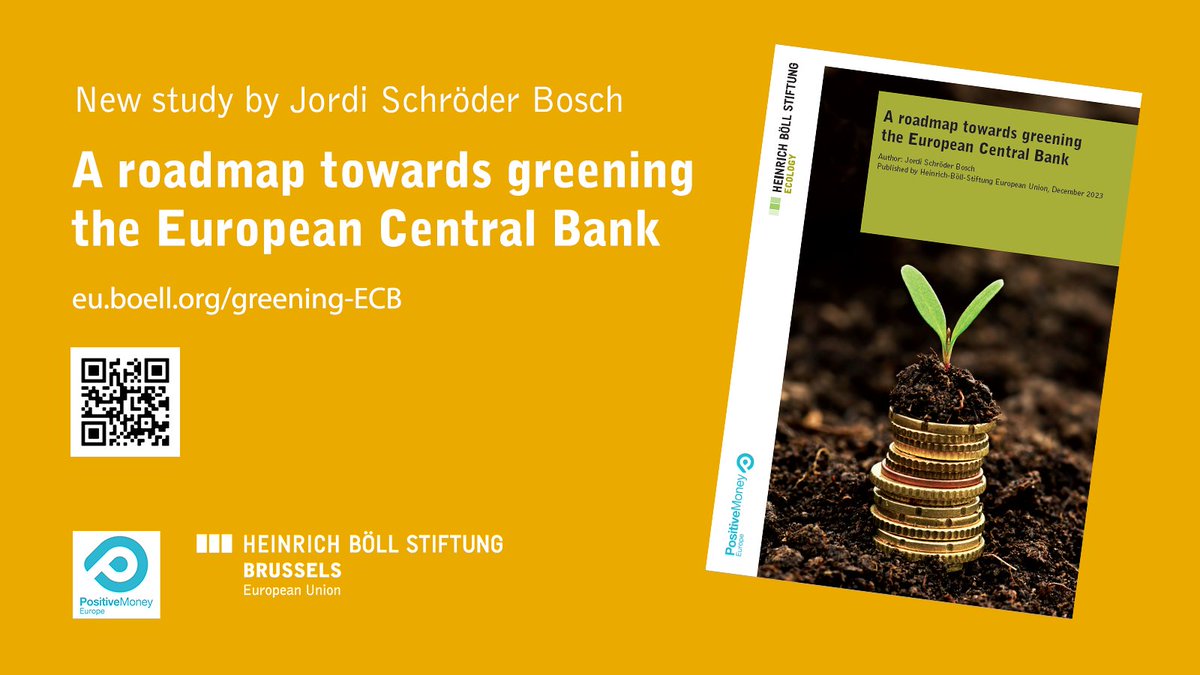
🟢 How the #ECB can use its vast portfolios and tools to actively reduce #climate risk? 💶🌍🛡️
Read our 🆕 study "A roadmap towards greening the European Central Bank", by @PositiveMoneyEU's @SchroderJordi ➡️ https://t.co/FJfeTBTzrX #WEF24@BoellStiftung
Key takeaways 🧵👇🏽
🔴Despite its #climate roadmap, the @ecb still supports fossil fuel companies by accepting their assets as guarantees when lending to #banks.
📢Assets from companies like @TotalEnergies that contribute to the climate crisis should not be considered safe!
https://t.co/JO1RTqIKe8
How can central banks contribute to the transition to environmentally sustainable economies in Africa?
Some ideas for consideration in this @GRI_LSE blog and policy brief.
Delighted to have worked with @reubenmuhindi and @joefeyertag on this.
Africa’s central banks are uniquely positioned to support their countries’ transitions to a green economy, but there is no one-size-fits-all approach, say @reubenmuhindi @joefeyertag and @Pierre_Monnin
https://t.co/gRatmWCbur
#Investissement 🔴 Des parlementaires examine ce mercredi l’idée d’intégrer la prise en compte des risques climatiques dans la gestion monétaire de la #BNS. Les économistes sont divisés sur la question ⬇️ https://t.co/pgxTJLqK99
Join us for our upcoming webinars featuring two esteemed speakers, Adelina Barbalau and @EspagneEtienne. 🎙️
Don't miss out on these insightful webinars! Join us and gain valuable insights from these experts. Visit our page to learn more: https://t.co/ZvkcrTXswX
#EconTwitter
On Monday 9th October, the Council on Economic Policies and @IDOS_research are launching the Global Tax Expenditures Transparency Index (GTETI).
👇 Join the event via Zoom: https://t.co/7s3kyrSbxo
🎦Watch the video for a quick overview of the GTETI.
https://t.co/yEdNlSGrus
Climate-related & environmental risks warrant special supervisory attention, says Executive Board member @Isabel_Schnabel. This is due to their size, global dimension & non-linearity, as well as the time criticality of action & a lack of knowledge and data https://t.co/KVZAHkhfiL
A faster green transition would benefit people, firms and banks, our economy-wide climate stress test finds.
It initially involves greater investment and higher energy costs, but financial risks decrease significantly in the medium term https://t.co/DDhETydVTd
Our September Digest is out and is curated by @jvtklooster and Eric Monnet.
The issue: Tightening monetary policies can deter investors from supporting climate-friendly projects due to higher financing costs 💸.
🔗 https://t.co/rKLkhiFbFP
#EconTwitter
An important topic in the current push from supervisors for more environmental disclosure as the solution to bridge the funding gap for the ecological transition.
The systemic nature of climate change calls for an appropriate macroprudential response!
Happy to share a few leads on how central banks and supervisors can implement sound climate systemic risk management practices.
Thanks to Paul Hiebert for the thought-sharing journey!
The systemic nature of climate change calls for a macroprudential response. Paul Hiebert @ecb & @Pierre_Monnin urge #centralbanks & supervisors to develop climate systemic risk management practices, like systemic risk buffers and concentration risk limits.
https://t.co/Vuawd7gTCw
.@TaskforceNM: Our real choice is not whether there should be #naturemarkets but rather how they can best be designed and governed to deliver equitable outcomes and sustainable positive impacts on nature and communities. https://t.co/sxNu4D6VMp #governingfinance@MakeNatureCount
Is central bank credit to banks neutral with regard to the climate transition?
Using confidential micro-level data, we explore the carbon bias of the ECB’s trillions of TLTRO credit to banks. And propose a green alternative.
A (simple) 🧵
🧵New Occasional Paper "Enhancing Climate Resilience of Monetary Policy Implementation in the Euro Area" by J. Aubrechtová, E. Heinle, R. Moyà Porcel, B. Osorno Torres, A. Piloiu, R. Queiroz, T. Silvonen & L. Vaz Cruz: https://t.co/hXgJCuAYQf 1/3
🚨 ONE WEEK LEFT to apply for our latest conference addressing research gaps on challenges posed by nature loss, including #deforestation and the related environmental risks & impacts for the #macroeconomy & #finance!
👉All info: https://t.co/0CP0safOFr… Apply by 15 July!
We are now accepting submissions for our annual Research Prize on the topic of "Financing the Green Transition."
The deadline is 15 September 2023.
Call for Papers➡️https://t.co/PmzZr5xeIb
More Info➡️ https://t.co/9ruvZAawwS
#EconTwitter@INSPIREgreenfin@Pierre_Monnin
#GreenFinance and #FinancialInclusion have mostly been treated by central banks and financial supervisors as two distinct agendas. @UliVolz and Peter Knaack call for an integrated approach to reflect the critical overlaps between the two. https://t.co/ba1Ubm9KG5
#climaterisks