1. LLMs can't even do multiplications.
2. Ok they can do multiplications but they can't do math competitions.
3. Ok they can do math competitions but they can't get gold at them.
4. Ok they can get gold but it's not like they can solve known unsolved problems.
5. Ok they can solve some known unsolved problems but not millennium prize problems.
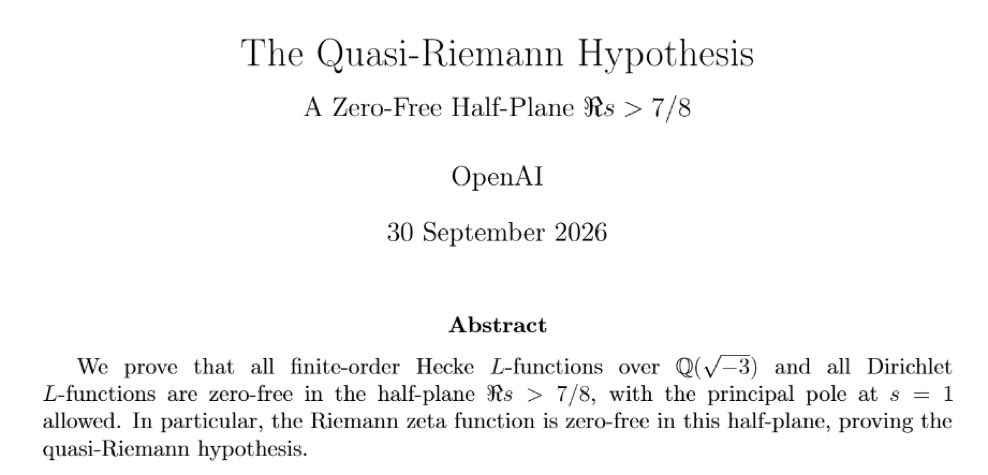
6. Ok they can solve a millennium prize problem but it's not the Riemann Hypothesis.
7. Ok they can solve the Riemann Hypothesis but...
Baseten Loops is now GA, and serverless.
Teams at @AmbienceAI, @datadoghq, and @LangChain use the Loops SDK for SFT and RL training to build durable intelligence.
Serverless Loops includes:
- Always-warm infra that eliminates cold starts
- Pay-per-token pricing for training and sampling
- One-click deployment from your trained checkpoint to production inference
- Model-specific numerical validation, with a focus on reducing mismatch between training and sampling
You bring the data, reward functions, and training logic.
We handle the infrastructure.
You always own the weights.
Learn more: https://t.co/vA6PvHEJq2
Super excited to share our work on training model routers!
Complex tasks often require frontier models, but for many routine tasks, a smaller, less expensive model performs just as well. We're building routers that decide which model each task actually needs.
Baseten Router cuts coding costs by 72% vs. Opus 5.5 on our benchmarks and beats random routing at every threshold, which none of the other routers we tested did.
Not every coding task needs the most expensive frontier model, and your engineers shouldn't have to figure out which ones do.
Model routers make that choice automatically, keeping spend down while reserving frontier capability for the work that needs it.
How we built it:
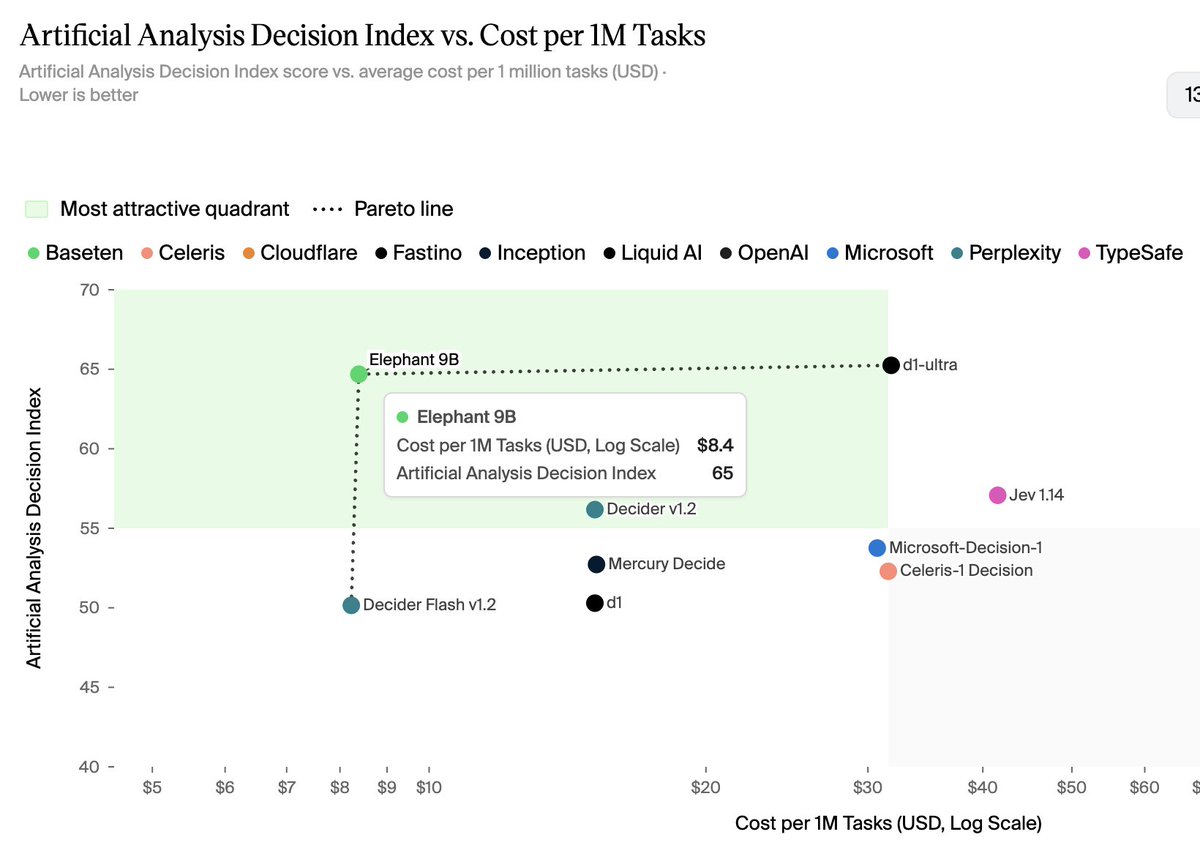
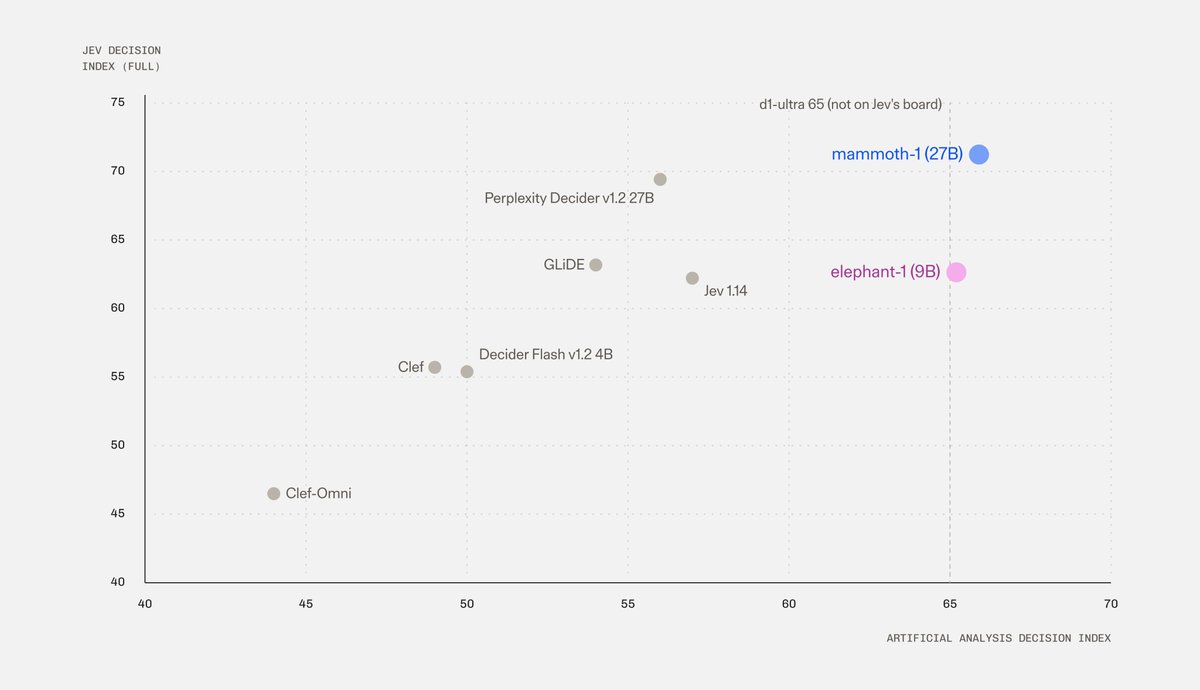
Today we release mammoth-1 and elephant-1!
We post-trained mammoth-1, the #1 ranked best decision model in the world, and elephant-1, which is the best model under 15B (and beats Jev).
We're open-sourcing all model weights and provide a technical report detailing all our training and data methods.
We’re excited to announce that 3/3 papers from our research team were accepted at NeurIPS workshops this year!
Two papers will be featured in the continual learning workshop, and another one in the grounded computer vision workshop.
More on the papers below 🧵
OpenAI is downplaying this for PR reasons. If you’re a mathematician, you must feel like a nuclear bomb hit, and you’re at ground zero.
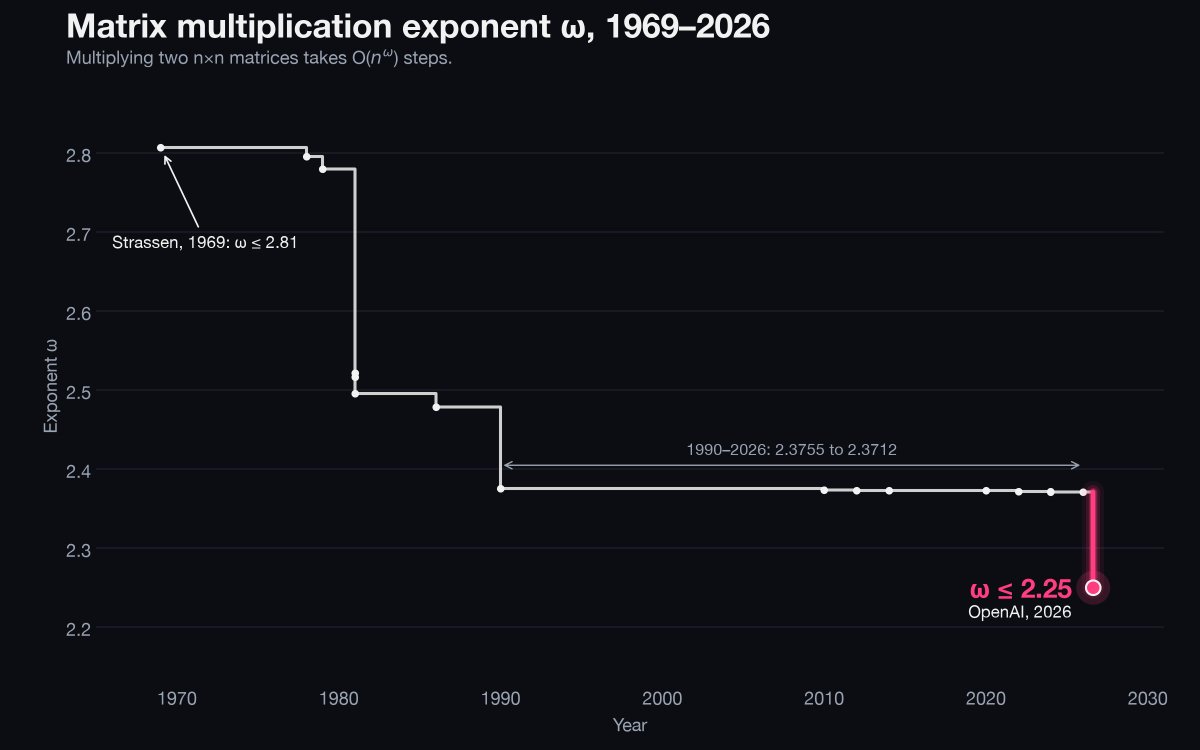
Reasoning models are two years-old. In that time they went from incapable of basic arithmetic to solving problems humans couldn’t solve for decades.
Math is only the beginning. AI will revolutionize the entirety of the human scientific endeavor. Most of us don’t appreciate what that means.
What a time to be alive!
We’re releasing a broad range of new mathematical results produced by an internal frontier model.
We’ve been consulting with the independent Advisory Group on Mathematics and Artificial Intelligence at the Institute for Advanced Study, and we have drawn on their advice and public recommendations to inform how we release these results.
https://t.co/7N6TPlft1P
We asked an unreleased research version of Claude to take a stab at the Riemann hypothesis.
It didn’t solve it, but it did make strides on a related problem: it increased the lower bound for the fraction of zeros of the Riemann zeta function that satisfy the hypothesis from 41.6% to 67.2%.
https://t.co/aZDvqqhHRi
For my first post, I’m sharing a letter @NVIDIA signed on why open models matter.
AI will transform every industry, power every company, and be built by every country.
Open models strengthen safety and cybersecurity, accelerate innovation and diffusion, and enable sovereignty.
The world needs both frontier closed models and frontier open models.
https://t.co/AUKzoQ5Ikb
1/ We fine-tune a lot of customer models, so we decided to systematically try and figure out some best practices for finetuning. SFT isn't sexy, but it's still important. We vary one SFT lever at a time across 2 model families, dense + MoE to 235B, on 4 real-world customer datasets.
What makes this clean is that each dataset is paired with an eval that took weeks to build with the customer, and the training outputs were generated to pass that eval. So the supervised target and the thing we measure downstream are the same criterion, which strips out the usual confounders
We're trying a new experiment at @cursor_ai - interviewing devs we admire.
I chatted with @oneill_c & @part_harry_ from @baseten about how they use coding agents. We discussed their current dev workflows & some predictions for the future.
Check it out below!
Impressive presentations from the @GarvanInstitute@kinghorngenomes and Data Science summer students. You have each achieved a lot in only 10 weeks. Hope to see you all back at Garvan soon. Applications for next summer will open in late Sept.