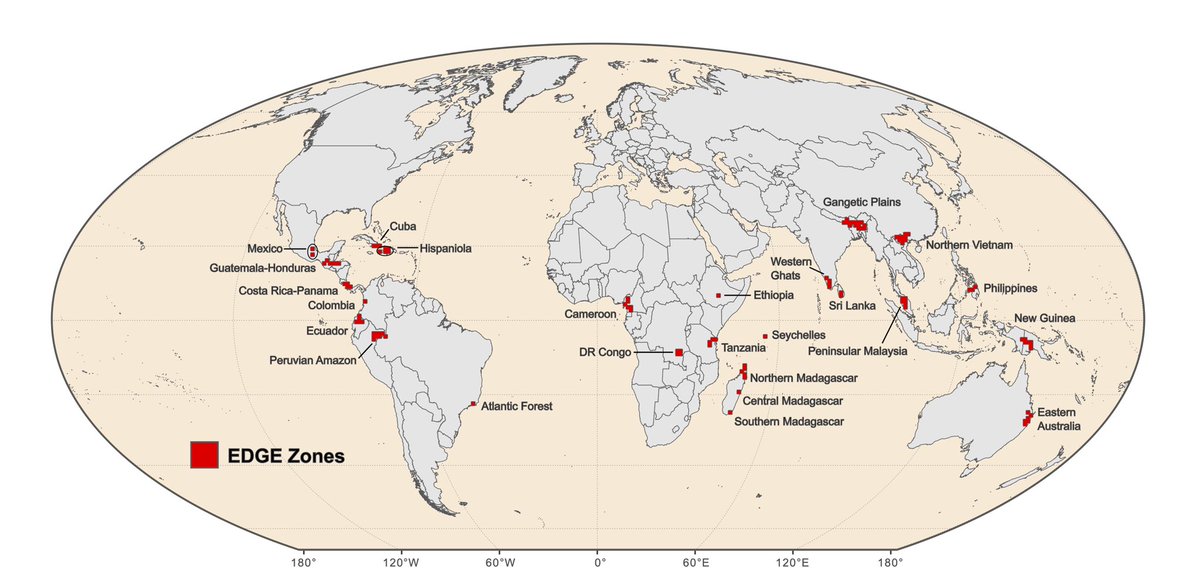
New article just published revealing patterns of the world’s most Evolutionarily Distinct and Globally Endangered tetrapod species. 🐸🦚🐊🦥
1/3rd are housed within just 0.7% of the world’s land surface, with half found nowhere else.
@NatureComms
https://t.co/zS6K24Z2rk
1/3
New article just published revealing patterns of the world’s most Evolutionarily Distinct and Globally Endangered tetrapod species. 🐸🦚🐊🦥
1/3rd are housed within just 0.7% of the world’s land surface, with half found nowhere else.
@NatureComms
https://t.co/zS6K24Z2rk
1/3
This paper has been years in the making and happens to be my first first-author paper - and the first of the PhD 😁
Thanks to: @ontheedge_org @ZSLScience@ImperialSci @rikkigumbs @NishaROwen@SSCP_DTP@Grantham_IC
More maps to come - next time, plants! 🌴🪷🌿 @KewScience
3/3
We called these 25 priority areas EDGE Zones.
They are insufficiently protected and are under high human pressure.
If these sites aren’t adequately conserved, there will be huge consequences for the Tree of Life.
2/3
Protecting just 0.7% of land could help save 1/3 of unique & endangered species, new research by @ImperialCollege, @ontheedge_org & @OfficialZSL finds.
The study argues big gains in conservation are possible by targeting key areas of biodiversity.
✍️https://t.co/cQM92EHBMP
Protecting <1% of world’s land could help save 1/3 of most unique and endangered species 😲
The latest paper from @EDGEofExistence, with @Imperialcollege and @ontheedge_org found the top 25 zones where conservation can have a huge positive impact on protecting #biodiversity
I can't imagine a better way to start this #IBC2024 than having a workshop with my friend @PipinsSeb to talk a bit about EDGE #plants
Thanks a lot to everybody in the room for coming and making this session so exciting!!
Are you interested in plant conservation and attending @ibc2024 ?
Take a look to our workshop (Sun 21/06, 12:00-13:30h):
Spatial applications of Evolutionarily Distinct and Globally Endangered (EDGE) plants 🌲🌼🗺️!!
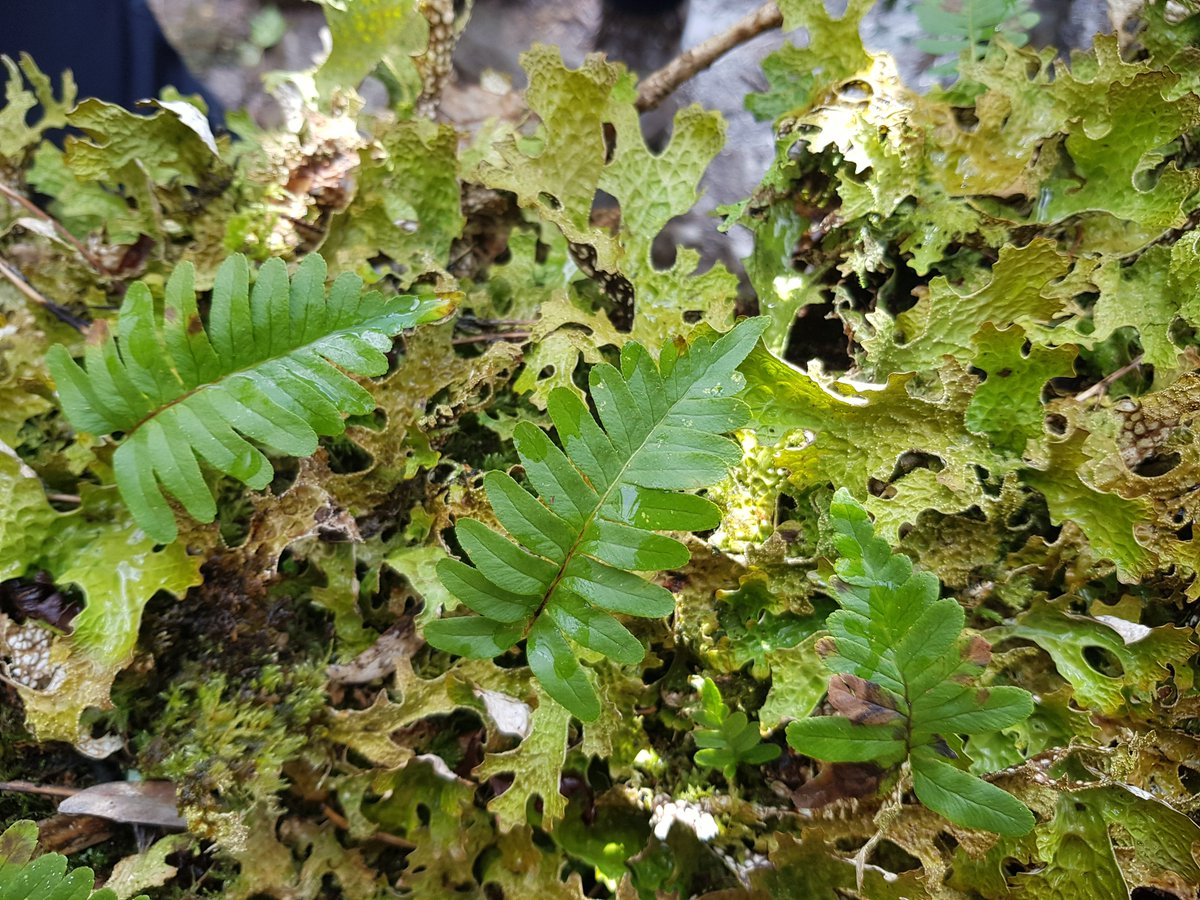
Did you know that there are species of #lichen, #mosses & #liverworts found only in UK #rainforest?
To celebrate the success of our rainforest conservation project in SW England, we are spotlighting 5 of the spectacular species found in #BritainsRainforests!👇
(1/7)
We are delighted to open the call for applications for the first EDGE Protected and Conserved Area Fund!
To learn more head to our Facebook page: https://t.co/4ADT1ziyXm or for full details, eligibility criteria, and how to apply visit our website https://t.co/P2MJPpkveL
16 years after the first EDGE List for the world’s mammals was launched, we are excited to present our new-and-improved approach to identify the world’s most evolutionarily distinct and threatened species, published today in @PLOSBiology https://t.co/vgG5dohi8t - thread: (1/11)
This #PLOSBiology Consensus View presents EDGE2, a protocol that draws on a decade of research and innovation to develop an improved, consistent methodology for prioritizing species #conservation efforts. @EDGEofExistence@ZSLScience @rikkigumbs https://t.co/FWItYf6oGV
@bio_carta As far as I’m aware, you’d need to be registered for either in-person or virtual attendance at the conference - a pre-print of this research should be live next month tho!
Join me at #BES2022 for a presentation on EDGE Zones - spatial priorities for conserving the Tree of Life - on Monday 19th Dec at 10.30am (Session 3, Conservation Science & Policy)
These areas harbour a huge diversity of threatened vertebrate species and unique evolutionary histories but the vast majority are under intensive human pressure - find out more on Monday! @ontheedge_org @EDGEofExistence @KewScience @SSCP_DTP@imperialcollege