I’m sure a lot of doctors accept kickbacks for MRI & CT scans, but at the same time, how much money did Raghav Chadha receive to switch parties? I’m just curious👀
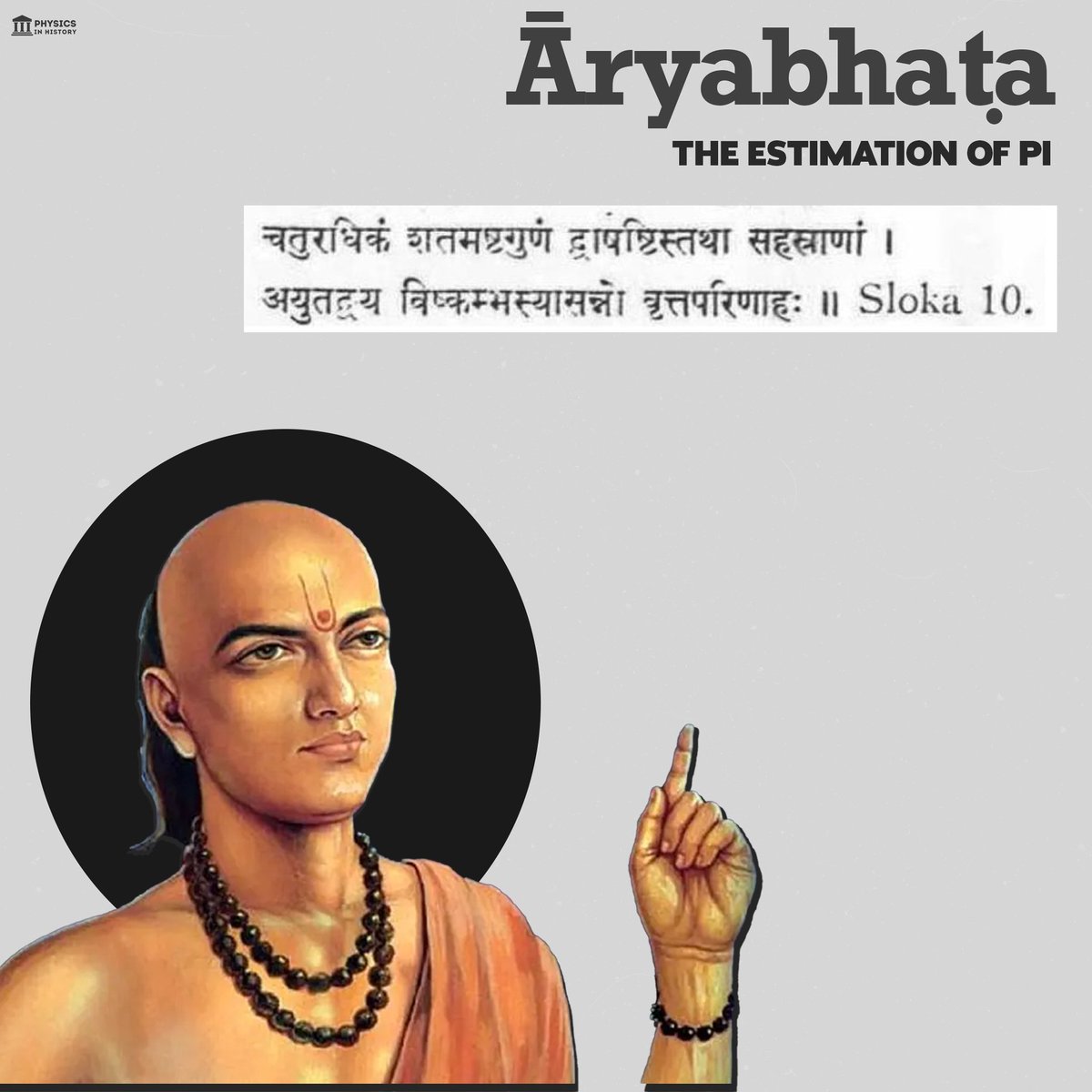
Aryabhatta's formula to calculate the value of π ✍️
caturadhikam śatamaṣṭaguṇam dvāṣaṣṭistathā sahasrāṇām
ayutadvayaviṣkambhasyāsanno vṛttapariṇāhaḥ.
Translation:
Add four to 100, multiply by eight, and then add 62,000. By this rule the circumference of a circle with a diameter of 20,000 can be approached.
Thus according to the rule ((4 + 100) × 8 + 62000)/20000 = 62832/20000 = 3.1416
The value of π calculated by this method is accurate unto 5 significant figures.
@DrJitendraSingh@narendramodi But sir maharastra wale to MBBS ko BHMS ke barabar karne mei lage hai.
At least you should intervene in this matter.where we are heading.
#WATCH | Mumbai | On the doctors strike, Maharashtra CM Devendra Fadnavis says, "I believe that protests should not be conducted in a manner that disrupts patient care. Any protest that hampers the treatment and relief of patients is inappropriate...For the state government, all doctors, regardless of the medical system they practice are equal, and we make no distinction among them. Doctors serving in our medical colleges and hospitals are especially important to us. I would like to assure them that the government has no intention of treating them unfairly"
The confidence went from ‘our Sugar Pills cure everything’ to ‘Allow us to prescribe your Modern medicine drugs and become modern doctor’ in record time.”
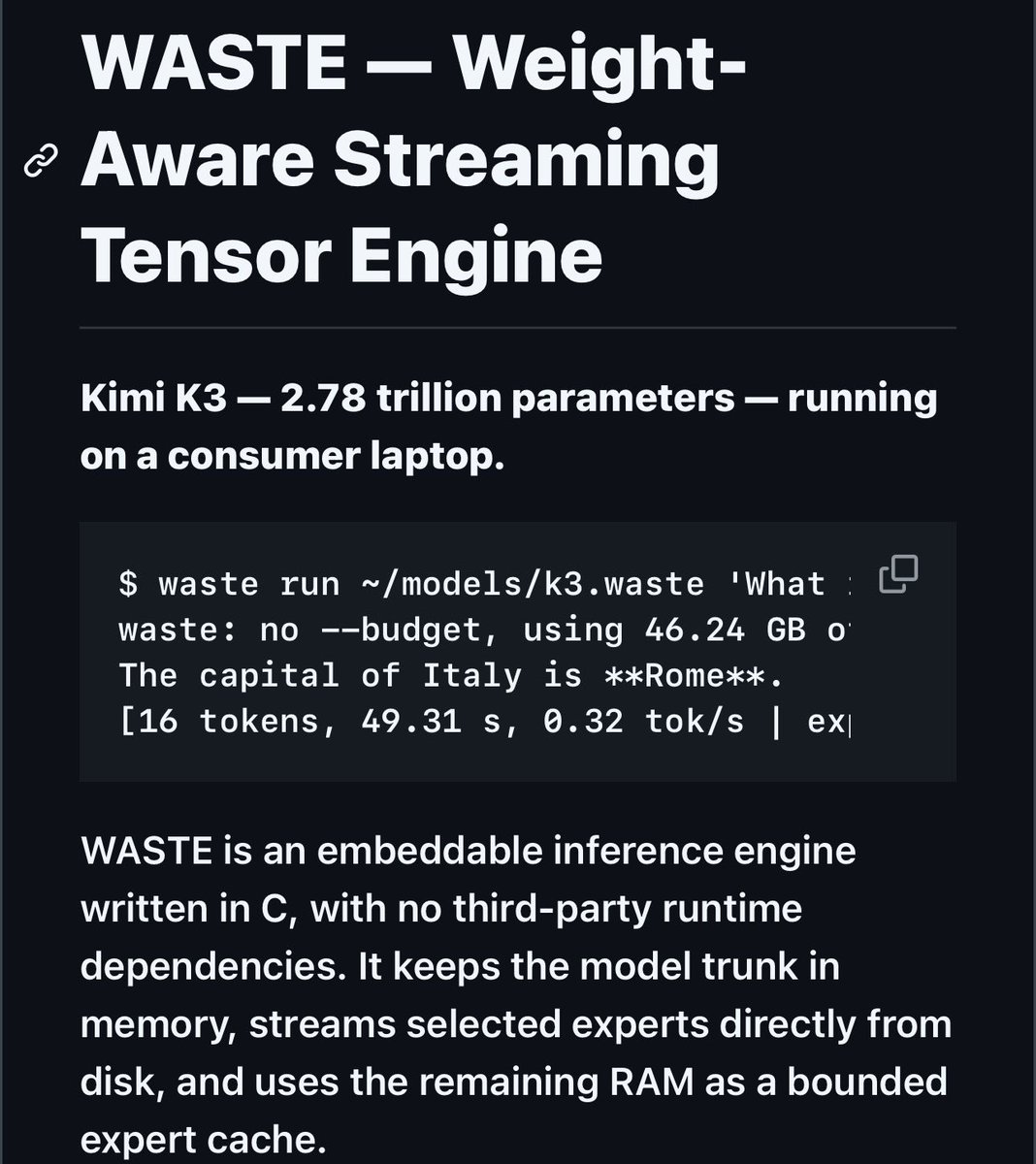
BREAKTHROUGH: A full, unmodified 2.78-trillion-parameter Kimi K3 on a consumer laptop by streaming only the activated experts from NVMe.
YOU CAN’T RUN KIMI K3 “ON THAT” THEY DECLARED.
There are many paths to do it.
This is one:
Marco Bambini Just Gave Us the Full Kimi K3 on a Laptop
Meet Marco Bambini he did something that felt impossible only a day ago.
He built WASTE Weight-Aware Streaming Tensor Engine a clean, dependency-free C inference engine that runs the complete, unmodified 2.78-trillion-parameter Kimi K3 model by streaming only the activated experts straight from NVMe.
No distillation.
No pruning.
No cloud.
The full open-weight model.
We have it running in the lab right now.
What Marco Actually Built
Kimi K3 is a sparse Mixture-of-Experts system.
Only about 4 % of its weights fire on any given token. Marco’s insight was simple and ruthless: the idle experts do not need to live in RAM. They only need to be reachable in time.
WASTE keeps the model’s “trunk” (attention, shared components, embeddings) resident in memory — roughly 27 GB on the converted container.
The 82,000+ routed experts stay on disk as tightly packed residual vector-quantized records. When the router selects its 16 experts per layer, the engine issues direct, cache-bypassing reads from the internal NVMe and feeds them into a bounded expert cache.
The rest of the machine’s RAM becomes working space for that cache.
On a 64 GB MacBook Pro with the container on the internal SSD, we are measuring 0.32–0.34 tokens per second at a comfortable memory budget.
Prefill sits a little higher. The vision tower works. Logits match the reference implementation to within a few parts in a million. It is the real model.
The container itself is 982 GiB after conversion from the original 1.42 TB MXFP4 weights. Minimum RAM floor is just over 29 GB for short context. Push the budget higher and the expert cache hit rate climbs; push too high and you start paging and the speed collapses. The sweet spot on current consumer hardware is clear and measurable.
How We Are Testing It
We converted the official weights, verified the container, and began systematic runs the same day the engine stabilized.
First we confirmed numerical fidelity against the PyTorch reference on short prompts. Then we moved to longer generation, vision inputs, and multi-turn chat using Kimi’s native XTML format.
We are measuring wall-clock decode, expert I/O versus compute split, cache hit rates at different RAM budgets, and thermal behavior under sustained load.
We are also exercising the OpenAI-compatible server that sits on top of the same C library so we can drop the model into existing agent loops without rewriting anything.
Early observations:
•Expert I/O dominates the timeline, as expected. On a fast internal NVMe the engine is already near the practical ceiling of the storage subsystem.
•The architecture’s sparsity is the entire enabler. A dense model of this size would be dead on arrival for local use.
•Context length is currently limited by RAM more than by the model itself. Practical working contexts sit comfortably in the tens of thousands of tokens on 64 GB hardware; the full million-token window will need more memory or smarter KV management.
•Thinking tokens are expensive at this speed. Long internal monologues turn into multi-hour runs. For agent work we are already experimenting with tighter control over when full reasoning is requested.
We are treating this as a research instrument, not a finished product. Every run teaches us something about expert locality, prefetch opportunities, and how far pure software streaming can push trillion-scale inference on ordinary machines.
1 of 2
This is a careful lecture that can be followed with zero background knowledge. Einstein thought he'd caught quantum mechanics in an act of spookiness — this podcast asks whether he was even worried about the right thing. Tim Maudlin, professor of philosophy at NYU and a leading philosopher of physics, delivers a rare full lecture tracing Einstein, EPR, and the road to Bell's theorem. The central claim: Einstein's real objection was never determinism — "God does not play dice" is a red herring — but non-locality, which he inferred rather than assumed. Maudlin traces the argument from Einstein's overlooked 1927 Solvay objection through the EPR paper's criterion of reality, showing why Bohr's famous reply never actually answered it.