Introducing a new versatile hash table, ~2x faster than rust's hashbrown (SwissTable). Precise capacity sizing and the physical load factor up to & including 1.
I'm excited to share the latest version of Valida! This release greatly expands the capabilities of Valida by enabling it to prove longer executions using multi-segment proofs.
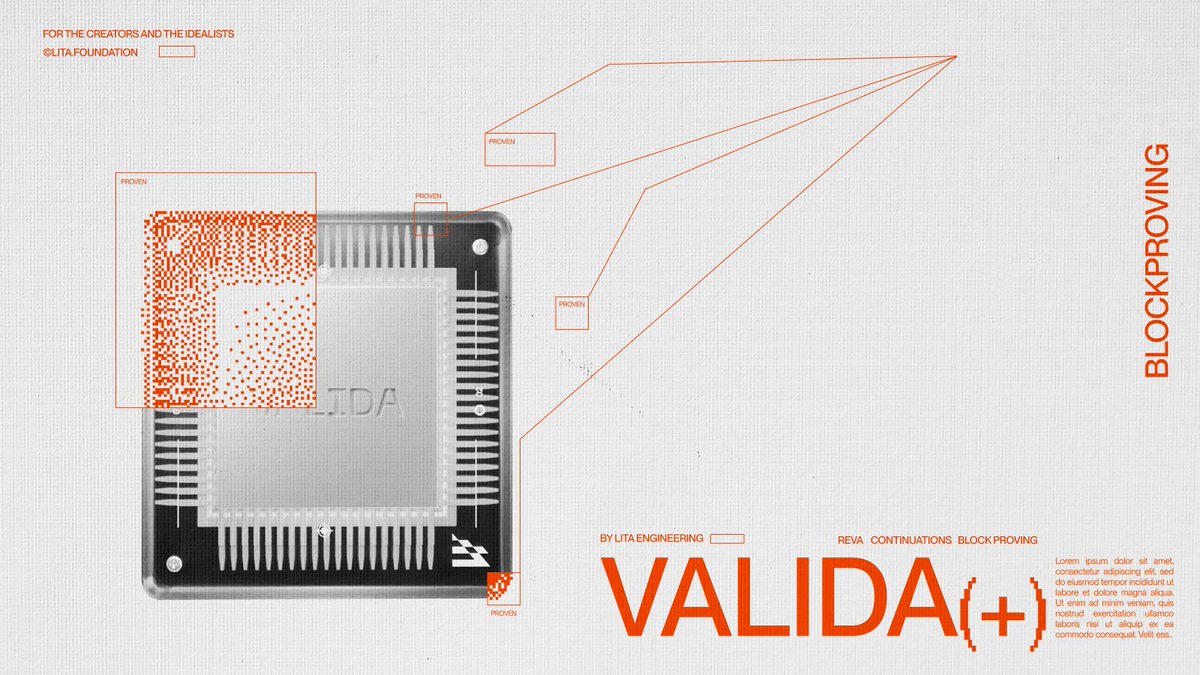
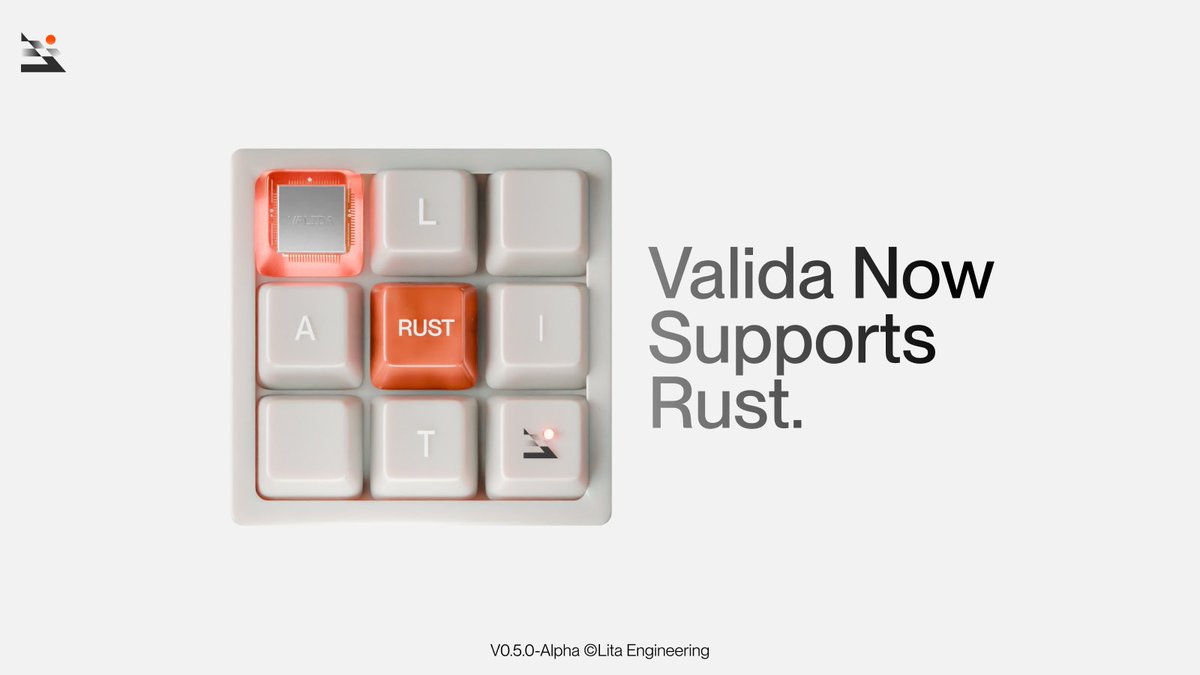
Releasing Valida Plus — our biggest update yet to the Valida zkVM.
From client-side proofs to Ethereum block proving, this release pushes the boundaries of ZK performance and usability.
Highlights below 🧵
Until recently, many zkVMs have remained experimental, slow, and costly to run at scale. With the release of zkMIPS 1.0, a supremely performant production-grade zkVM, we aim to change that.
Built on MIPS32r2 and optimized for recursive STARK proving via Plonky3, zkMIPS 1.0 is a full-stack rewrite of the zkVM, delivering 6x to 19x performance gains over its previous version (0.3.0).
Here, we present the benchmark results comparing zkMIPS 1.0 with zkMIPS 0.3, ROVM 2.0.1 (@RiscZero), and SP1 4.1.1 (@SuccinctLabs) across standard workloads.
All benchmarks were run on an AWS r6a.8xlarge (CPU) instance.
👇
The Valida ISA Formal Spec (PDF ⬇️)
This specification intends to guide implementors of zkVMs and compiler toolchains for Valida.
It provides an unambiguous definition of the semantics of Valida programs and may be used as a starting point for formalization efforts.
Ventali’s Twitter (@ventali ) and Telegram (@ventali08) accounts have been compromised. Please do not engage with any messages from those accounts until further notice.
For urgent matters, please reach out through official Lita channels, or email [email protected].
BOSes - we did it.🟧🧙♂️
On May 4 2025, we successfully demoed the first *bridgeless* transfer of BTC between Bitcoin and Cardano mainnet. 🟠🤝🔵
Performed with @SundialProtocol and @adahandle, using our all-new unchained token standard.🔓
Here’s what happened. 🧵👇
@huitseeker@0xLita@LurkLab I agree with you 100% on this, @huitseeker ! Valida has been architected from the outset to support users adding their own precompiles. Practically speaking, it is not a thing right now, while Valida is closed source, but that will change.
Holy shit--that's a lot of bugs. https://t.co/DhBecyFbO1 And every bug with "Impact=Soundness" means that an attacker could have used that one bug take over the entire account of every user of every app/smart contract on every platform that relied on this ZK verifier. ⤵️
@4rgon4ut_@0xLita I don't think that hardware acceleration of zk-VM proving has anything to do with the ISA of the zk-VM. Hardware acceleration has to do with speeding up basic crypto operations, which are not much different between Valida and its closest RISC-V competitors.
@cryptograthor@portport255@0xLita Yes, Lita's Rust to Valida compiler has matured since then, and we now support the various memory management strategies used by Rust programs.
We’ve been discussing the recent paper —https://t.co/VdAef4IdPm — “How to Prove False Statements: Practical Attacks on Fiat-Shamir” by Khovratovich, Rothblum, and Soukhanov, which highlights a diagonalization attack against certain GKR-based proof systems that embed their own cryptographic primitives (e.g., polynomial commitment schemes or hash functions) in the same circuits they prove.
Lita cryptographer @thesecretdore has also posted a separate thread delving deeper into the theory behind these attacks—https://t.co/wkyCQqKZVG —emphasizing there is no reason for undue fear for popular proof systems like STARKs without some key properties held by universal or highly general GKR protocols.
Key takeaways from the theoretical side:
1. This attack underscores that the random oracle model (ROM) alone doesn’t guarantee soundness for non-interactive proof systems similar to GKR when applied to circuits that can “simulate” their own hashing or PCS subroutines.
2. Standard-model security (i.e., security without relying on the ROM) for SNARKs remains an open challenge. Indeed, we’ve long known that SNARKs for general circuits from purely falsifiable assumptions (like discrete log) with optimal security properties do not exist at all in the standard model (https://t.co/OkALtvjzXa).
By contrast, many SNARKs of practical interest, including “STARKs” are known to be secure in the random oracle model (https://t.co/RjRBIVC1Wp). See (https://t.co/dYJkJleLrS) for a recent overview of known theoretical impossibility results as well as work on standard-model-secure SNARKs with weaker security properties or restrictions on the computations performed.
3. The ‘N’ in ‘SNARK’ stands for ‘non-interactive’. To achieve this property, most if not all constructions of SNARKs rely on the Fiat-Shamir transformation to derive a non-interactive argument from an interactive one. This transformation simulates the verifier by a hash function. We’ve long known that the Fiat-Shamir transformation does not always preserve standard-model soundness (https://t.co/Iheki9LMsy), but these counter-examples are contrived.
On the other hand, the Fiat-Shamir transformation is known to be secure in the standard model for some limited classes of interactive proofs, based on hash functions satisfying certain pseudorandomness properties (https://t.co/bmaKxDlQSM, https://t.co/nFCEAiHpkD). These properties are not known for industry-standard hash functions like SHA256 or Poseidon2, but hash functions with these properties may be constructed from standard cryptographic hardness assumptions.
4. The new work of [KRS25] shows that the Fiat-Shamir transformation of the interactive GKR protocol is unsound when applied to sufficiently general circuits (namely, those which can simulate their own polynomial commitment scheme and the hash function used by the Fiat-Shamir transformation). This is the first known attack on the Fiat-Shamir transformation of a proof system which is relevant to industry. The construction relies on the fact that the GKR protocol reduces a claim of knowledge of a satisfying witness for a circuit to a claim about the value of the circuit’s input and output, without committing to the rest of the witness.
Scope:
- Systems (e.g., STARKs) that commit the entire witness or utilize “one-shot” protocol steps before any interaction are not targeted by the diagonalization trick shown in the paper. A valid attack on such systems would need entirely different ideas.
- The attack on the GKR protocol applies to circuits which can simulate the protocol’s hash function and polynomial commitment scheme. These types of circuits are widely used in the construction of recursive SNARKs, and also include universal circuits such as those proved by zk-VM’s. The attack does not apply to the GKR protocol when applied to fixed known-in-advance circuits of limited depth, such as those used to construct efficient GKR-based lookups in (https://t.co/Gr73b2gEiC).
- The attack in this paper could be extended to proof systems other than GKR, although this is the only known-vulnerable proof system which is widely used in industry. As discussed in the paper, the attack could be extended to other proof systems sharing GKR’s property of “claim reduction” of a sufficiently large computation without any intermediate commitments. This could potentially be relevant for future constructions/optimizations of recursive SNARKs to avoid committing to intermediate computation states.
Regarding the Plonky3 Fiat-Shamir issue:
Independently, the Plonky3 Fiat-Shamir issue concerns an implementation-level vulnerability. The issue arose from a “weak Fiat-Shamir transformation,” where not all crucial data was included in the transcript—something that can undermine security in any model. Notably, this is unrelated to the ROM per se; it’s a very common pitfall in popular implementations of protocols using the Fiat-Shamir transformation (https://t.co/LCc54SpbM4). We are pleased to report that the Plonky3 team has already been extremely efficient in resolving this issue and has involved us at every step. We are consistently impressed by their rigor and competence, as they have shown in both development and security practices.
Next steps:
We’re hosting a group discussion to explore both the theoretical implications and practical mitigations. Industry leaders such as @EliBenSasson, @VitalikButerin, @drakefjustin, @fede_intern, @RiscZero and @0xPolygon (and any other interested researchers) are invited. Please DM us for an invite link.
We remain committed to pushing forward secure, reliable cryptographic solutions. Continuous research, collaboration, and transparency are essential to strengthening the entire ZK-proof ecosystem.
If you have thoughts, questions, or want to contribute, feel free to reach out! We welcome further dialogue on how to refine proof protocols, fix potential vulnerabilities, and advance the state of the art in zero-knowledge.
https://t.co/qipnQ0Jgg0
....uh oh, rip the ROM!!! provable security in the standard model is notoriously hard. This result shows that complexity restrictions on the circuit/proof system are needed for any standard model security result on a system using Fiat-Shamir.