CT-inspired two-photon lets us record glutamate activity from hundreds of synapses at a time, at >1000 Hz. Really happy to share this, and there's more to come!
https://t.co/VAIi8GFTG0
@Nick_from_Texas@AllenInstitute@abhi_aggarwal1 These are spontaneous release events in TTX (called 'minis'). They occur randomly. Without TTX, we see larger, synchronous, often wave-like patterns. Example data available for download with the 2023 iGluSnFR3 paper. Our newest indicators, iGluSnFR4, are now out on bioRxiv!
Meet MagLOV: an engineered protein that responds STRONGLY to magnetic fields.
This is a fluorescence timelapse of MagLOV in E. coli. We're waving a (small) magnet under the plate.
Can you tell where the magnet is?
Want some? It's on Addgene now! https://t.co/eWs0aAIT1A
@hod_dana@voigtvision@Thorlabs@brunopichler@Labrigger@ptrrupprecht Overall, excited. 3mm has lower dark counts than 6mm would, and it's not too hard to keep all your light in the 3mm. 6mm will be a better drop-in. Main worry is that they will underperform the SiPMs impressive dynamic range at high gain because of amplifier rails/detector limits
I am thrilled to share my first bio paper ever in @AdamEzraCohen lab with super important contributions from @rhodamine110 lab!
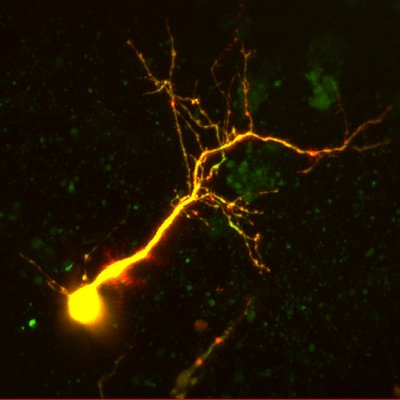
We asked the question: How do neurons compute? We focused on L2/3 neurons.
Come for the science, stay for the videos! (1/17)
https://t.co/6zxtsAQzpZ
We @AllenInstitute for NeurDyn-Ophys are gearing up to launch a platform for in vivo testing of genetic NM/NT/Voltage indicators. We want your opinion on the most suitable AAV serotype to deliver sensors to be tested. Which serotype do you think would be the best fit?
🎉 Thrilled to share 4 yrs of hard work: iAspSnFR preprint at https://t.co/h1PdrjkUz5 🔬 GFP-based aspartate sensor, engineered via deep mutational scanning, tested in HEK293 cells. Highly specific for intracellular aspartate! #iAspSnFR#biosensor#aspartate
@HasanU_JP@abhi_aggarwal1@HHMIJanelia@AllenInstitute I saw an abstract (I believe from Torok group) about development of an ultrafast iGluSnFR3. Axonal localization was achieved by Kim et al (https://t.co/TBUNzpiWtv).
One of our iGluSnFR4 variants is *extremely* fast as well, but still to be tested in vivo. Stay tuned!
@AndrewHires@abhi_aggarwal1@HHMIJanelia@AllenInstitute It's a tricky measurement to make. We haven't gone deep on it. Looking at amplitudes, some sites are very quantal, while others are not. There's been some nice work from @OertnerLab with older iGluSnFRs, would be exciting to see with iGluSnFR3.
iGluSnFR3 is published! Check it out⬇️
https://t.co/hQC58oNxj2
We made a new glutamate indicator with improved sensitivity, kinetics & localization for imaging synaptic transmission.
This is #iGluSnFR3 in action detecting minis w/ TTX.
@PodgorskiLab@HHMIJanelia@AllenInstitute
Our group is looking for a Research Associate interested in helping test new fluorescent indicators in vivo. Fun team. Relocation support to Seattle. Know anyone? https://t.co/uGlnwERPm4
Folks, first paper of our lab is out!!
We discovered that a couple of trans-synaptic proteins, LGI1 and ADAM23, are acutely translocated to the synaptic surface during firing!
This controls their abundance at clefts, impacting locally glutamate release.
https://t.co/NHDywvGrYR
We wrote a blog post in 2018 about the latest glutamate sensor - but times have progressed and so must we. @abhi_aggarwal1 updated our post to feature the new newest sensor: iGluSnF from @PodgorskiLab.
https://t.co/VI2NfuClsG